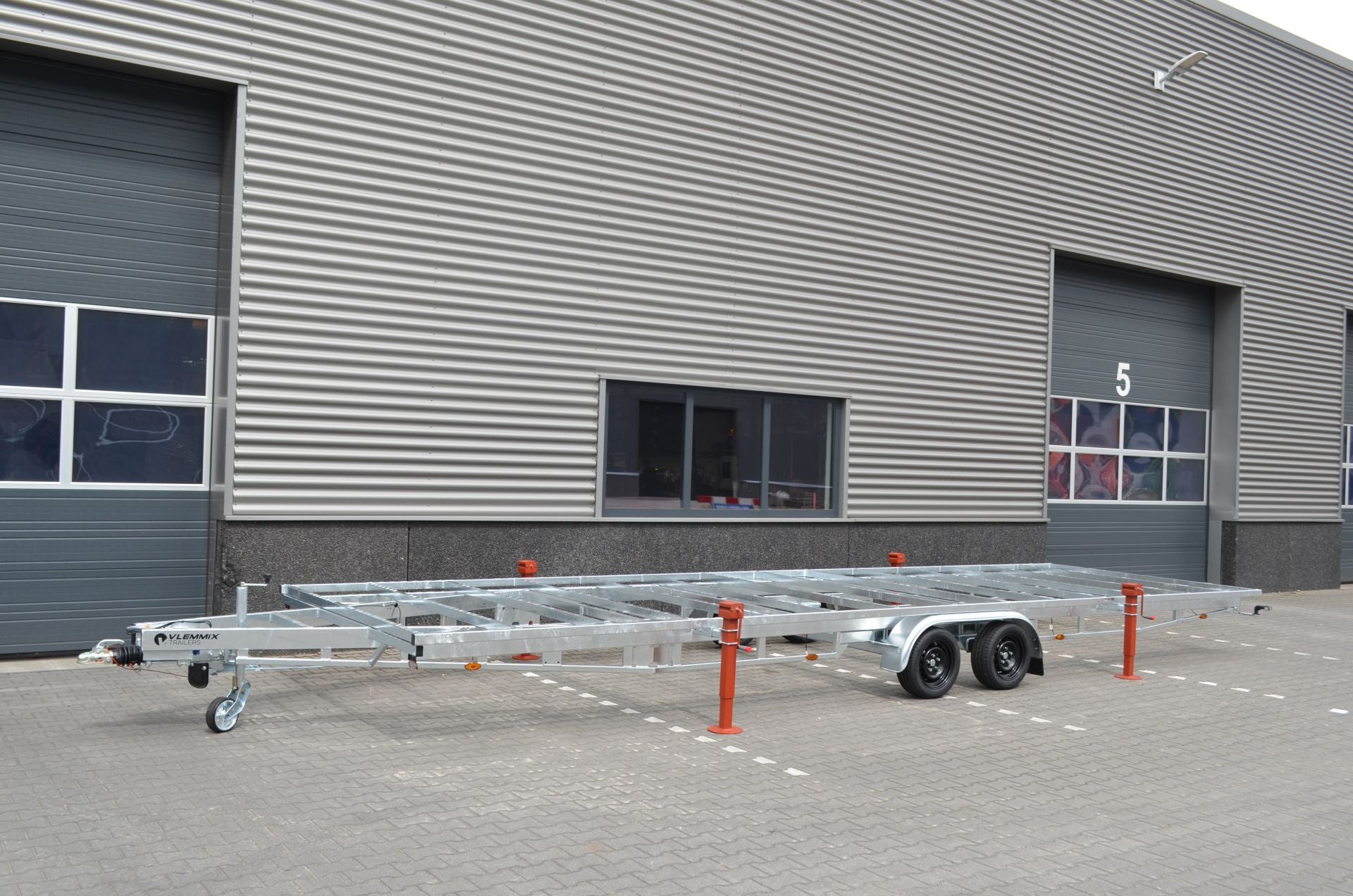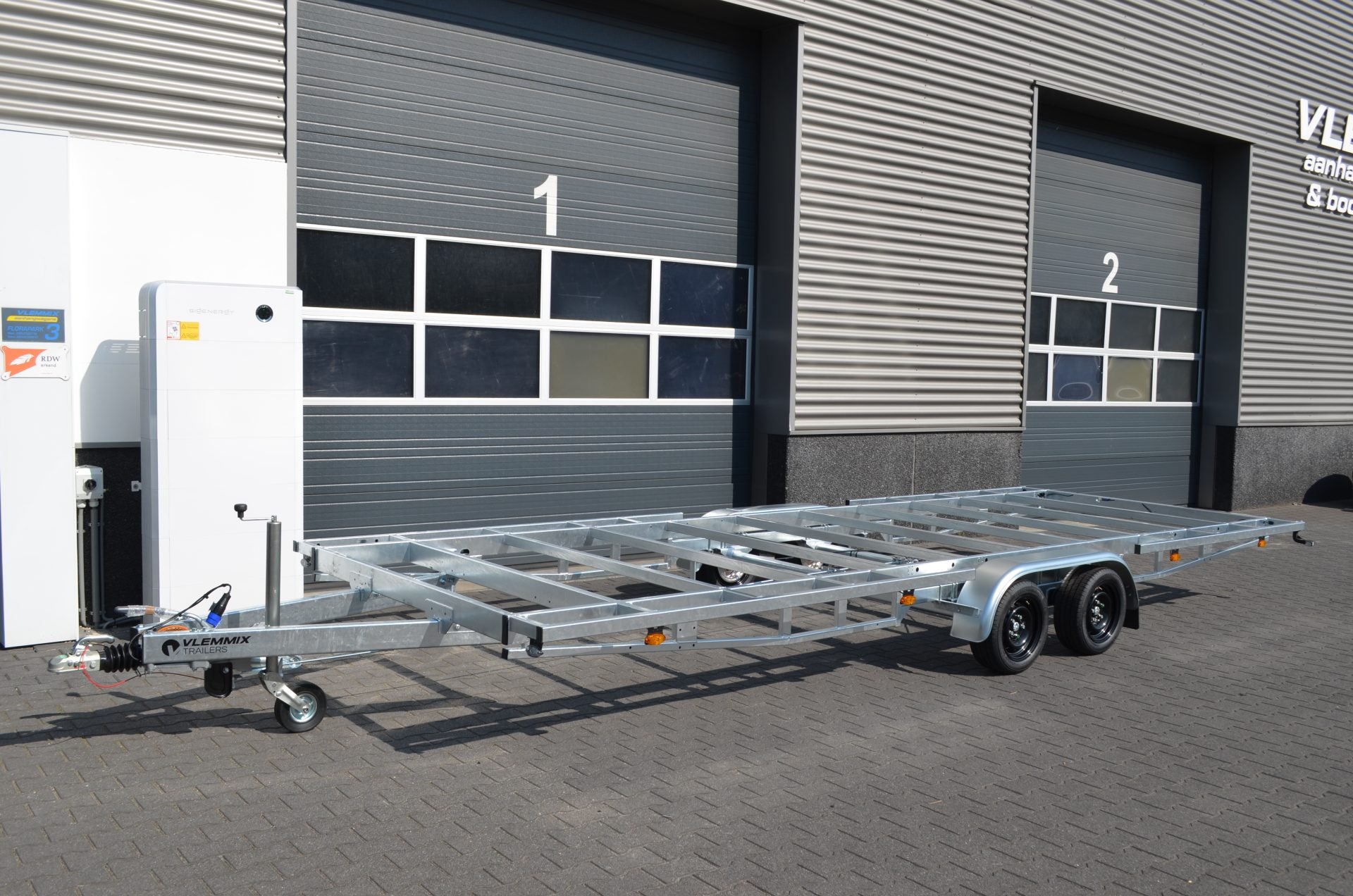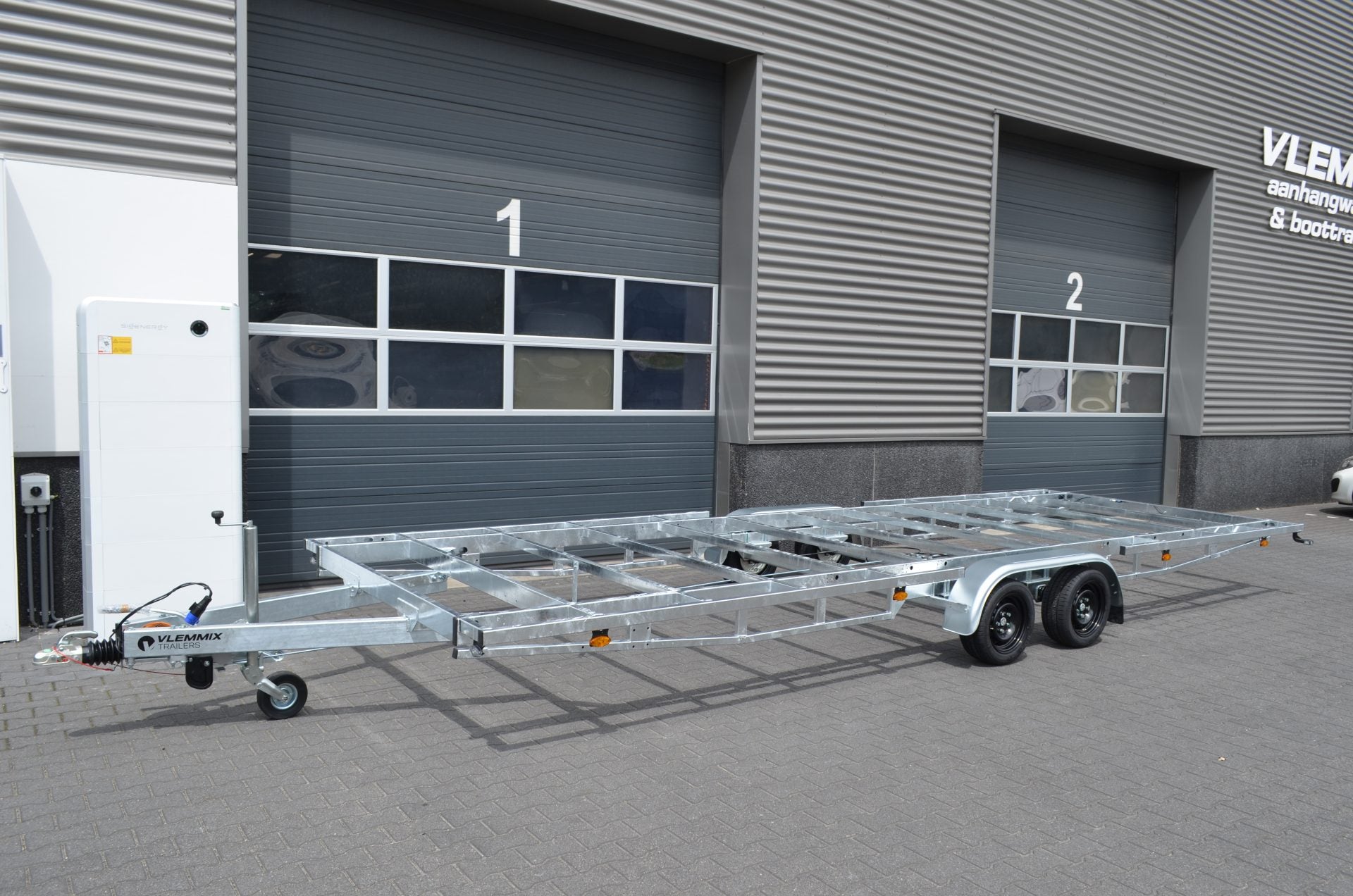

The ultimate guide to buying right the first time.
Choosing a boat trailer doesn't allow for "almost." If you fail at measures , in capacity , in brakes or in Anti-corrosion protection , the result is the same: instability, premature wear, hull damage, and scares on the road. Most trailers that cause problems don't come defective from the factory; they come poorly chosen for the boat, for actual use, and for the environment where they will get wet.
What you need to consider is Spanish regulations, how the actual weight is calculated (including engine, fuel, and equipment), and what details separate a trailer that lasts for years from one that falls apart in two summers. If you're at that point, here's a clear roadmap to help you decide, compare, and buy with confidence.
Critical dimensions when buying a boat trailer
Trailer length is a factor in stability. The safest rule is that the trailer should be longer than the boat by approximately [number of meters]. Half a meter , because it gives you room to adjust the load distribution without straining the drawbar or compromising the hull's support. When the towline is too short, the boat ends up positioned "however it can be," with the bow too close to the end or the stern hanging off, and that creates swinging and fatigue in the whole. In addition, a long, well-adjusted trailer makes launching and retrieving easier with fewer maneuvers, something that is greatly appreciated on ramps with crosswinds or currents.
The other important measurement is width. If you're unsure... The width a trailer can have in Spain , the general reference is 2.55 meters as the maximum width for driving without special authorization under ordinary conditions, according to the weight and dimension framework of the General Vehicle Regulations (RD 2822/1998) and associated regulations. Exceeding this limit usually implies entering scenarios of Special transport involves procedures, restrictions, and costs that aren't worth discovering after you've already bought the trailer. On a practical level, a wide trailer also reduces visibility, requires additional mirrors, and increases stress when overtaking, navigating roundabouts, and entering ports. Measuring the actual width (including bumpers and any protruding elements) prevents unpleasant surprises.
The axle and the capacity: what really determines safety and service life
The axis is chosen using a calculator. The weight that matters is the Actual weight , not the weight listed in the boat's brochure. Add up the hull, engine, fuel, batteries, electronics, bimini, anchor, chain, safety equipment, and then add a reasonable margin. A common mistake is buying a trailer that's just barely adequate because "I'll only use it in the summer." A trailer that operates near its weight limit will be underpowered. MMA It always lives on the edge: it runs hotter, puts more strain on bearings, subjects the chassis to micro-fatigue, and turns every bump into a hammer blow. If you're hesitating between two capabilities, it's usually wiser to go up a step than to settle for the minimum.
The axle configuration also matters. A single axle can work for light boats and occasional trips, but it requires more precise weight distribution. With medium loads and frequent use, a double axle provides stability , improves braking, and reduces swaying in crosswinds. On the road, that means peace of mind. And be careful with the towing vehicle: the car's technical specifications limit what you can tow, even if the engine is capable. If you're towing with a car or 4x4, it's advisable to check the towing capacity, the maximum vertical load on the tow ball, and the compatibility of the approved hitch.
Many people make mistakes when sizing, buying the trailer first and then discovering that the car doesn't fit legally or is a forced fit.
Launch, brakes and suspension: the combination that makes the difference on the road
In Spain, as soon as the trailer exceeds 750 kg of MMA , the picture changes. It's no longer just a matter of "handling it carefully." This range includes requirements for documentation , own registration , sure and, above all, the obligation to have a suitable braking system. The DGT (Spanish Directorate General of Traffic) repeatedly reminds drivers that trailers with faulty braking systems must comply with regulations. lighting , brake either structure They appear in inspections and campaigns because they pose a clear risk to everyone. And from a technical point of view, it makes sense: a car with a heavy trailer behind it needs the trailer to brake predictably to avoid pushing hard during braking and destabilizing the vehicle.
The suspension and drawbar determine how the trailer handles with the boat on it. Modern solutions with elastomer torsion bars They tend to offer a more progressive response and require less maintenance than older systems in typical use, and they help prevent the trailer from bouncing on bumpy roads. There's also a point that's often overlooked: speed. The DGT (Spanish Directorate General of Traffic) sets out the following general speed limits for cars towing trailers. 90 km/h on motorways/highways and 80 km/h on conventional roads . Respecting these limits isn't just for show: at that speed, the vehicle remains in its stable zone. Going "a little faster" is the classic recipe for experiencing oscillations and longer braking distances precisely when you have the least margin for error.
Galvanizing and anti-corrosion: where saving money often ends up costing more
It's important to understand the difference between a galvanized and a painted trailer . If your trailer frequently goes on ramps, the anti-corrosion treatment becomes a crucial factor. A well-applied hot-dip galvanized coating withstands repeated immersion better, protects joints, and slows down corrosion in critical areas. Even so, no trailer lasts forever if it isn't washed, dried, and inspected. Maintenance makes a huge difference, especially for axles, brakes, and bolts. Those who take washing with fresh water, checking bearings, and repairing damaged areas seriously gain years of real lifespan.
Paint can work for very light use, especially indoors and without immersion, but it usually fails sooner on the coast. The paint chips with impacts, and corrosion seeps underneath. Galvanizing, while also susceptible to damage, offers a more robust barrier against the marine environment. If your plan is to launch at sea, get the axle wet, and store the trailer near the port, the difference translates into less structural rust, fewer bolts corroded and welded together, and fewer breakdowns due to electroplating. In other words, paying for quality now saves you money later.
Galvanized trailer vs. painted trailer
A painted trailer can make sense if your boat is moved only a few times a year, you don't submerge it, you store it indoors, and you're willing to touch up vulnerable areas frequently. In that scenario, the paint job can do the trick, although it requires regular monitoring. However, if the trailer sits on a sea ramp and is left exposed, the paint deteriorates rapidly, and rust appears at welds, edges, and points of friction. Experience in Spanish ports is quite consistent: in saltwater, painted trailers age faster unless they receive very meticulous care.
Hot-dip galvanizing offers a greater margin of safety, but it's not a guarantee of safety. Zinc does provide protection, but bumps and scratches can still cause problems. That's why, in addition to the finish, design matters: drainage, profiles that prevent water accumulation, protected wiring, and well-sealed lights. If you want to know how long a boat trailer lasts , it depends on the environment, but the galvanizing and washing habits are often the difference between comfortably reaching a decade of use and starting to experience serious problems much sooner.
Checklist before buying: the fastest way to avoid mistakes
Before paying, check what really determines your purchase. Measurements: length with margin and beam measured honestly.
Weight: calculate the actual weight and add a margin.
Legality: if you pass 750 kg MMA , assumes brakes, insurance, registration and MOT as appropriate.
And then comes what people often forget: ease of use. Rollers that won't scratch the hull, adjustable supports, side guides for centering the boat, a reliable winch, and protected ramp lights. These are "details" that, in practice, determine whether each trip is easy or a struggle. If the trailer forces you to perform acrobatics, it's not the right trailer for you.
It's also worth anticipating two common questions. The first: "Do I need insurance?" For light trailers, it usually depends on the towing vehicle, but for larger trailers, separate insurance and registration are required, and that's not something to take chances with.
The second question is: “Which trailer is right for me if I have a sailboat?” A sailboat introduces a keel, height, and delicate support points; not just any configuration will do. If you're in this situation, it makes sense to use a specific guide like "Which trailer do I need for my sailboat ?" because the keel and the distribution of support points are more important than the length alone. And if you want a complete framework to help you decide from scratch, the starting point is why you're buying a boat trailer .
Buying a "cheap" boat trailer often ends up being expensive. Purchasing a properly sized trailer with adequate brakes, good suspension, and corrosion protection reduces breakdowns, protects the hull, and provides a stable ride on the road. Measuring, calculating, and adjusting before buying prevents 80% of typical problems: swaying, blown tires, burned bearings, and premature rust.
At remolque.es, we advise owners who tow cars, SUVs, or 4x4s every day , helping them choose the right trailer without trial and error. We offer a wide selection of top-quality trailers , precision-manufactured and designed for use in Spain. If you tell us your vehicle's length, beam, actual weight, and where you travel, we'll guide you to the perfect trailer so you can enjoy it for years to come without any surprises.