
A boat dolly costs between 30% and 50% less than an approved trailer of the same capacity. That saving comes with a condition: it cannot be driven on public roads, and doing so is punishable by up to 500 euros and immobilization of the unit. Choosing incorrectly between the two is the most expensive mistake a new boat owner makes. This guide resolves it with clear criteria.
- A boat dolly moves the boat short distances within private premises or a ramp. Without approval, without lights, and without brakes: prohibited on the road.
- A road trailer has a technical data sheet, lighting, brakes (if it exceeds 750 kg GVWR), and European approval. It is the only legal option on public roads.
- Approximate price: boat dolly from 250-500 euros; approved boat trailer from 500-1,200 euros depending on GVWR.
- If you store the boat at home or on a plot and launch it on public ramps, you need a road trailer. A boat dolly is only useful if the boat is kept near the water.
- There is a third option: the storage trailer or cradle, designed for dry storage of the boat without paying mooring fees.
Direct answer: it depends on where your boat is kept
If the boat is stored less than 100 meters from the ramp, in a club, dry marina, or plot by the water, a boat dolly is sufficient. If the boat has to touch public asphalt at any point, even if it's only 50 meters down the street, you need an approved road trailer. There is no legal middle ground.
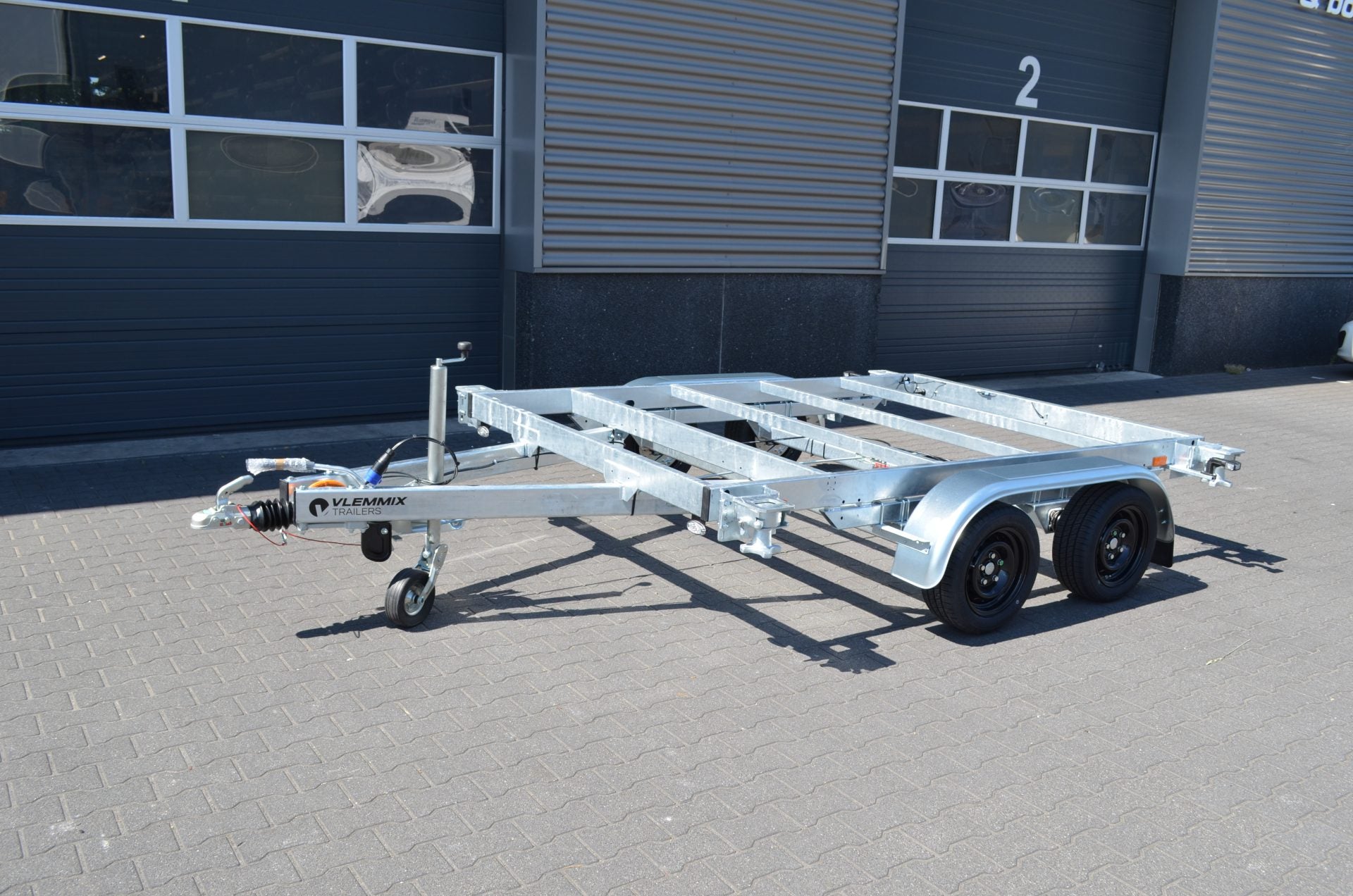
The confusion is common because both look similar: chassis, wheels, rollers, and a winch. The difference lies in what is not visible. The trailer has a technical data sheet, approval, and a lighting system; the boat dolly has none of that.
What is a boat dolly and what is it for?
A boat dolly is a wheeled platform designed for launching and retrieving a boat over short distances. It is used within ports, nautical clubs, and private plots. It features robust rollers and adjustable hull supports, and can be managed by a single person for many small models.
Its main advantage is simplicity. With no electrical installation, no brakes, and no documentation, there is little to maintain and little to break. Axles and bearings suffer similarly from saltwater, but repairs are simpler and the purchase price is 30-50% lower than an equivalent trailer.
Its limitation is legal, not mechanical. Spanish regulations only permit its use in private enclosures and ramps, where the rules of the enclosure apply. The moment it touches a public road, even if it's to cross from the esplanade to a municipal ramp, the unit is operating without approval, without lights, and without valid insurance, with the penalties that entails.
What is a marine road trailer?
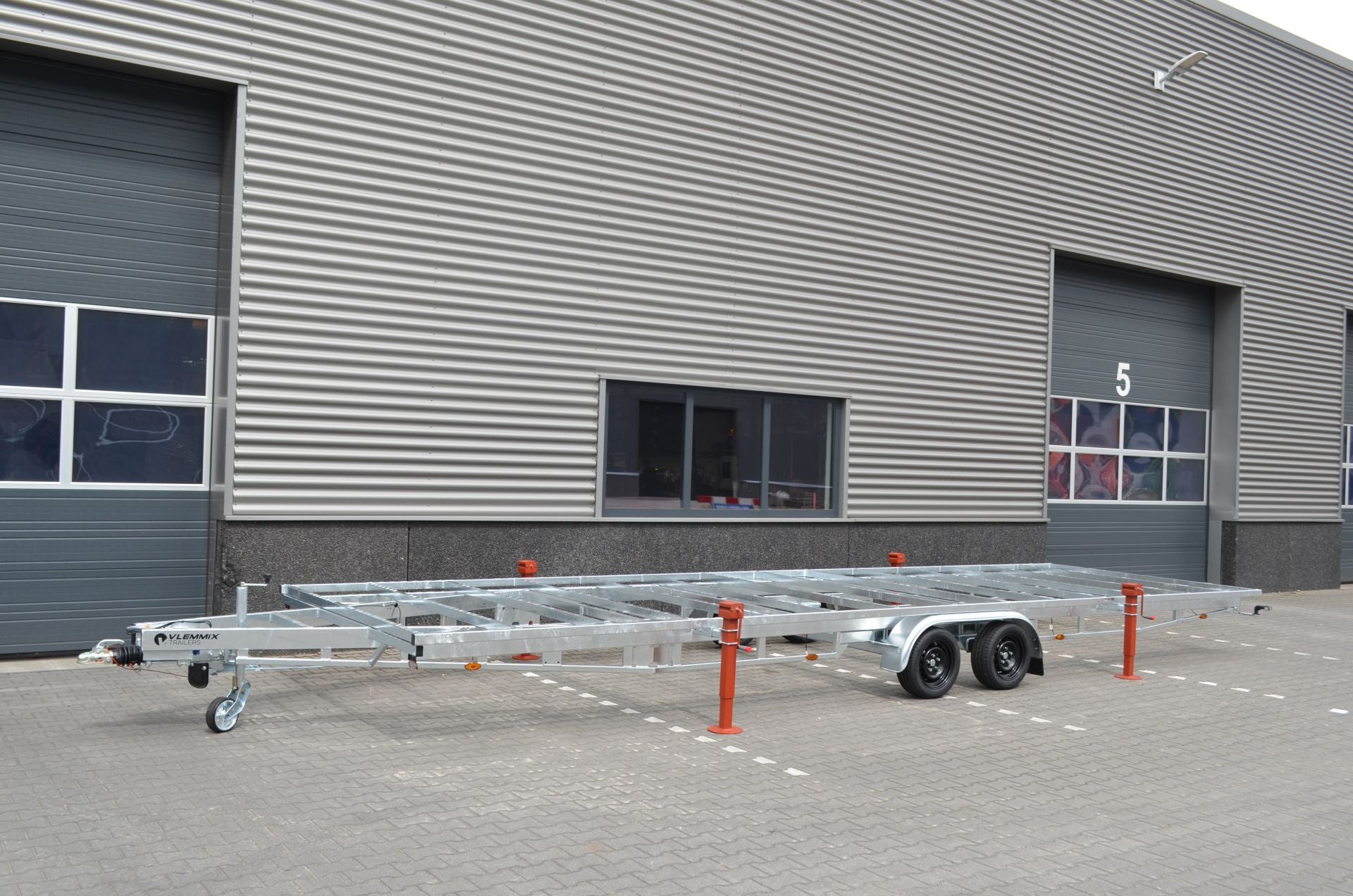
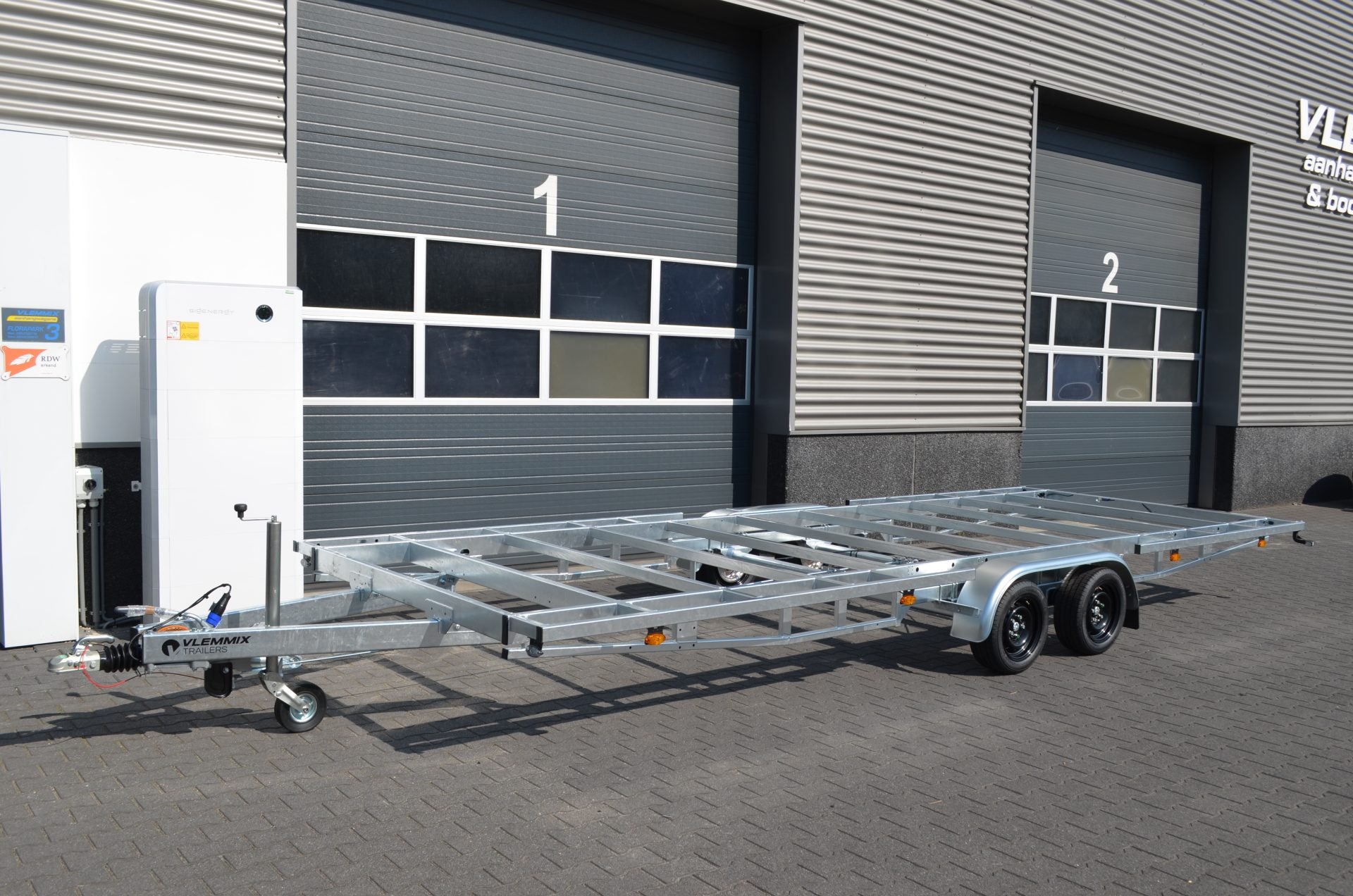
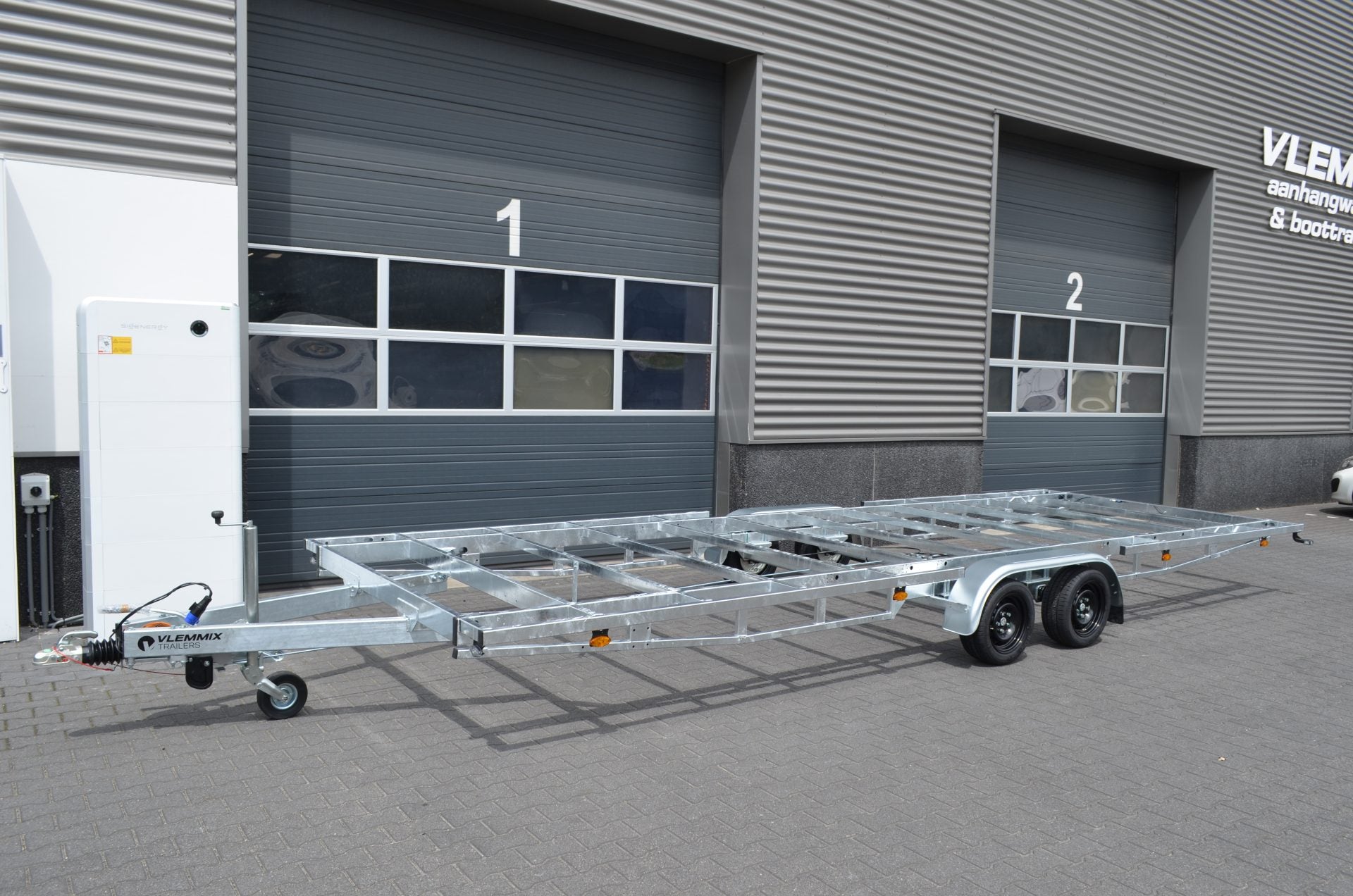
A road trailer is a vehicle in every sense. It has its own technical data sheet, European type approval, complete lighting, mudguards, and reflectors. For GVWR exceeding 750 kg, it includes inertia brakes, its own red license plate, and independent insurance. It can travel 700 km on a motorway just as easily as 7 meters on a ramp.
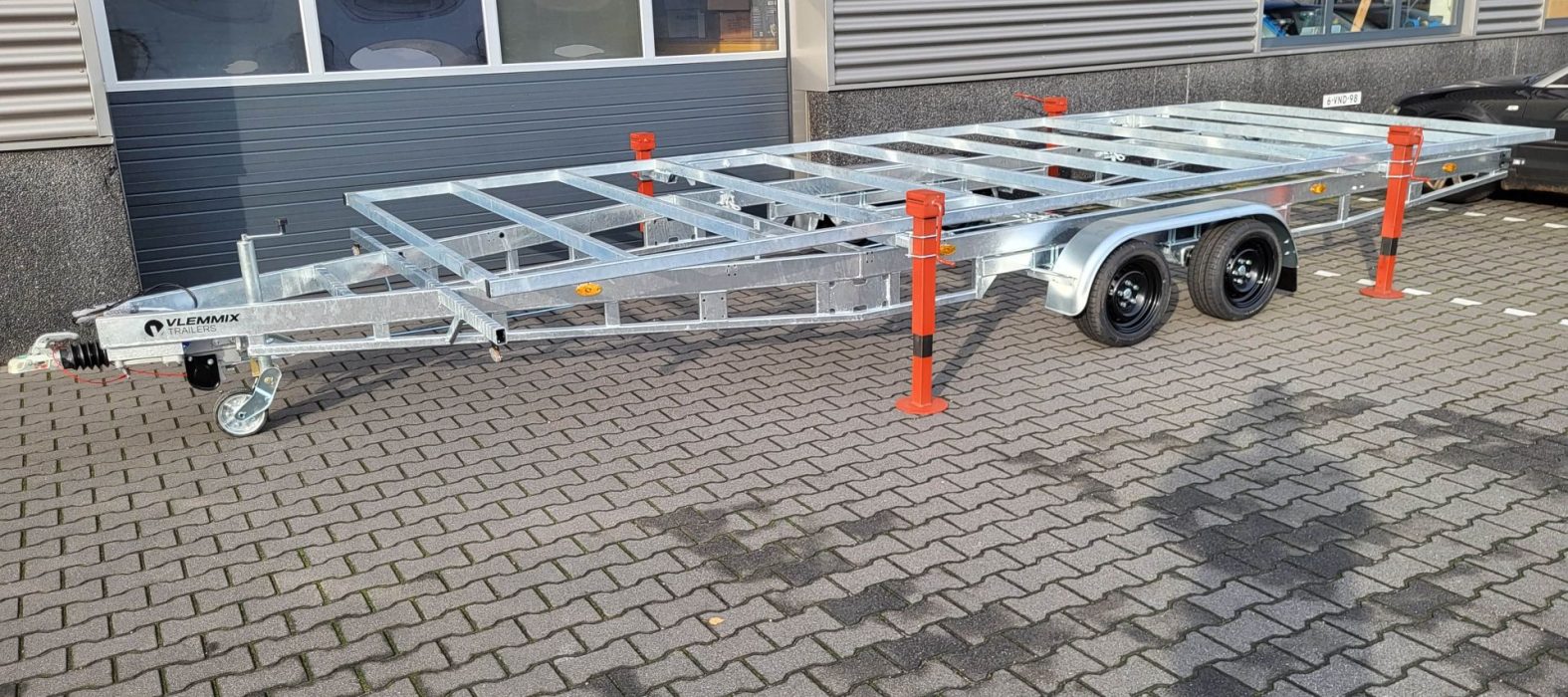
For marine use, the chassis is more important than for any other trailer. Every launch submerges axles, brakes, and connections in saltwater. That's why serious trailers feature a hot-dip galvanized chassis, which resists corrosion for decades where a painted one would last only a few years. We explain how to protect the unit in the guide on how to extend the life of your trailer if you navigate in saltwater.
With a road trailer, the boat no longer depends on the port. You can launch it at any ramp you want, change coasts on the weekend, and store the boat at home. If you're going to buy one, the guide to choosing the perfect trailer for your boat explains how to size it by length and weight.
Comparison table: boat dolly vs. road trailer
| Criterion | Boat Dolly | Road Trailer |
|---|---|---|
| Driving on public roads | Prohibited | Legal (approved) |
| Technical data sheet and approval | Not applicable | Required, included |
| Lights, brakes, and mudguards | Not fitted | Complete, depending on GVWR |
| License plate and insurance | Not applicable | Car's plate (≤750 kg) or own plate (>750 kg) |
| Approximate price | 250-500 € | 500-1,200 € and more depending on GVWR |
| Typical use | Ramp and private enclosure | Transport, launching, and storage |
| Handling | By hand or with a vehicle within the enclosure | Hitched to the car |
| Maintenance | Minimal (axles and bearings) | Axles, brakes, lights, and post-launch wash |
When a boat dolly is enough
A dolly makes sense in a specific scenario: the boat lives near the water. Nautical club members with their own esplanade, houses with direct ramp access, and jet skis stored in the port's garage. In these cases, you pay only for what you use and avoid the extra cost of approval that you would never utilize.
It is also the correct tool as a secondary piece of equipment. Many owners use a road trailer for travel and a lightweight dolly for daily use on the ramp, because submerging a good trailer every week accelerates brake and hub corrosion. The dolly handles the dirty work, and the trailer arrives at the long trip in good condition.
For small boats and jet skis, the dolly is lightweight and can be moved by hand. If this is your case, also check out the specific trailers for jet skis, which combine a contained weight with full approval for only a little more money.
When you need a road trailer
The list is short and conclusive. You need an approved trailer if you store the boat at home, if you change navigation areas, if the boat goes to the workshop by road, or if the nearest ramp is not within the same enclosure where the boat is stored. Any meter of public road requires it.
Economics also push in that direction. A mooring or dry marina costs between 150 and 800 euros per month depending on length and area. Storing the boat at home on a trailer eliminates that entire bill: the trailer pays for itself in the first year for most trailerable lengths. The calculations are detailed in the guide for storing the boat in winter.
Remember that an approved trailer requires its paperwork to be up to date: technical inspection card always, and license plate, insurance, and periodic inspection if it exceeds 750 kg. We cover this in full in the guide on how to pass the trailer ITV first time.
The third way: dry storage without compromise
Between the pure dolly and the travel trailer, there is a range designed for the owner who wants the boat dry all year round. Boat storage trailers are road-approved but optimized for long stays: the hull is well supported, ventilated, and safe from osmosis that affects moored boats.
For boats that won't move for years, or for workshop jobs, the boat cradle is the most stable and economical option. No wheels, no documentation, and full hull support. Many shipyards and workshops prefer it because it allows working underneath the boat safely.
The final decision depends on weight, length, and use. The full range of marine trailers covers everything from 4-meter inflatables to 12-meter boats, with hot-dip galvanized chassis, 2 mm steel, and a 2-year warranty. Arnaud will help you size the exact equipment without obligation.
Total cost over 5 years: the comparison almost no one makes
The purchase price only tells half the story. Over five years, the boat dolly maintains its advantage only if the boat is kept near the water. As soon as dry marina rental or annual professional transport is factored in, the equation quickly reverses.
Example with a 5-meter motorboat. Option: boat dolly plus dry marina: 350 euros for the dolly and about 1,200-2,400 euros per year for storage, totaling between 6,350 and 12,350 euros over five years. Option: approved trailer with boat at home: 900-1,200 euros for the trailer, minimal maintenance, and zero euros in monthly rent. The difference exceeds 5,000 euros in the most conservative scenario.
Added to this is the resale value. A well-maintained galvanized trailer retains between 50% and 70% of its value after five years, because the used boat market absorbs them quickly. A boat dolly has almost no second-hand market outside its original enclosure.
The three mistakes we see every season
The first: buying a boat dolly "for everything" and ending up driving it on public roads. Every summer, the Civil Guard immobilizes unapproved units on public ramps. The fine is around 500 euros and the boat stays where it's stopped, with the towing costs at your expense.
The second: submerging a road trailer without preparing it. Inertia brakes and electrical connections suffer with each launch if they are not rinsed with fresh water afterwards. The typical result is a seized brake drum mid-season. Ten minutes of hosing after each launch doubles the life of the brakes.
The third: buying based on price without looking at the steel or the treatment. A painted 1.5 mm chassis costs less on day one and significantly more by year five, when corrosion forces its replacement. Hot-dip galvanizing on 2 mm steel is the difference between 5 and 20 years of service in a saline environment.
Frequently asked questions
Can I drive a boat dolly on the road, even if it's only 100 meters?
No. A boat dolly lacks approval, lighting, and brakes, so it cannot be driven on public roads for even one meter. The penalty can be up to 500 euros and includes immobilization. For any section of street or road, you need an approved trailer with its documentation.
Which is cheaper, a boat dolly or a trailer?
A boat dolly costs between 250 and 500 euros for common sizes, 30-50% less than an equivalent approved trailer. The comparison changes if you store the boat at home: the trailer eliminates mooring or dry marina costs (150-800 euros per month) and pays for itself in the first year.
Can a road trailer also serve as a boat dolly?
Yes. Any approved marine trailer can launch and retrieve on a ramp. The caution lies in maintenance: after submerging it in saltwater, it's advisable to wash brakes, axles, and connections with fresh water. If you launch weekly, consider an auxiliary dolly to preserve your travel trailer.
Does a boat dolly need an ITV card or insurance?
No. Since it is not a public road vehicle, it does not have a technical data sheet, license plate, insurance, or inspection. This is its advantage and its limit: without documentation, there are no obligations, but it also cannot leave the private enclosure or ramp where it is used.
What does my boat need to be stored dry year-round?
It depends on the use. If the boat travels, an approved storage trailer provides both storage and transport. If it won't be moved, a fixed cradle supports the hull better and costs less. In both cases, the hull remains ventilated and protected from osmosis.
How much does a boat dolly weigh?
Models for inflatables and jet skis weigh around 40-80 kg and can be moved by hand. For 5-6 meter motorboats, the weight increases to 150-250 kg and already requires a vehicle or winch. An equivalent road trailer weighs slightly more due to the brakes, lights, and chassis reinforcements.
Can I convert a boat dolly into an approved trailer?
In practice, it's not worth it. Approval requires a technical project, installation of lighting, brakes if it exceeds 750 kg GVWR, and passing a single approval process that costs several hundred euros. The result is almost always more expensive than buying a new, approved trailer with a warranty.
What is the difference between a boat dolly and a boat cradle?
A boat dolly has wheels and is used to move the boat short distances; a cradle is fixed and used for stable storage for months or years. A cradle supports the hull better and costs less, and allows working underneath the boat. Many owners combine both: a cradle for winter storage and a dolly or trailer for movement.
Is a boat dolly suitable for a jet ski?
It's its most common use, along with small inflatables. It's lightweight, can be handled by hand, and withstands daily ramp use well. However, if the jet ski travels to other beaches or is stored away from the water, an approved trailer is still mandatory for any road trip, no matter how short the distance to the ramp.