

Boat Storage Trailers
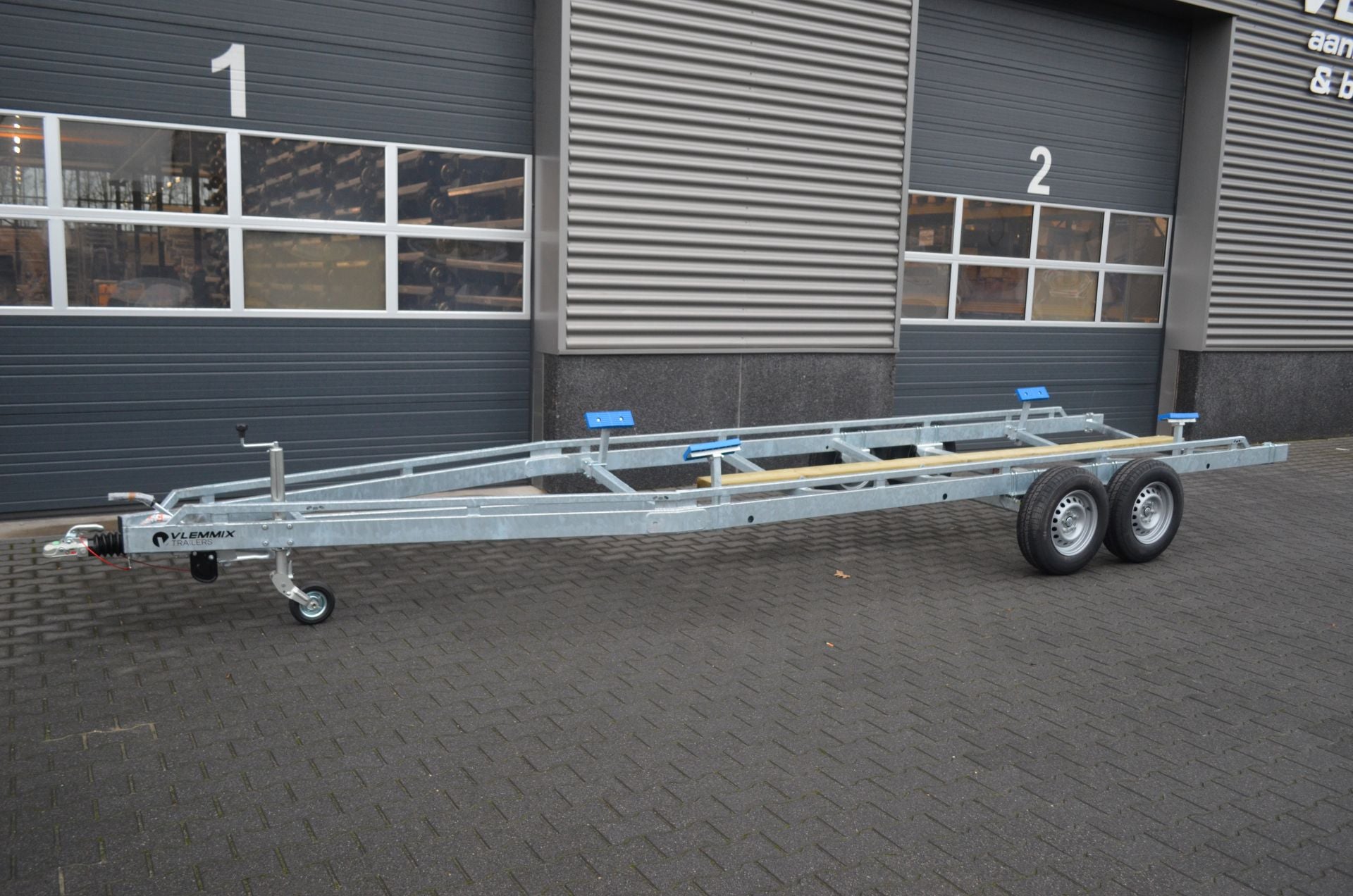
Approved trailers designed specifically to keep your boat dry for months. These are not reinforced transport trailers: they are trailers optimized from the chassis for prolonged stationary use.
Adjustable keel supports, curved cross members that lower the center of gravity, and a galvanized chassis inside and out to withstand years of exposure without internal corrosion.
Eleven configurations from 6.31 to 10 meters with 1, 2, or 3 axles of 1,800 kg. Europe's No. 1 brand in the Netherlands. 2-year warranty. Shipping throughout Spain.
If you are looking for the complete solution for transporting and storing your boat, you will find everything you need at Remolque.es. Explore our selection of standard boat trailers, the versatile Flex Roll multi-roller trailers, practical boat cradles, and boat storage equipment. Find the ideal trailer according to the size and type of your boat.
Designed to keep your boat dry for months
A standard transport trailer can hold a boat parked for months. It is not designed for this. Repeated pressure points on the same area of the hull, internal corrosion of the hollow chassis, and lack of adjustable supports eventually damage the boat or the trailer.
These trailers solve the four common problems of long-term storage:
- Load distribution on the keel with impregnated board
- Internal galvanization that prevents corrosion in non-visible areas
- Adjustable side and keel supports to the exact shape of the hull
- Low center of gravity thanks to curved cross members
If your boat is going to live on the trailer for months, this matters more than the type of brake or the maximum towing speed.
5 technical differences compared to a transport trailer
1. Adjustable keel supports
Adaptable to the exact shape of the hull. They distribute the boat's weight over the entire contact area, not specific points.
They prevent deformation in fiberglass hulls during long storage periods. Your boat lifts off the trailer without marks after months of being stationary.
2. Impregnated keel board
Treated wood that protects the keel during prolonged contact with the trailer.
Absorbs slight vibrations and prevents marks on the hull. Replaceable when worn, without touching the chassis.
3. Galvanized chassis inside and out
Hot-dip galvanization covers the entire structure, including the inside of the tubes.
In a poorly galvanized hollow chassis, corrosion starts from the inside and appears years later. Not here.
4. Curved cross members
The boat remains as low as possible on the trailer.
Better static stability, lower height for maneuvering under the boat, comfortable access to the underwater hull for maintenance.
5. Heavy folding front wheel
Facilitates maneuvering the loaded trailer in a static position.
Folds away so it doesn't get in the way when hitching and supports the weight of the bow without bending.
Which model you need based on your boat
Small dinghies and RIBs (up to 5 m)
Light boats up to 1,000 kg. The models in this catalog (from 6.31 m) are oversized for this range.
They make sense if you want to winterize the boat with plenty of space, or if you plan to upgrade to a larger boat in a few years.
Medium dinghies and RIBs (5-7 m)
Boats weighing 800-2,000 kg dry. This is where the bulk of the catalog comes in: 1 axle 7 m, 2 axles 6.31 m, 2 axles 7 m.
The 2 axle 7 m configuration is the most balanced for prolonged storage with occasional transport use.
Small sailboats and cabin cruisers (7-8.5 m)
Boats weighing 1,500-2,500 kg. The 2 axle 7.8 m and 2 axle 8.4 m models are the most in-demand.
The 3 axle 8.4 m option adds static stability for outdoor storage exposed to wind or uneven ground.
Large boats (8.5-10 m)
Boats weighing 2,500-4,000 kg. The 2 axle 9.2 m, 2 axle 10 m, 3 axle 9.2 m, and 3 axle 10 m models cover this range.
The 3 axle is the recommended option for heavy boats that will remain stationary for long periods: better load distribution on the hull.
[PENDING DATA: exact payload capacity per model confirmed with manufacturer]
Typical use cases
Prolonged dry winterization. Taking the boat out of the water during cold months prevents osmosis, dirt, and antifouling wear.
Saving on mooring fees. The annual cost of a mooring often exceeds the price of the trailer. Storage on private property pays for the trailer in 1-2 years.
Periodic hull maintenance. Polishing gelcoat, applying antifouling, repairing the underwater hull. The boat is accessible dry without shipyard costs.
Second home with own boat. You take the boat once a year to your coastal home and it lives on the trailer between uses.
Nautical professional with rotating fleet. Several static trailers in a shed allow alternating boats without occupying another shipyard's space.
Homologation and driving license
All models comply with CE Directive and are delivered with documentation for registration in Spain. Although their primary use is static, you retain the possibility of transporting the boat by road when you need to.
Category B license. Car+trailer combination up to 3,500 kg MMA. Covers 1-axle models with light boats.
Category B+E license. Required above 3,500 kg. Covers 2 and 3-axle models with medium and large boats.
Before buying, confirm the exact MMA of the set and the required documentation from your provincial traffic office with Arnaud.
Frequently asked questions
How do they differ from a normal transport trailer?
Storage trailers are optimized from design so that the boat can live on them for months without damage.
They have adjustable keel supports, impregnated board, internal chassis galvanization, and curved beams. A standard transport trailer withstands transport but is not designed for prolonged load distribution or long-term internal corrosion.
Can I also use it to transport the boat by road?
Yes. They have CE approval and registration in Spain. They function as a transport trailer when you need one.
It is not their primary use, but they allow occasional transfers (change of port, taking the boat to the workshop, transfer between residences).
How long can the boat be stationary on the trailer?
No technical limit. These trailers are designed for prolonged storage of months or years.
Recommendations for stops longer than 6 months: chock the wheels, relieve tire pressure, and check the adjustment of supports once a year.
Do I need to chock the wheels if the boat is going to be stationary for months?
Yes. Chocking the wheels prevents flat spots on the tires due to sustained pressure.
It is also advisable to reduce tire pressure by 50% during long stops to preserve the rubber.
How do I know which model I need for my boat?
Send us the length, dry weight, beam, and hull type. We will confirm the correct model before ordering.
Also consider your driving license: with a B license, the MMA of the car+trailer combination cannot exceed 3,500 kg.
What warranty do they have?
2-year manufacturer's warranty against manufacturing defects. Covers galvanized chassis, axles, braking system, supports, and rollers.
After-sales technical support with Arnaud for the entire lifespan of the trailer.
What is the delivery time?
5-15 business days from order confirmation.
For winterization campaigns, we confirm the specific timeframe before ordering.


