
An empty 20-foot container weighs between 2,080 and 2,300 kg (tare weight). A double-axle trailer with a 3,500 kg GVW can legally transport it behind a regular car. Nevertheless, several container sellers state that carrying a container with a car is impossible. This is a half-truth that confuses many buyers. Here are the full numbers, case by case.
TL;DR
- Yes, under conditions: a 10-foot container (tare 1,200-1,400 kg) and an empty 20-foot container (2,080-2,300 kg) fit on a trailer with a 3,500 kg GVW.
- No, you cannot: a 40-foot container (tare 3,700-3,900 kg) nor any container loaded with heavy goods.
- The trailer must have twist locks on the ISO corners, a double axle, and an overrun brake.
- The car-plus-trailer combination requires a B license for up to 3,500 kg combined GVW, a B96 for up to 4,250 kg, and a B+E for above.
- With your own trailer, each container movement costs fuel; with a hired crane, 150 to 600 euros per trip.
Direct answer: yes, up to an empty 20-foot or 10-foot with light load
Physics and the law agree on the same limit for the combination: the 3,500 kg GVW of the approved trailer. Subtracting the tare weight of the trailer itself (around 750-900 kg for a double-axle container trailer), there is about 2,500-2,700 kg of payload remaining. An empty 20-foot fits with margin. A 10-foot even fits with several hundred kilos inside.
The mistake of those who say "it's impossible" lies in the case they analyze: a container loaded with goods. They are right there, because a 20-foot can hold up to 28,000 kg of cargo, and that is truck territory, not car territory. The correct question is not whether it can be done, but how much your container weighs at the time of moving it.
The numbers that matter: tare by container size
| Container | Length | Tare (empty) | Transportable by car and trailer? |
|---|---|---|---|
| 8 feet | 2.44 m | 950-1,100 kg | Yes, even with light load |
| 10 feet | 2.99 m | 1,200-1,400 kg | Yes, with up to 1,000-1,200 kg of load |
| 20 feet standard | 6.06 m | 2,080-2,300 kg | Yes, empty only |
| 20 feet high cube | 6.06 m | 2,200-2,500 kg | Tight: check actual tare |
| 40 feet | 12.19 m | 3,700-3,900 kg | No: exceeds legal payload |
Tare weights vary depending on the manufacturer, year, and condition. Before planning transport, look for the tare weight engraved on the container door (CSC plate): this is the official and verifiable data for that specific unit, not an average market figure that can be off by hundreds of kilos.
With this data, the calculation is simple: container tare weight plus trailer tare weight must remain below the GVW, with a safety margin of 10-15%. The complete mechanics of the calculation can be found in GVW and payload: how to calculate it without exceeding and without fines.
What trailer do you need: not just any flatbed will do
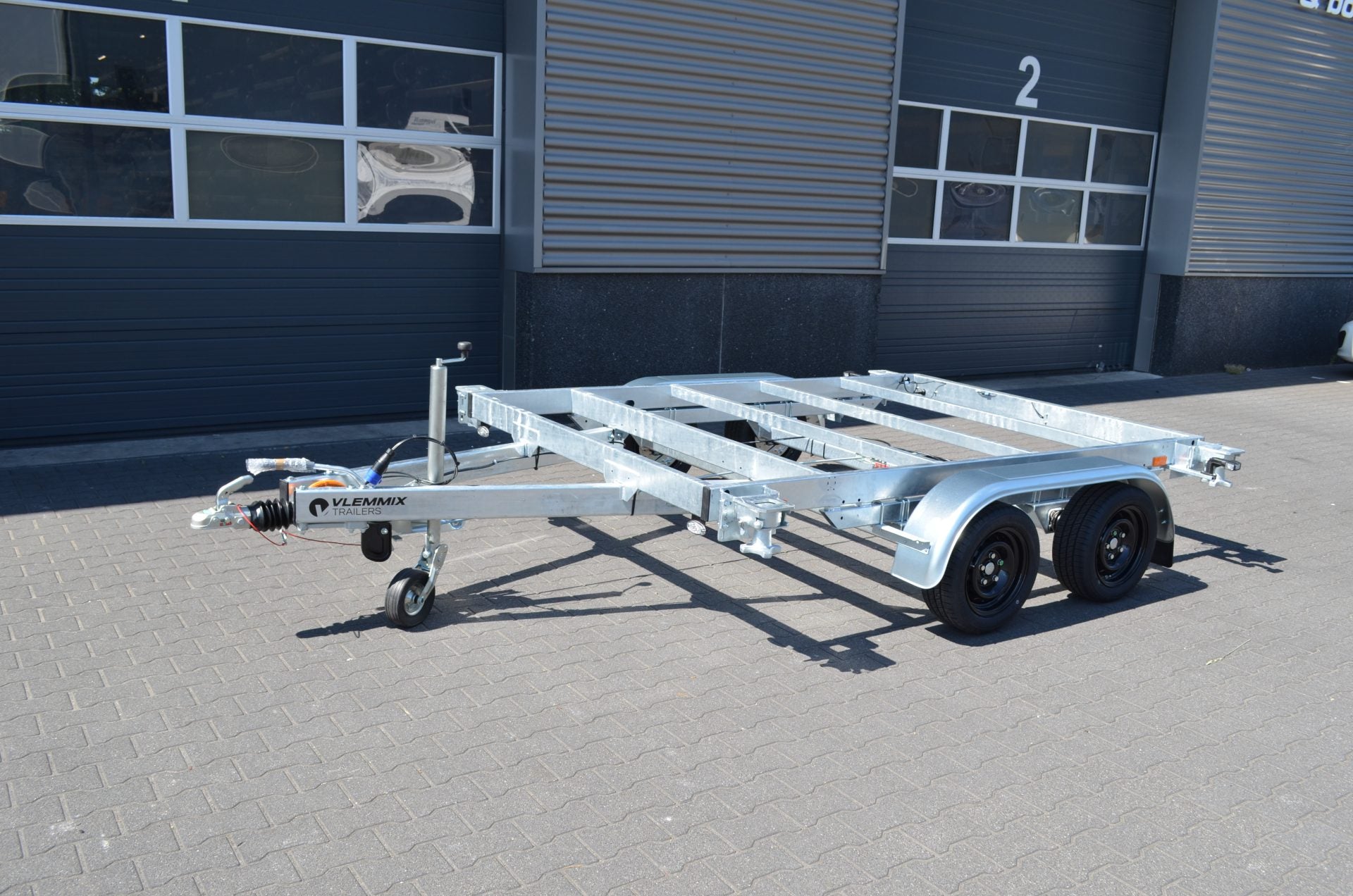
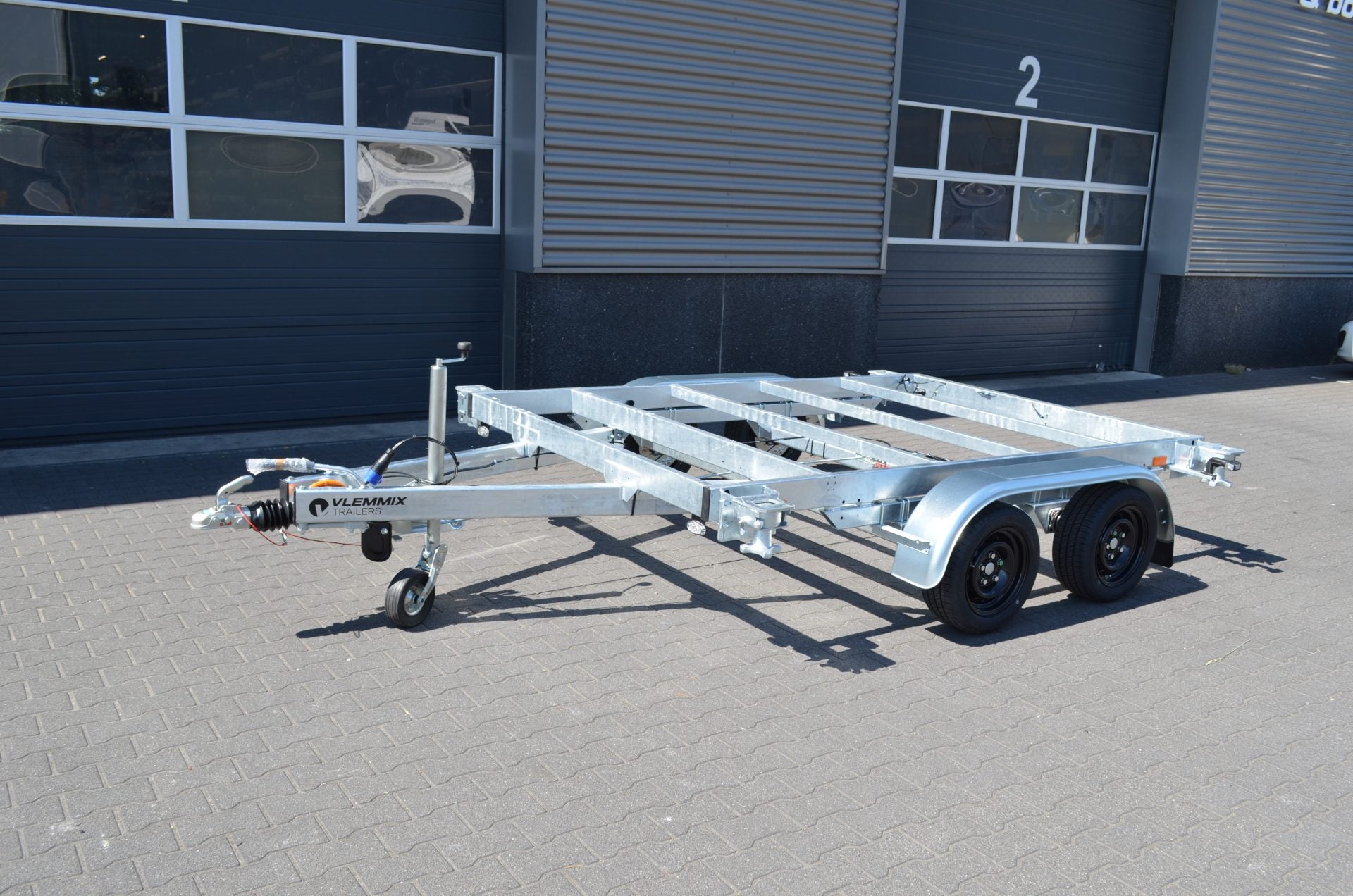
A container is not tied down with straps like a pallet. It is anchored by its ISO corner castings, the reinforced corner cubes, using twist locks: approved rotary latches that lock the container to the chassis at four points. Without them, the container can slide during braking, and the combination is punishable for improper stowage.
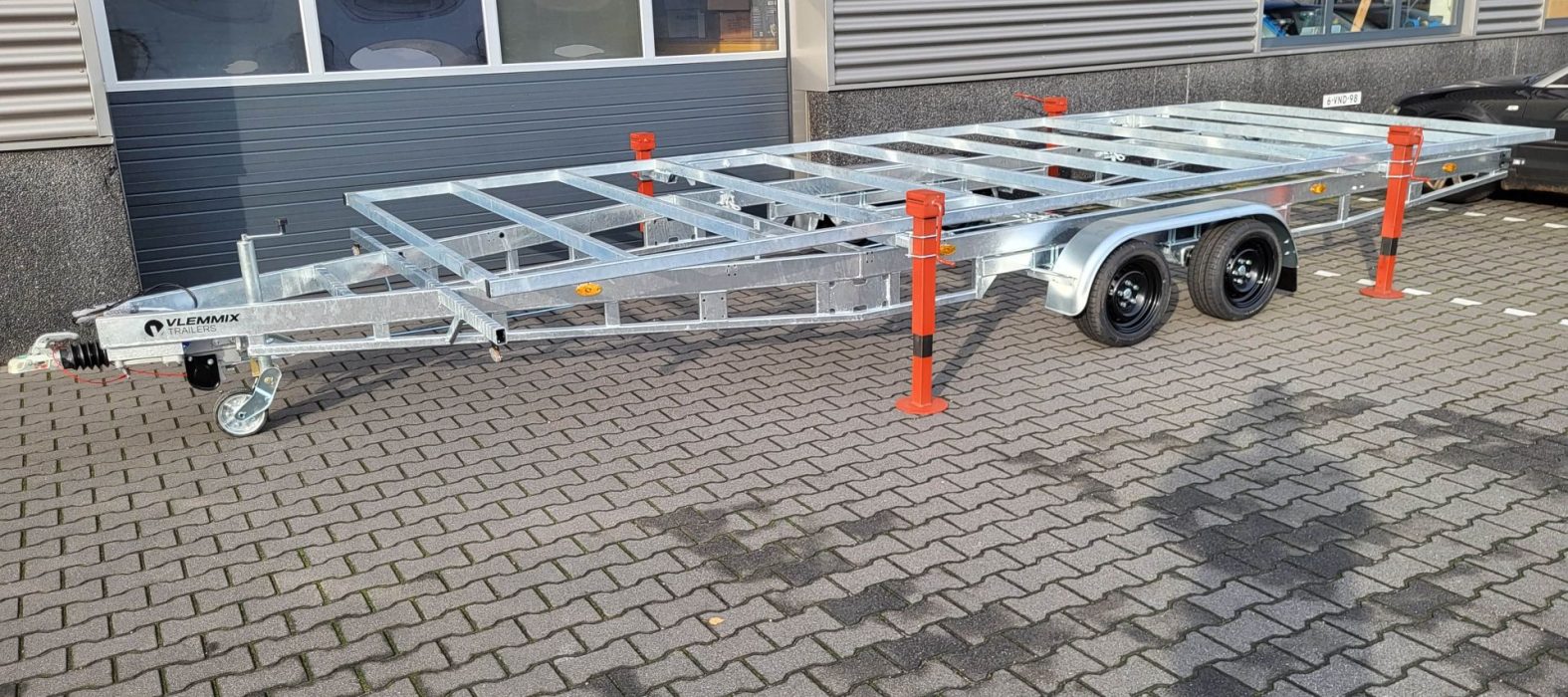
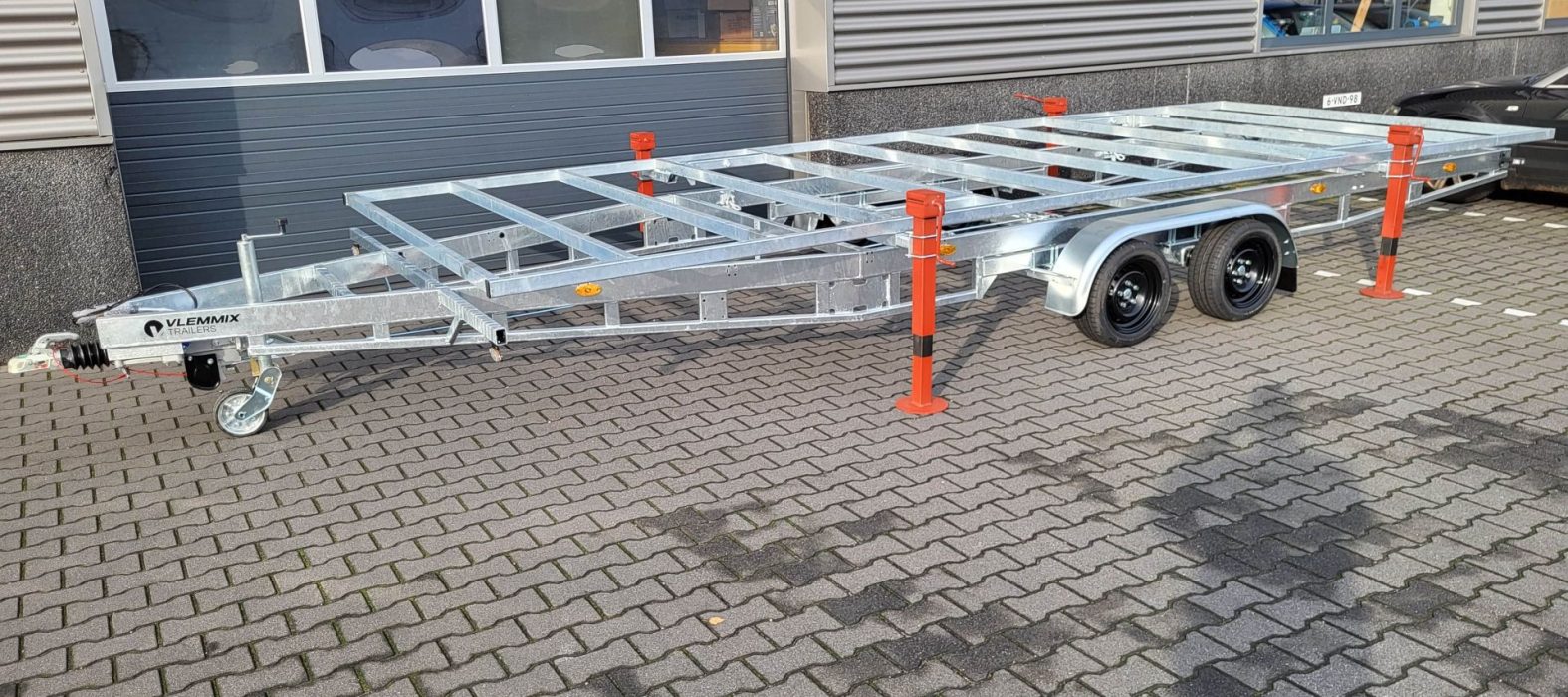
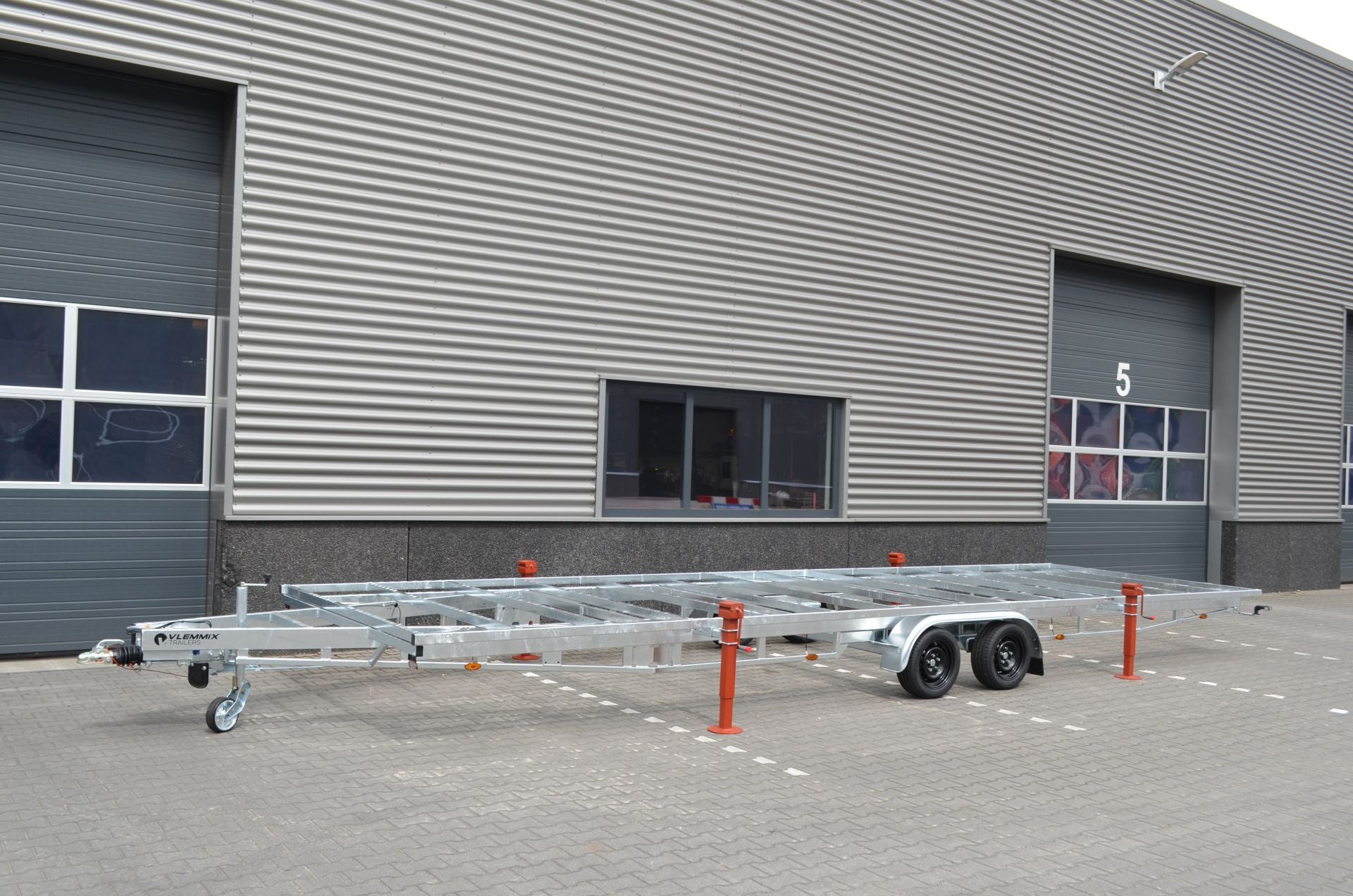
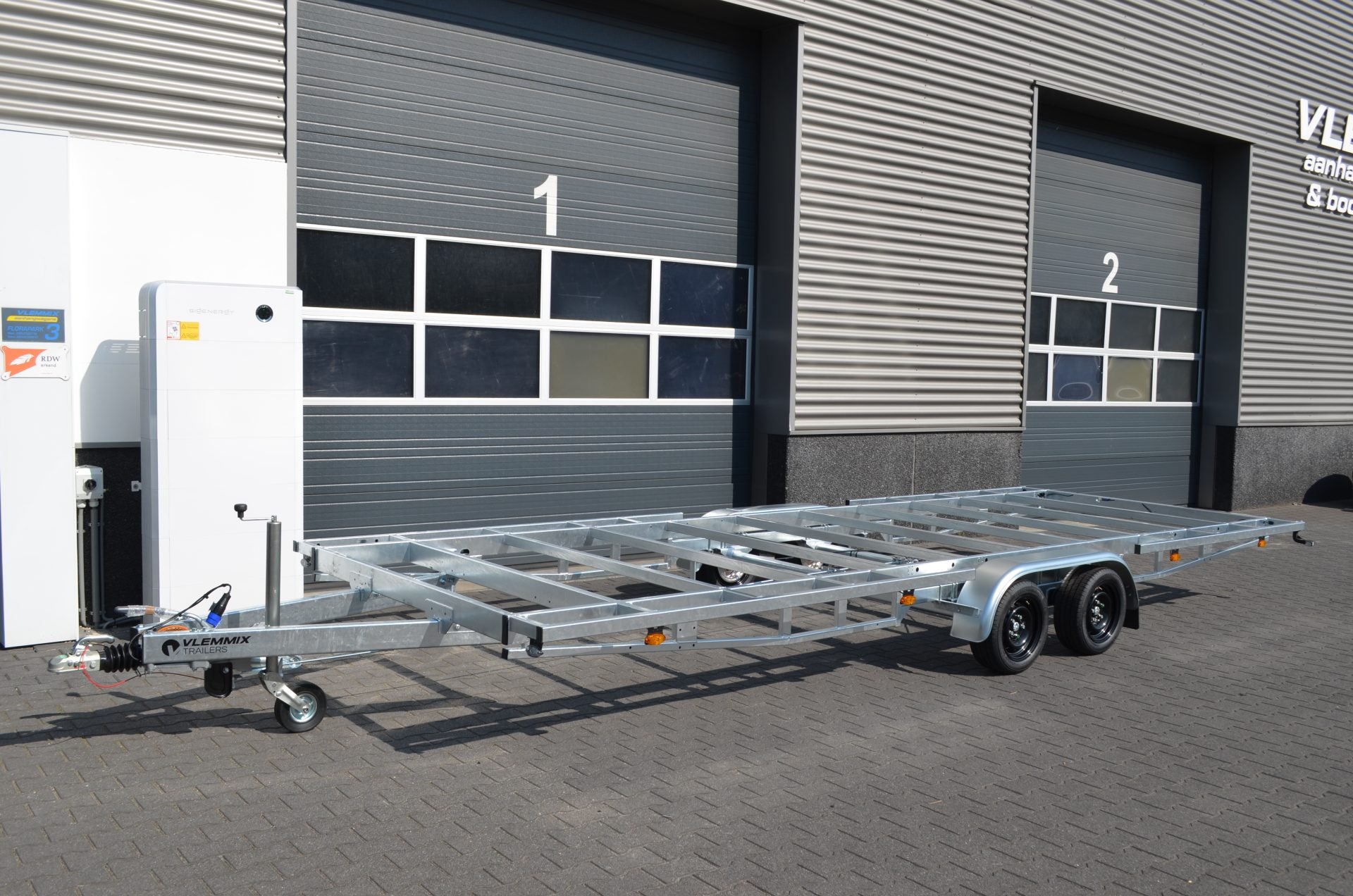
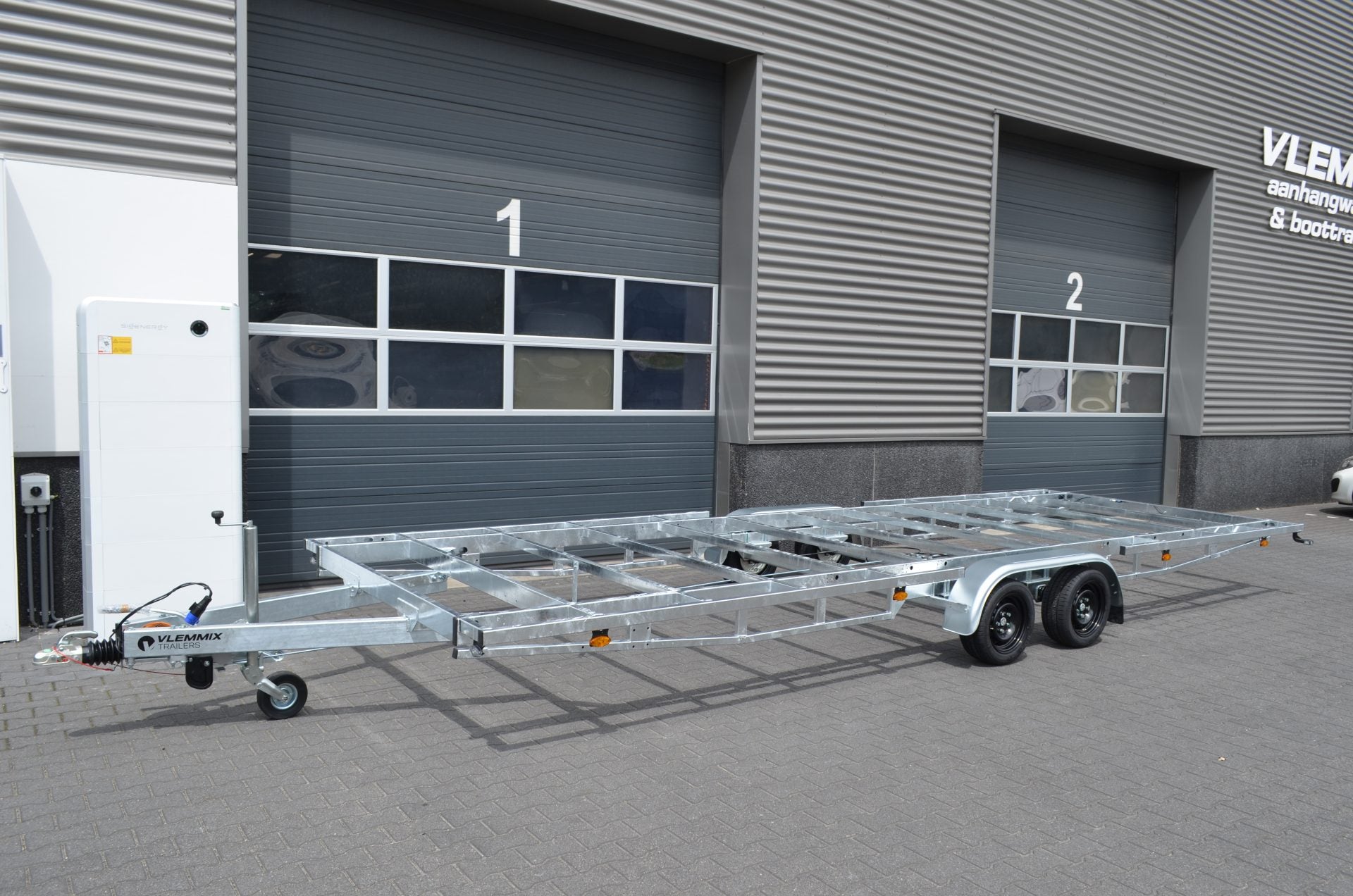
The correct trailer for this task has three characteristics: a chassis dimensioned to the container (3 meters for a 10-foot, 6.06 for a 20-foot), twist locks on all four corners, and a double axle with an overrun brake, which is mandatory for anything over 750 kg GVW and highly recommended for stability with tall loads.
10-foot container trailers and 20-foot container trailers come with integrated ISO anchors and a configurable GVW up to 3,500 kg. The chassis is hot-dip galvanized with 2 mm steel compared to the standard 1.5 mm, and the full range is in the container carrier category.
What car and what license are needed
The car must have a maximum towing capacity equal to or greater than the actual weight of the combination. For an empty 20-foot container on a trailer (around 3,100-3,300 kg actual weight), we're talking about a large SUV, pickup truck, or off-road vehicle with a towing capacity of 3,500 kg (braked). For a 10-foot container, any family car or mid-size SUV with 1,800-2,200 kg capacity will suffice.
The license follows the same scale. With a B license, you can drive combinations up to 3,500 kg combined GVW. Between 3,500 and 4,250 kg, you need the B96 authorization, a maneuvering test without a theory exam. Above that, and up to 7,000 kg, the B+E. For the typical case (empty 20-foot container and SUV), the B96 or B+E are almost always necessary, because the car's GVW already approaches 2,500-3,000 kg.
The choice of towing vehicle has its own guide: check the list of the best cars for towing a trailer in Spain with the actual towing capacities per model.
The documentation for the combination
A trailer weighing more than 750 kg GVW is an independent vehicle: it has its own red license plate, registration certificate, and independent insurance, plus an annual periodic inspection for up to 10 years. In addition, every trailer must have its technical data sheet; we explain this in detail in the technical inspection card for trailers and semi-trailers.
The container, on the other hand, does not have traffic documentation: for legal purposes, it is cargo, just like a giant pallet. It is advisable to carry the invoice or purchase contract during the first transports, because a container on the road behind a car attracts attention during checks.
When you CANNOT: the three forbidden cases
First, the 40-foot. Its tare weight of 3,700-3,900 kg exceeds the payload of any car trailer, and its 12.19 meters exceed the legal length of the combination. It is transport for a truck with a semi-trailer, no discussion.
Second, a container loaded above the payload. A 20-foot container with 2 tons of material inside totals more than 4,200 kg, and no paperwork will legalize it behind a car. The Civil Guard weighs combinations on the road with portable scales, and exceeding the weight limit results in a fine and immediate immobilization at the checkpoint.
Third, the wrong trailer. A flatbed without twist locks with the container strapped down can go unnoticed until the first hard braking. Improper stowage is punishable by up to 500 euros, and in case of damage, civil liability falls on the driver.
How the transport is done, step by step
The day of transport has a fixed sequence. First, cold verification: actual tare weight on the CSC plate, trailer tire pressure, lights connected, and twist locks open and greased. Five minutes that prevent 80% of problems on the road.
Second, loading. The container is lifted onto the trailer with a rented telescopic handler or with container jacks that raise the box while the trailer backs underneath. Align the corner castings with the four anchors, seat the box, and close the twist locks with a quarter turn each. Check the closure by pulling each lever.
Third, departure. Start slowly and brake gently in the first few meters to settle the combination. After 10-15 km, stop and recheck all four closures and pressure: this is the standard check for all cargo transport. On the road, anticipate braking and allow extra space in roundabouts, because a combination with a 20-foot container is around 11-12 meters long in total.
At the destination, unloading reverses the process. With your own jacks, you are completely autonomous; with a telehandler, coordinate the rental so that the machine is at the destination upon your arrival. Owners who repeat routes usually have jacks at each usual point and complete the operation without relying on anyone.
Buy the equipment or contract each transport
The alternative to owning a trailer is to hire a crane truck: between 150 and 600 euros per movement depending on distance and access. If you move the container once in your life, hire one. If you move it two or more times a year, owning a trailer quickly pays for itself and also serves for other loads on the farm or business.
Many container uses involve recurrent movements: seasonal shed, event storage, construction module that rotates between projects. We review the most profitable ideas in creative uses for shipping containers. For other loads, the range of cargo trailers covers everything from pallets to machinery.
All models are delivered with European homologation, complete documentation, and a 2-year warranty, buying directly without intermediaries. Arnaud will confirm which configuration fits your container and your car: consult without obligation.
What about renting a trailer for a single trip?
The logical question for someone who only moves once. The market reality: the rental of container trailers with twist locks for private individuals barely exists in Spain. Rental companies offer generic flatbeds without ISO anchors, which do not solve legal stowage, and the few container trailers for rent are truck semi-trailers for fleets.
That leaves three options for a single trip: a hired crane truck (the simplest), asking the container seller to include transport when negotiating the purchase, or buying the trailer and reselling it after the trip: a galvanized container trailer hardly loses value in a year and the used market absorbs it well. This last option turns the single trip into a de facto rental for the price difference.
For the rest of the scenarios (two or more movements), direct purchase easily wins the calculation, with the added benefit of having the equipment available on the exact day you need it.
Frequently Asked Questions
What type of trailer do I need to transport a shipping container?
A container trailer with twist locks on all four ISO corners, a chassis sized for the container (3 m for 10-foot, 6.06 m for 20-foot), a double axle with overrun brake, and a GVW of up to 3,500 kg. Generic flatbeds without twist locks do not legally secure the container.
Can I place a loaded container on a car trailer?
Only if the combination respects the payload. A 10-foot container can hold 1,000-1,200 kg of goods without exceeding the 3,500 kg GVW. A 20-foot container uses almost all of its payload with its own tare weight, so it can only travel empty or with very light cargo.
How much does an empty 20-foot container weigh?
Between 2,080 and 2,300 kg depending on the manufacturer and condition, with high cubes slightly more. The exact data for each unit is on the CSC plate on the door. Always compare this actual tare weight with your trailer's payload before planning the transport.
What license do I need to tow a container with a trailer?
It depends on the combined GVW. Up to 3,500 kg combined, a B license is sufficient, which is viable with a 10-foot container and a light car. The typical case of an empty 20-foot container with an SUV usually requires a B96 (up to 4,250 kg) or B+E (up to 7,000 kg combined).
Can a 40-foot container be transported by car?
No. Its tare weight of 3,700-3,900 kg already exceeds the maximum payload of a 3,500 kg GVW trailer, and its 12.19 meters in length exceed what is allowed for a car-trailer combination. A 40-foot container requires a truck with a container semi-trailer.
How fast can I drive when towing a container?
The general limits for trailers: 90 km/h on motorways and dual carriageways, 80 km/h on conventional roads. With a container, which raises the center of gravity and offers a large surface to side wind, the prudent reference is to drive below the limit and increase braking distance.
Does the container need any special transport permit?
Not in the legal cases described. An empty container or one with cargo within the GVW is ordinary cargo, without special authorization, because the combination respects general dimensions and masses. Special transport begins where these measurements end, i.e., with a 40-foot container or a loaded container.
How do I load the container onto the trailer if I don't have machinery?
With container jacks: they attach to the four corner castings, lift the box above the chassis height, and the trailer backs underneath. A set costs 600-1,500 euros and can be operated by one person. The temporary alternative is to rent a telescopic handler for 200-350 euros per day.
What is the total length of the combination with a 20-foot container?
Around 11-12 meters total length (car plus drawbar and chassis), 2.44 meters wide, and about 3 meters high with a standard container mounted. Within general driving limits, but requires planning turns, gas stations, and parking with long vehicle considerations.