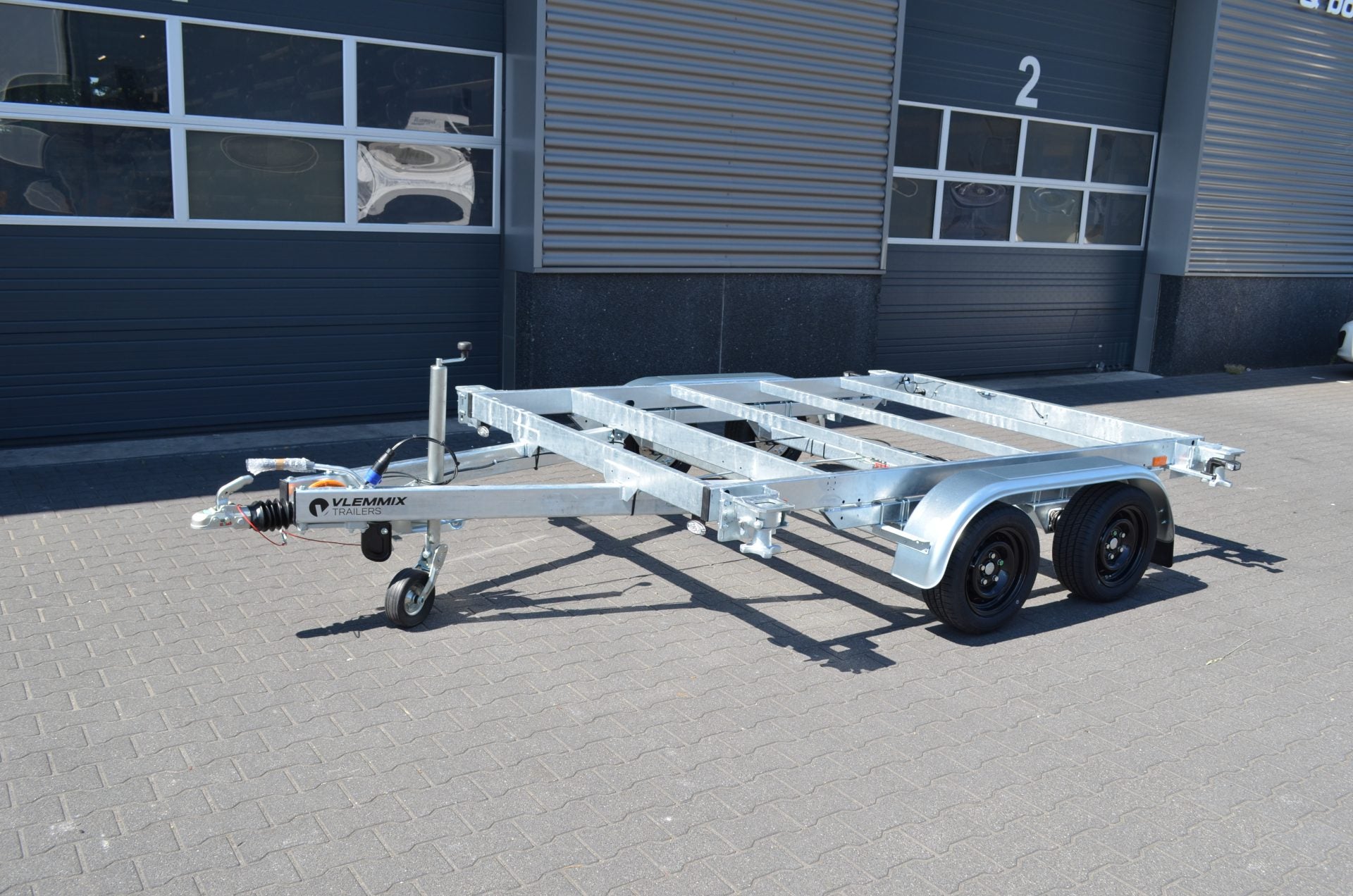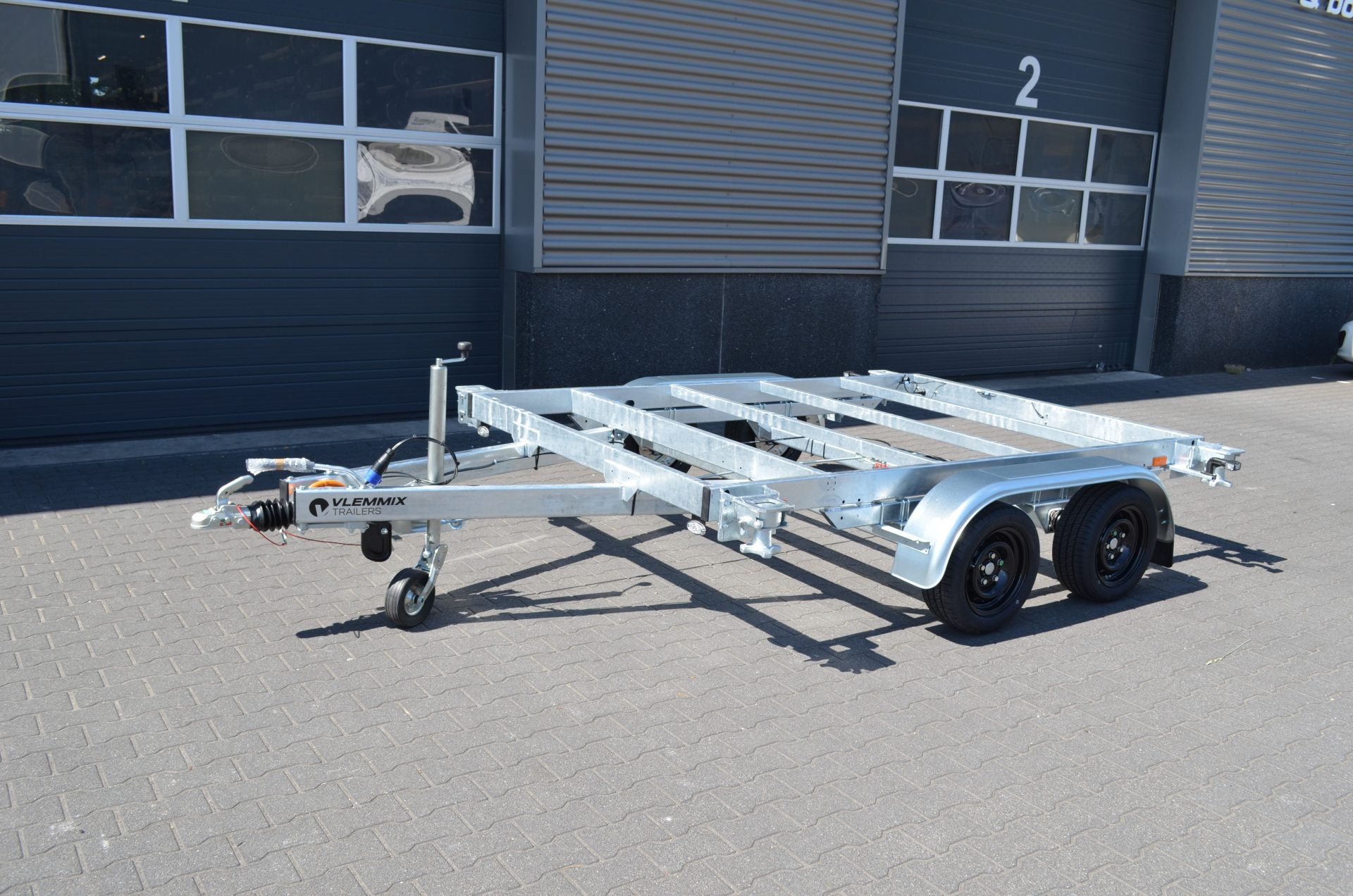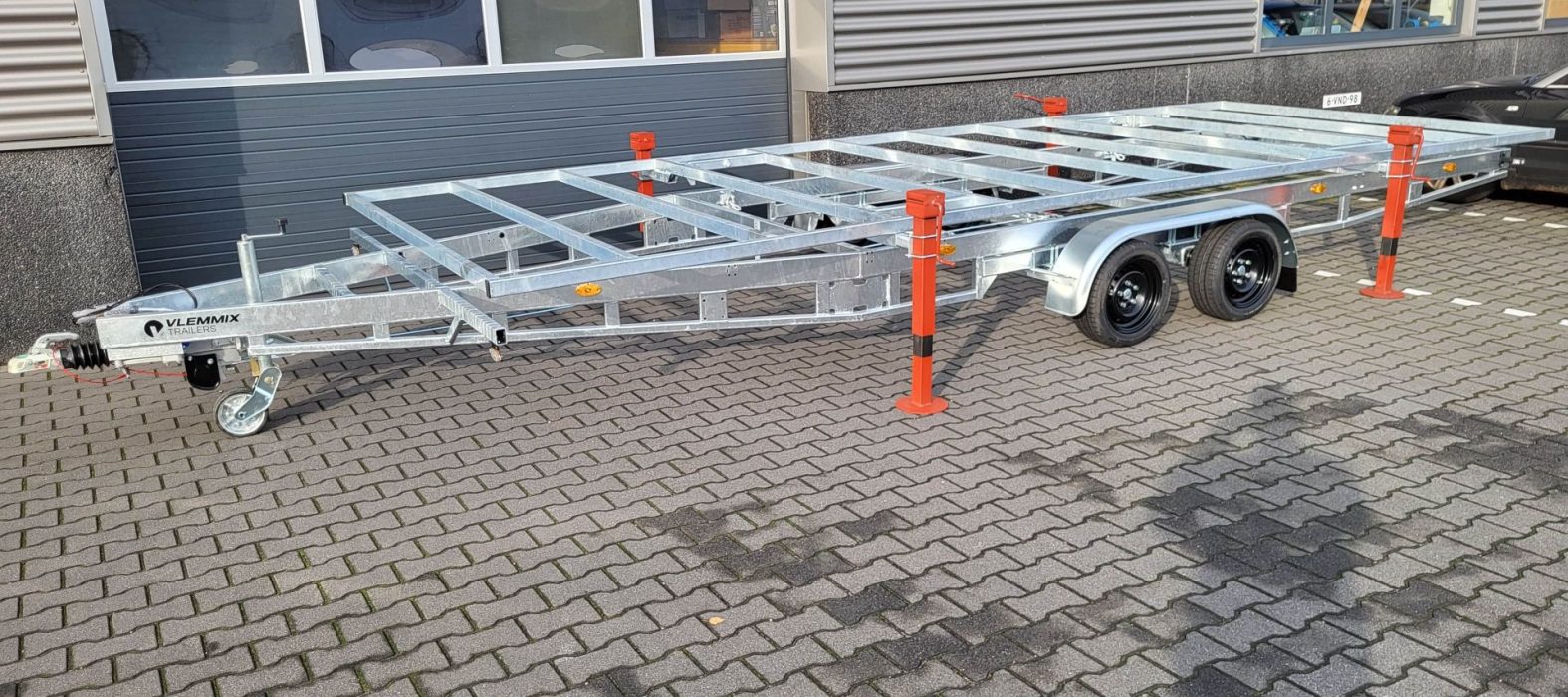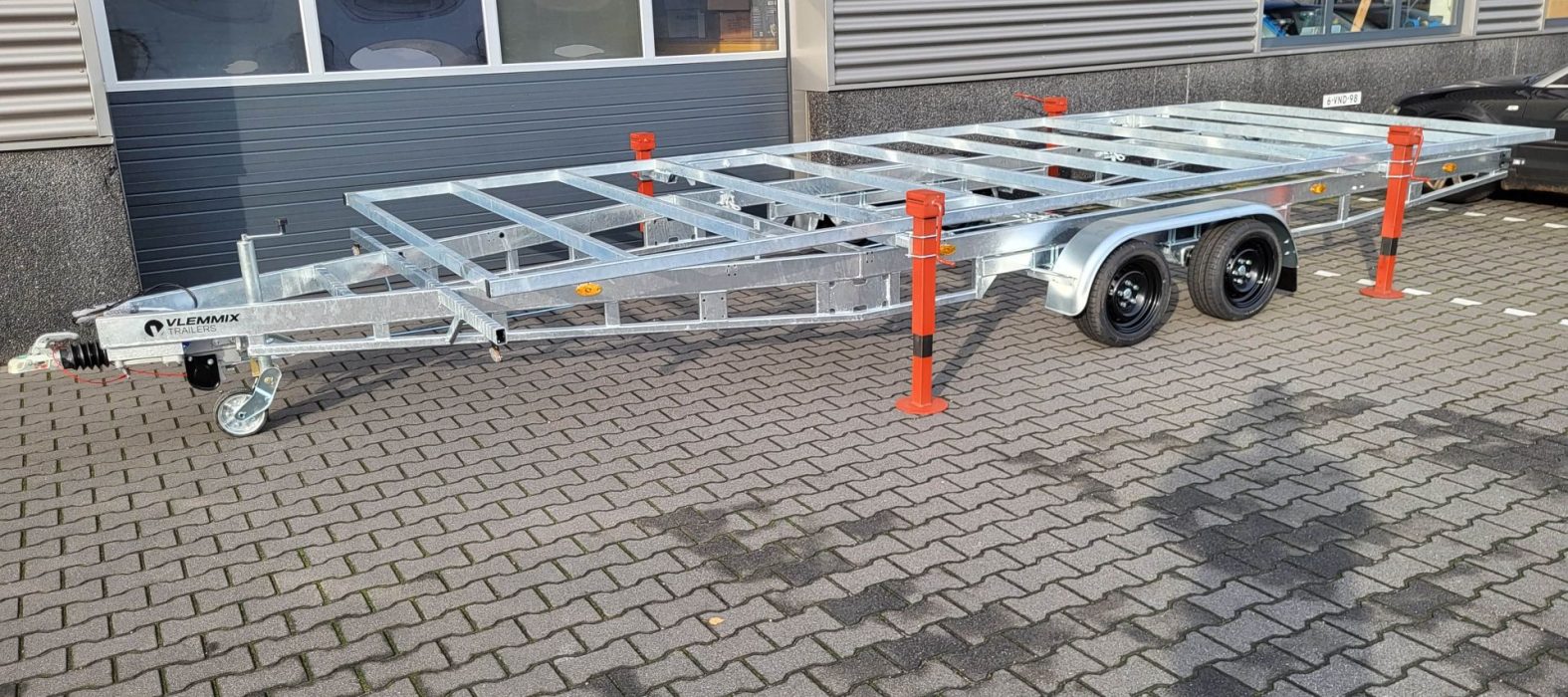

A standard Spanish garage space measures around 4.5-5 metres long by 2.2-2.4 wide, with doors 2 to 2.2 metres high. A 4-metre boat on a trailer with a folding drawbar takes up about 4.8 metres. The short answer is yes: thousands of Spanish boats sleep in garages, and the saving compared with the marina is around €2,000-€4,000 a year. The full answer depends on three measurements we are going to go through.
TL;DR
- Yes, you can, and it is the cheapest and best-protected option of all: no recurring cost and the boat under cover.
- The three numbers that decide it: total length of the outfit (hull plus drawbar), height on the trailer and door width.
- Standard space (5 m): boats of up to 4-4.5 metres with a folding drawbar, jet skis and inflatables.
- Double garage, large storage unit or industrial unit: lengths of 5 to 7 metres with no trouble.
- A folding drawbar saves 80-120 cm of length and is the accessory that settles half of all cases.
- Empty tanks, battery disconnected and a breathable cover: the boat comes out in spring just as it went in.
Straight answer: more boat fits than you think
The doubt comes from comparing the boat's length with the length of the space, and that sum is set up wrong. What you store is the boat and trailer together, and that outfit is optimised by design: folding drawbar, bow against the back wall and engine trimmed. A well-configured 4.2-metre boat goes into a space where it "did not fit".
The hard limit is usually height, not length. A standard garage door is 2-2.2 metres. A RIB on a trailer measures 1.7-2.1 metres up to the console; a motorboat with a tall windscreen or the canopy up goes over 2.2 metres easily. Measure your boat at its highest point on the trailer before you decide anything.
The three measurements you settle first
| Measurement | Standard space | Double garage/unit | Your outfit |
|---|---|---|---|
| Usable length | 4.5-5 m | 6-9 m | Hull length + drawbar (or drawbar folded) |
| Door width | 2.3-2.5 m | 3-5 m | Beam + 10 cm of clearance |
| Door height | 2-2.2 m | 2.5-4 m | Highest point on the trailer |
Take the real measurements, not the ones you remember: usable length has to discount steps and cupboards at the back, and the height is set by the lowest point of the door frame, not the ceiling. On the boat side, measure with the engine trimmed down (transport position) and with the canopy off.
On paper, that makes the split clear. Jet skis and 3-4 metre inflatables: a standard space is more than enough. RIBs and motorboats of 4-5 metres: a standard space with a folding drawbar, or a long space. Lengths of 5-7 metres: a double garage, an industrial storage unit or a small warehouse. Beyond that, an outdoor plot or the marina options.
The folding drawbar: 100 cm that change everything
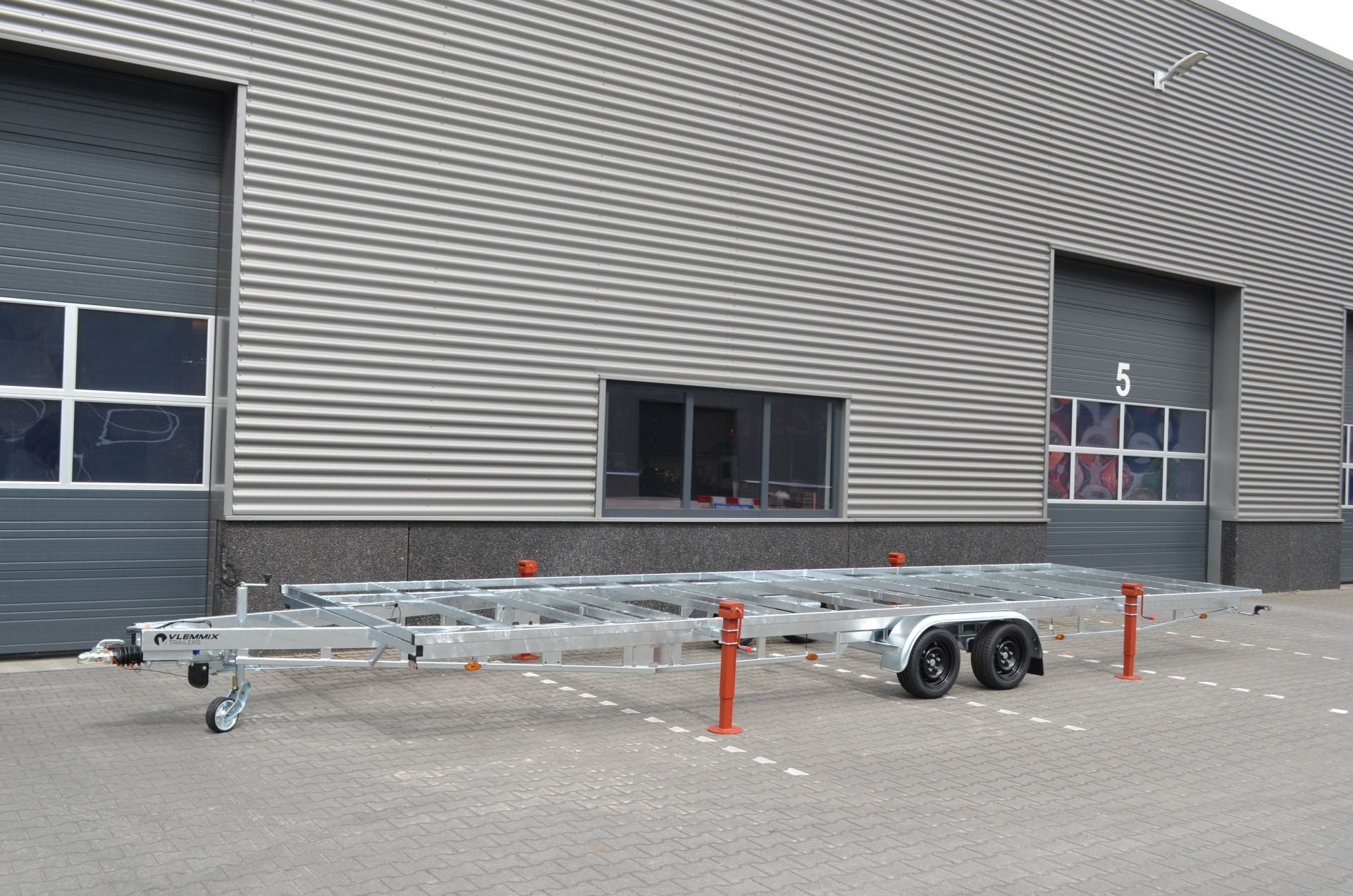
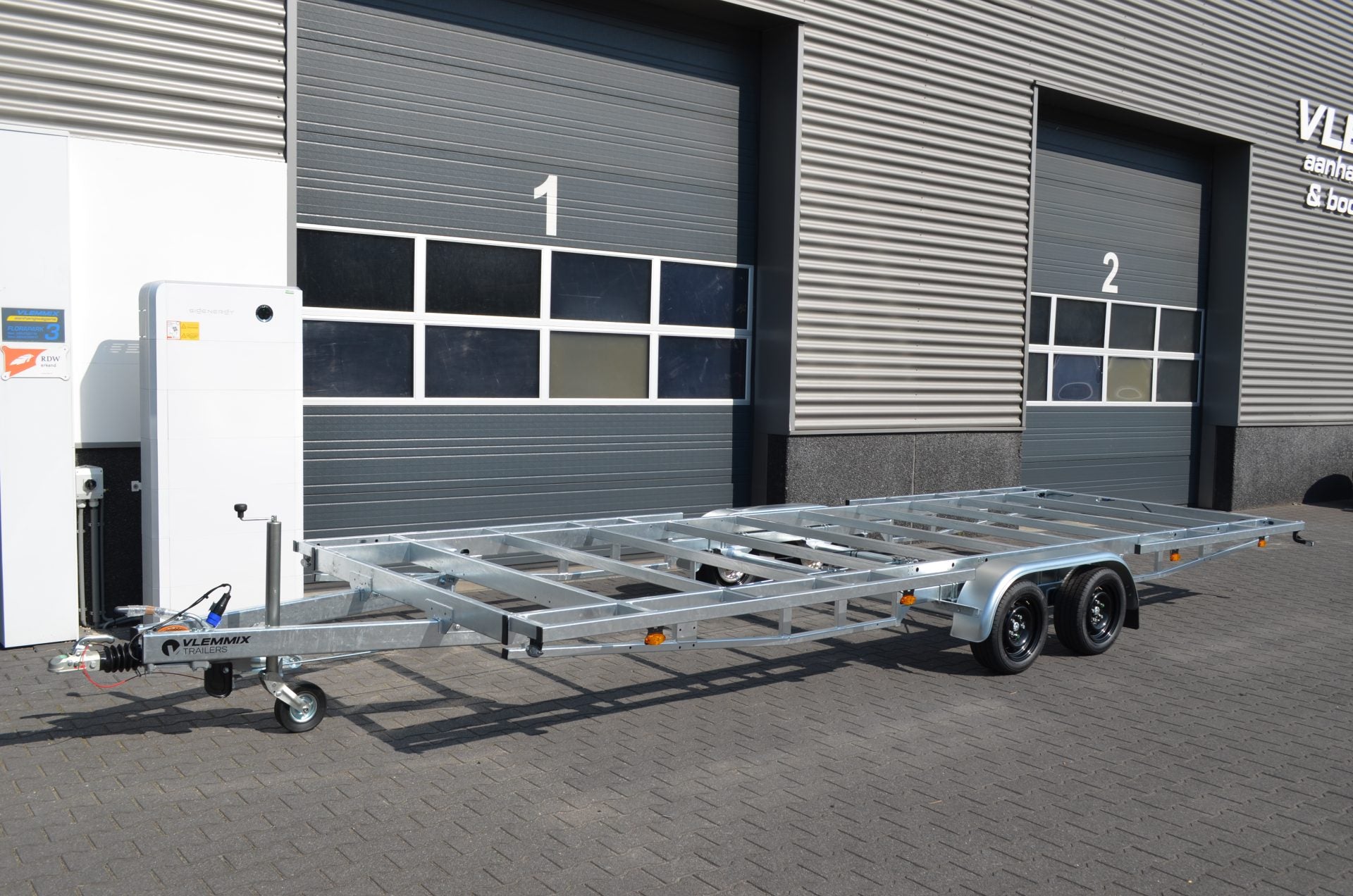
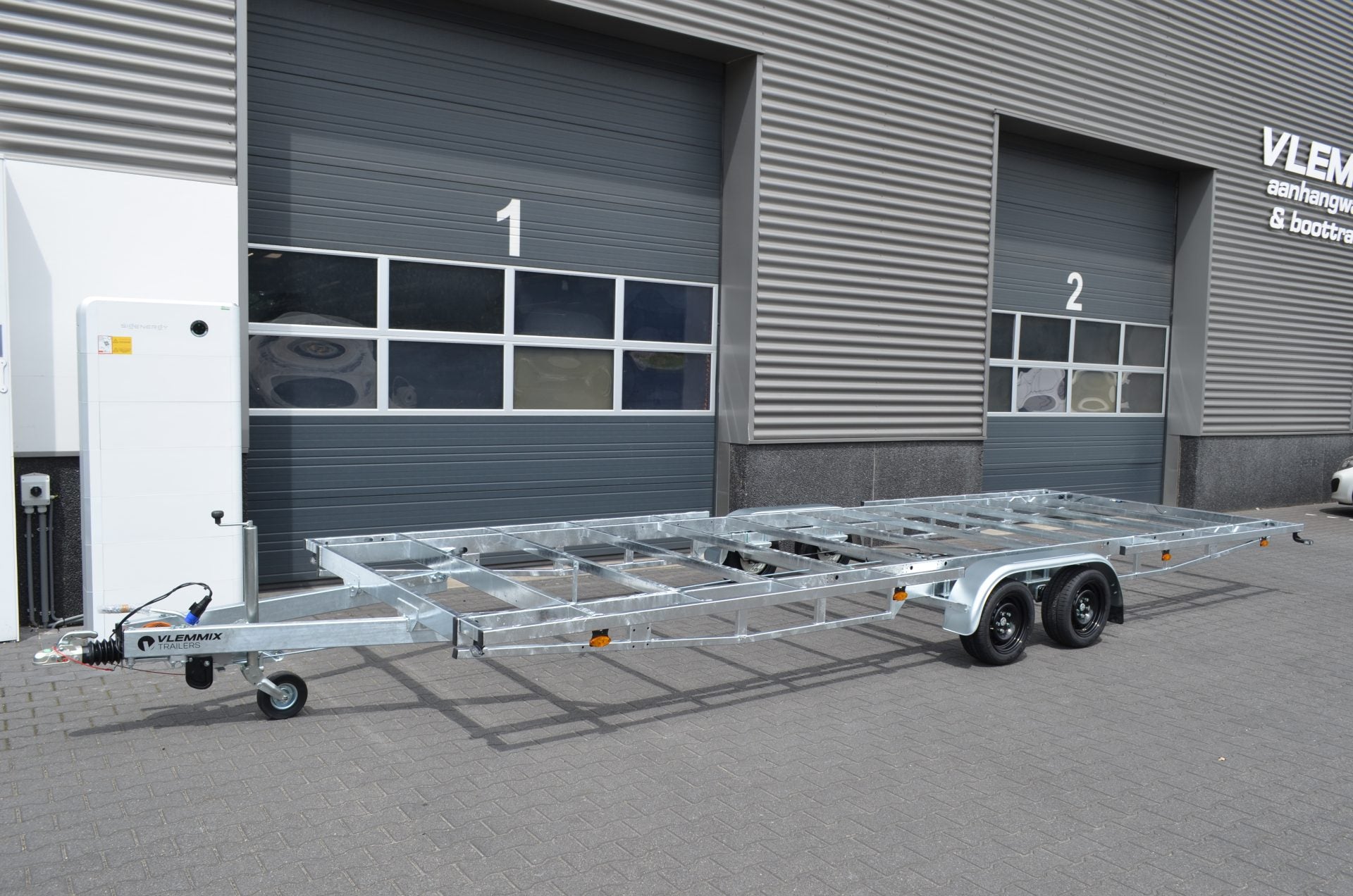
A boat trailer with a folding drawbar folds the front section away once parked, cutting between 80 and 120 cm off the total length. That is the difference between fitting and not fitting for most 4-5 metre boats in standard spaces. If your garage is tight, ask for this configuration when you buy the trailer: fitting it afterwards is also possible, but it costs more.
The second space trick is orientation: bow towards the back, with the drawbar folded upwards against the wall. The engine ends up facing the door, easy to flush with fresh water after every trip, and the side passage stays clear. Trailers from the boat range, among the lightest on the market, help here too: less weight means less effort when manoeuvring by hand.
The manoeuvre: getting the outfit in without breaking a sweat
Reversing a trailer into a tight space is frightening the first time and boring by the tenth. Three options in order of effort. With the car: slow reversing with small corrections; practise two afternoons in an empty car park and you will have it mastered. By hand: with the outfit on the level and a light boat, the jockey wheel steers and one person pushes; it works up to a real 700-900 kg.
The third is a powered mover: an accessory that moves the trailer by remote control and positions the outfit to the centimetre in impossible spaces. It costs €800-€1,500 and makes sense in very tight garages or when the manoeuvre will be done by someone without practice.
Inside the garage, chock the wheels, lower the jockey wheel onto its pad and take weight off the tyres if the stay runs beyond two months: supports under the chassis or a couple of boat stands are enough to stop the tyres deforming from standing on one spot.
The boat correctly positioned on the trailer: half space, half safety

Where the boat sits on the trailer decides centimetres and stability at the same time. Bow firm against its stop, hull centred on the bunks or rollers and the engine trimmed to transport position: that way the outfit takes up its real minimum length and does not shift during the garage manoeuvre. A boat sitting too far back on the trailer gives away 20-30 cm of length and unbalances the drawbar.
The weight distribution benchmark is the same as on the road: between 5 and 10% of the weight on the drawbar, the rest centred over the axles. With that distribution, manoeuvring by hand is possible and the jockey wheel neither digs in nor lifts. The fine tuning, with photos and measurements, is in our guide to positioning the boat on the trailer.
A tight-garage trick: mark the final position of the trailer wheels on the floor with tape. The second time you park the outfit, those marks turn a ten-minute manoeuvre into a two-minute one.
Preparing the boat to sleep under cover
The garage does half of your winter storage for you: no sun, no rain and no salt in the air, so the boat looks after itself. The other half is still yours: fuel tank with stabiliser or empty depending on the season, battery disconnected or on a maintainer, and drains and bilge left open so nothing traps moisture.
The engine deserves its ritual even with the boat under cover: internal flushing with fresh water, oil if it is due and cylinder protection for long lay-ups. The full procedure, outboard and inboard, is in our guide to winterising the engine step by step.
A cover is still useful under a roof: breathable and not pulled tight, it protects against building dust and knocks in a shared garage. And the outfit appreciates a check of straps and supports every few weeks, especially if someone else moves things around the boat.
What to do when the boat does not fit
If the outfit is only slightly too long, look at what can be trimmed: folding drawbar (80-120 cm), engine trimmed and no auxiliary outboard bracket. If it is too tall, check whether the critical point can be removed: a folding windscreen, a folding light bar or the canopy taken off. Plenty of "it does not fit" cases turn into a yes with €200 of accessories.
If it genuinely does not fit, the order of alternatives by cost is: your own plot with a cover or a light canopy, an outdoor boat park (€30-€70 a month with the boat on your own trailer) and a dry stack marina. The full winter storage procedure, wherever the boat ends up, is in storing the boat over winter. Watch out too for the outfit on the street while you manoeuvre or wait for a space: overhanging loads and parking have rules of their own in Spain, summarised in how far a boat can overhang a trailer.
The right kit for living under cover
For a boat that sleeps in a garage, the ideal trailer is different from a pure touring one: folding drawbar, a sturdy jockey wheel and a compact chassis. The boat storage trailers are designed for exactly this: long stays, occasional movement and a hull well supported and ventilated all year round.
If the boat also travels every weekend, the general boat trailers range combines both functions with a hot-dip galvanised chassis and 3 mm steel. For lengths at the limit of a double garage, the trailer for a 6-metre boat is the benchmark for compact dimensions.
And for stays of several years or project boats, a boat cradle frees up the trailer and supports the hull along its whole length. Every product comes with EU type approval and a 2-year warranty, bought direct with no middlemen. Arnaud will confirm the exact outfit dimensions for your garage before you buy: ask with no obligation.
Frequently asked questions
What size of boat fits in a standard garage?
In a 4.5-5 metre space with a door 2-2.2 metres high: jet skis, inflatables and boats of up to 4-4.5 metres in length on a trailer with a folding drawbar. With a double garage or an industrial storage unit of 6 metres or more, lengths of 5 to 7 metres will go in.
How deep does the garage need to be for a 5-metre boat?
Around 5.3-5.5 metres with the drawbar folded, or 6.2-6.5 with a fixed drawbar. Add the hull length, the overhang of the trimmed engine and the remaining section of drawbar, and leave 20-30 cm of manoeuvring clearance against the back wall.
Do I still need to winterise the boat if it is in a garage?
Yes, although there is less work. A roof removes sun, rain and salt air, but the engine still needs its flush, oil and protection, the battery its disconnection or maintainer, and the fuel its stabiliser. The hull, on the other hand, asks for almost nothing under cover.
How do I reverse the trailer into a tight space?
With practice (two sessions in an empty car park are enough), by hand using the jockey wheel if the outfit is light and the ground is level, or with an electric powered mover with a remote (€800-€1,500) for millimetre-perfect spaces. A folding drawbar also makes the final turn easier.
Can the boat sit on the trailer for months in the garage?
Yes. For stays of more than two months, take weight off the tyres with supports under the chassis, keep the correct pressure and leave the handbrake off with the wheels chocked so the shoes do not stick. With those three steps, the trailer comes to no harm.
How much do I save by keeping the boat in the garage?
The whole marina cost: €1,800-€4,500 a year for a berth or €900-€4,800 for a dry stack depending on length and area, plus much of the annual antifouling. The one-off investment in a trailer with a folding drawbar pays for itself in the first year in most cases.
Can I keep the boat in a storage unit or rented warehouse?
Yes, and it is the middle route when your own garage is not big enough: partitioned units and XXL storage rooms take outfits of 6-7 metres for less than a dry stack costs. Check the door width, the height and that the contract allows boats.
Can the residents' association stop me keeping the boat in my space?
In a space you own, parking use generally allows a registered boat and trailer outfit that stays within the limits of the space. Each association's rules may qualify that: check them first, especially if the outfit encroaches on communal areas while you manoeuvre.
Should I store the boat with the tank full or empty?
For lay-ups of a few weeks, an almost full tank with fuel stabiliser reduces internal condensation. For lay-ups of many months, almost empty is better, topping up with fresh petrol in spring. Either way, ventilate the garage and allow no build-up of fumes: this is fuel under a roof.
How tall is a boat on its trailer?
Between 1.5 and 2.1 metres for inflatables, jet skis and RIBs with a low console, and 2.2 to 2.8 for motorboats with a tall windscreen, arches or a cabin. It is measured from the ground to the highest point with the engine trimmed for transport. Folding items (arch, aerial, windscreen) win back the centimetres you are short of.
Is a powered mover worth it for the garage?
If the manoeuvre is millimetre-perfect, there is a slope or it will be done by someone without practice, yes: €800-€1,500 that turn parking into a stroll with a remote control. For wide spaces and light outfits, the jockey wheel and two afternoons of practice give the same result for free.
Does salt do any damage if I store the boat without rinsing it?
Yes: dried salt keeps absorbing moisture and corrodes fittings, trailer wiring and anodised parts even under cover. A fresh-water hose over the hull, engine and trailer before putting it away is the two-minute routine that adds the most life to an outfit kept in a garage.
Can I keep the boating gear in the space too?
Cupboards at the back and racks above the boat's foredeck use up the dead volume of the space for lifejackets, covers, lines and fenders. Avoid resting weight directly on the hull or the canopy, and always keep the inspection route around the outfit clear.
What do I do with the trailer if the boat spends the winter on a cradle?
Use the chance for its annual maintenance (hubs, lights, brake) and store it folded against a wall if the drawbar folds: it takes up little more than a motorbike. It is also the moment for its ITV (Spain's roadworthiness test) if it is due; the inspection goes better with the trailer empty and clean.