
Transporting cargo in a trailer is a common practice for both recreational and professional use, but it also raises a lot of legal questions. One of the most frequently asked questions is... How much can the load of a trailer protrude without breaking the law ? And it's not by chance: a misinterpretation of the limits causes hundreds of fines, immobilizations and dangerous situations on the road every year.
The problem lies not only in ignorance of the regulations, but in applying rules "by ear" or extrapolating criteria from passenger cars to trailers, when The regulations are different and much stricter . In this article, we analyze exactly what the law says, how excellence is measured, and what happens in the real-life cases that generate the most conflicts.
What does Spanish legislation say about overhanging loads?
The main regulations are found in the General Vehicle Regulations (RD 2822/1998). This text clearly distinguishes between vehicle dimensions , Allowable overhang and Poorly stowed cargo , three concepts that are often confused.
The regulations allow the load to protrude. Only when it is indivisible , properly secured, and does not compromise road safety. This means that it is not enough for it to "not be in the way" or "not move": it must comply with very specific length limits and not alter the overall width.
Distance that the load can protrude from a trailer in Spain
Furthermore, the trailer has approved dimensions that They cannot be modified by the load . If the load makes the vehicle exceed the general limits, it ceases to be a legal overhanging load and is considered an oversized load.
|
Outstanding type |
Is it allowed? |
Maximum legal distance |
Mandatory conditions |
Common reason for sanction |
|---|---|---|---|---|
|
In front of the trailer |
❌ No |
0 cm |
No frontal projection is allowed. |
Forward loading onto drawbar or hitch |
|
From behind (divisible load) |
✅ Yes |
Up to 10% of the total length of the trailer |
Secure load + V-20 warning sign |
Exceeding the permitted percentage |
|
From behind (indivisible load) |
✅ Yes |
Up to 15% of the total length of the trailer |
Indivisible load + V-20 mandatory |
To consider a burden indivisible when it is not. |
|
Along the sides |
❌ No |
0 cm |
The load cannot increase the total width. |
Even if the lateral projection is minimal, it should be minimal. |
|
Total width of trailer + load |
✅ Yes |
Max. 2.55 m |
Includes cargo, mudguards and fixed elements |
Exceed 2.55 m without special transport |
|
Outstanding overnight charging |
✅ Yes |
Same limits as during the day |
V-20 + mandatory additional lighting |
Lack of lights or rear visibility |
|
Cargo that obstructs lights or license plate |
❌ No |
0 cm without adaptation |
Lights and license plate must be repeated |
Circular without additional signage |
How much can the load protrude from the front and back?
In trailers, the regulations are especially clear: the load can never protrude from the front .
All the permitted margin is concentrated at the rear, and always within these limits:
-
Up to 10% of the total length of the trailer , if the load is divisible
-
Up to 15% , if the load is indivisible
The total length of the trailer is measured from one end of the trailer to the other, excluding the towing vehicle. This is important because many drivers measure from the hitch or from the car, which is incorrect.
In practice, this margin is smaller than it seems. In short trailers, even a few extra centimeters constitute an infraction, even if the load is properly secured.
How much can the load protrude from the sides?
There is no room for interpretation here, The load cannot protrude laterally under any circumstances .
The maximum legal width of the trailer + load combination is 2.55 meters , and the load You cannot increase that width , even if the trailer is narrower.
This point causes many problems in:
-
Boats with a wide beam
-
Machinery
-
Prefabricated structures
-
Mobile homes
If you need more detailed information on this topic, we recommend this specific article about What is the maximum width allowed for a trailer in Spain? , where limits, exceptions and common errors are analyzed.
Differences between a light trailer and a heavy trailer
Regarding overhanging load, the limits are the same For light trailers (≤ 750 kg GVWR) and heavy trailers (> 750 kg GVWR). There is no further allowance for light trailers.
The difference lies in the control:
-
In heavy trailers, any irregularity can imply immediate immobilization
-
In trailers subject to vehicle inspection (ITV), any fixed element used to support load must be listed in the vehicle registration document.
Trusting that "being lightweight means nothing will happen" is one of the most common and most penalized mistakes.
Mandatory marking of protruding load
Whenever the load protrudes from the rear, it is mandatory to mark it using the approved V-20 panel .
The panel must be placed at the rear of the load and strictly comply with regulations. If the load spans the entire width, a single centered panel is sufficient. If it protrudes only on one side, two panels must be placed in an inverted V shape.
Damaged tapes, cardboard boxes, or panels They are not valid and they are sanctioned.
Lighting and visibility when the load protrudes
If the protruding load is totally or partially hidden:
-
Taillights
-
Intermittent
-
Stoplight
-
Tuition
It is mandatory to install additional lighting and signage at the rear end of the load. This is especially relevant when traveling at night or in poor visibility, where non-compliance is considered a serious offense.
Common cases that raise doubts
Boats and jet skis
The hull cannot protrude laterally, and the rear overhang must strictly adhere to the permitted percentages. In this context, it is crucial to use trailers specifically designed for this purpose, such as the nautical trailers , which minimize legal and stowage risks.
Machinery and structures
Overhangs are only permitted if the load is indivisible. If it can be disassembled or divided, overhangs are not legally justified.
Mobile homes and long structures
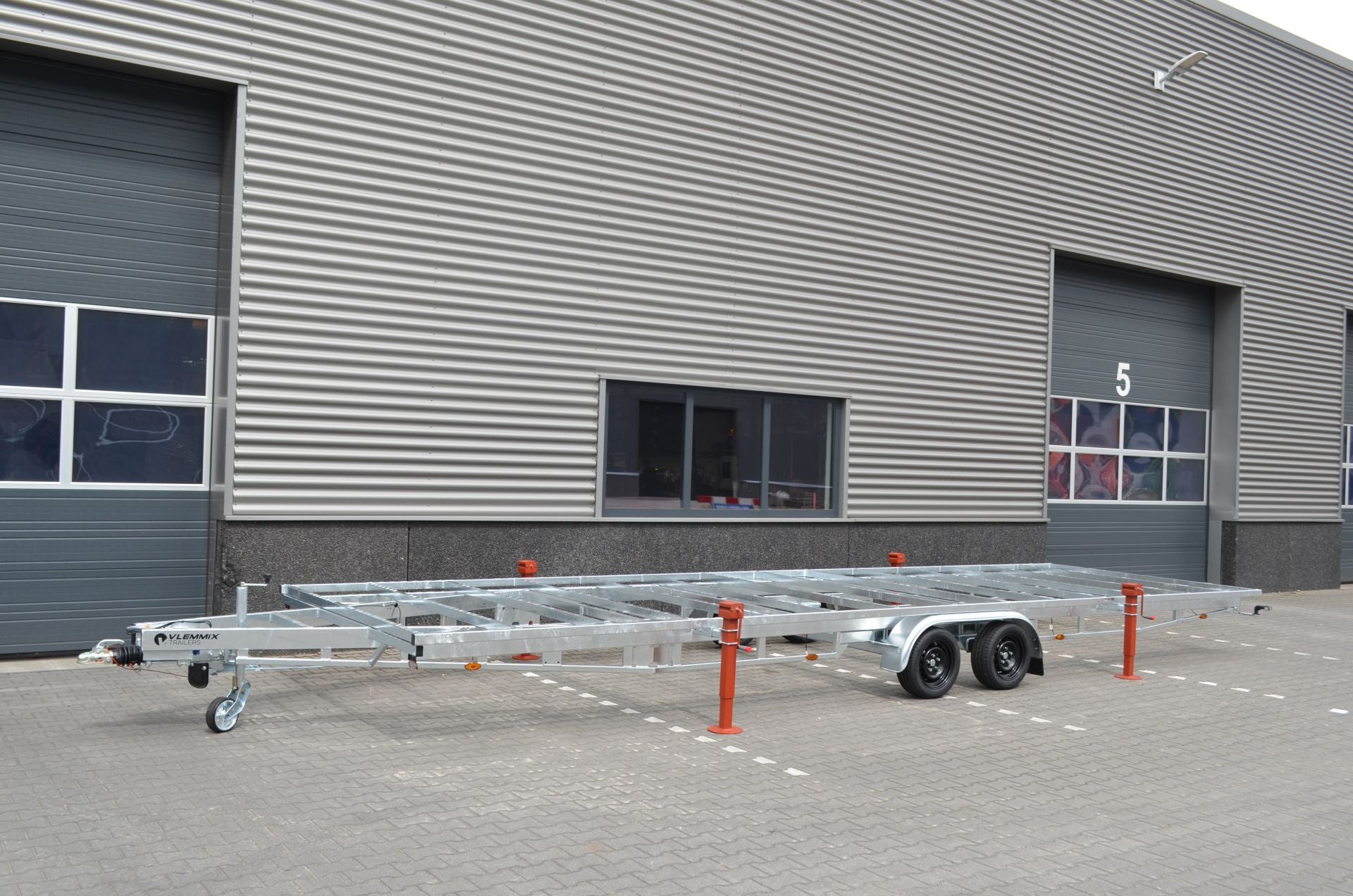
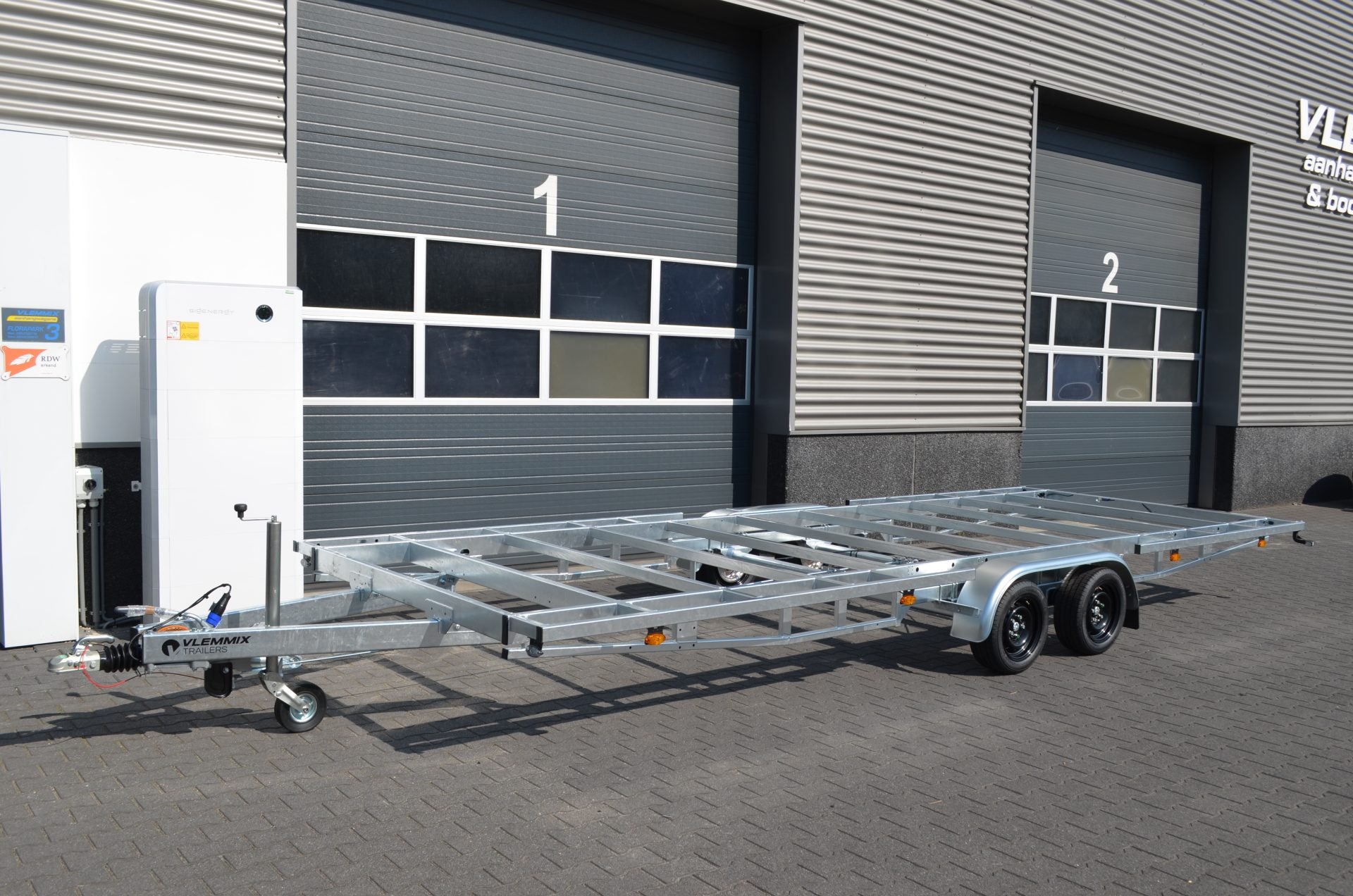
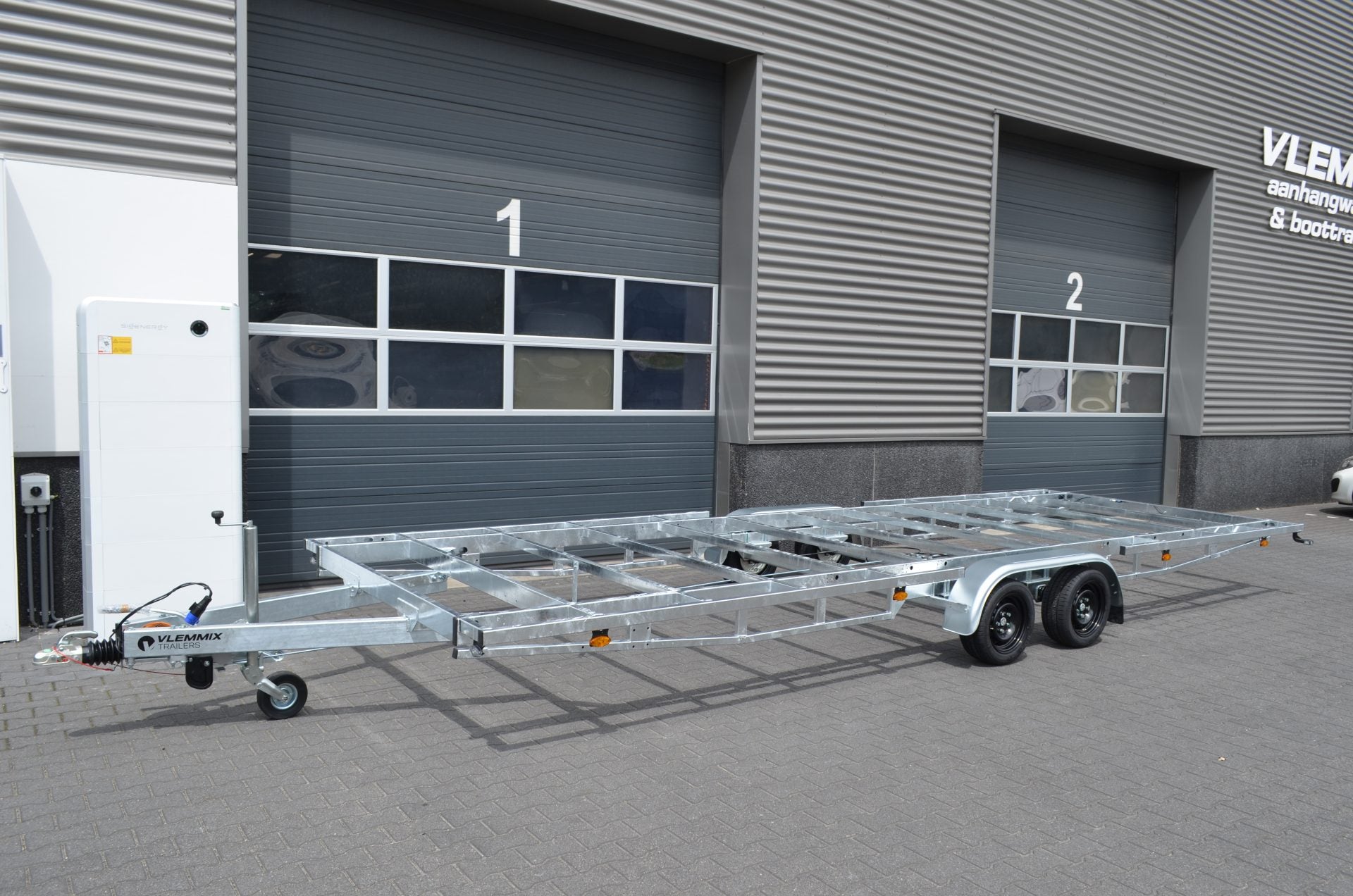
Transporting mobile homes is one of the most problematic cases. In many instances, a trailer for tiny house It already operates at the legal limit, so any outstanding performance usually makes the whole thing illegal.
Oversized cargo vs. special transport
When the length or width limits are exceeded, the term "permitted overhang" is no longer used and the scope of the special transport , which requires express authorization from the Directorate General of Traffic.
These authorizations are not granted for recreational or private use, so in practice, If you don't comply with the limits, you can't drive .
Penalties for carrying incorrect overhanging load
The most common penalties include:
-
Fines of €200
-
Immobilization of the assembly
-
Obligation to correct the load on site
-
Aggravated liability in case of accident
They do not involve the loss of points, but they do involve delays, costs, and legal problems.
How to check if your load is legal before driving
Before setting off on the road, it's advisable to check:
-
That the load only protrudes from the back
-
That does not exceed the permitted 10% or 15%.
-
That does not increase the total width of the set
-
That it is properly signposted
-
That does not obscure lights or license plate
Choosing the right trailer from the start is key. For general cargo, the cargo trailers They offer greater operating margin without the need for outstanding performance.
Most common mistakes that result in fines
-
To think that it “doesn’t stand out much”
-
Do not measure the actual length
-
Confusing an indivisible load with a large load
-
Signposting in an improvised manner
-
Assume that the agent will not check dimensions
In controls, It is measured and penalized .
Practical recommendations based on real experience
If you regularly transport long loads, consider a longer trailer rather than pushing the limits.
Avoid driving in the city with an overhanging load: the risk increases significantly.
If you change your tractor unit, make sure it has sufficient capacity. You can check one here. list of cars with the capacity to tow trailers to avoid overall errors.
Frequently Asked Questions about Overhanging Loads on Trailers (FAQ)
Can the load be visible at night? Yes, but with mandatory signage and additional lighting.
Can it protrude laterally if it's small? No, never.
Does the ship's hull count as overhanging cargo? Yes, for safety and overall width purposes.
Can they impound my trailer? Yes, if there is a risk or if it exceeds the dimensions.
The load may protrude from a trailer, but only within very specific and strict limits . Measuring, marking correctly, and choosing the right trailer is the only way to avoid fines and problems on the road. Regarding oversized loads, Every centimeter counts , and relying on intuition often comes at a high price.