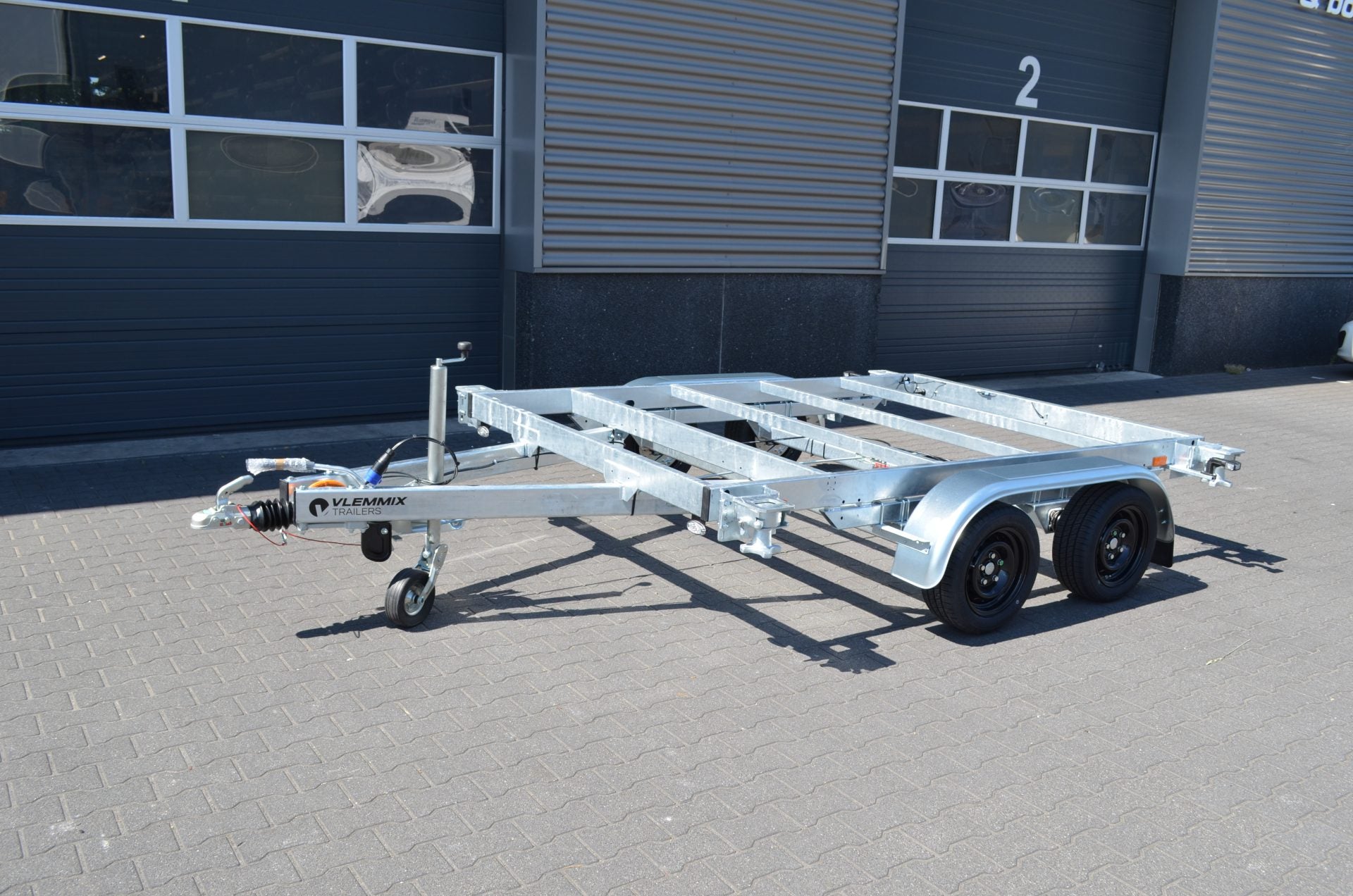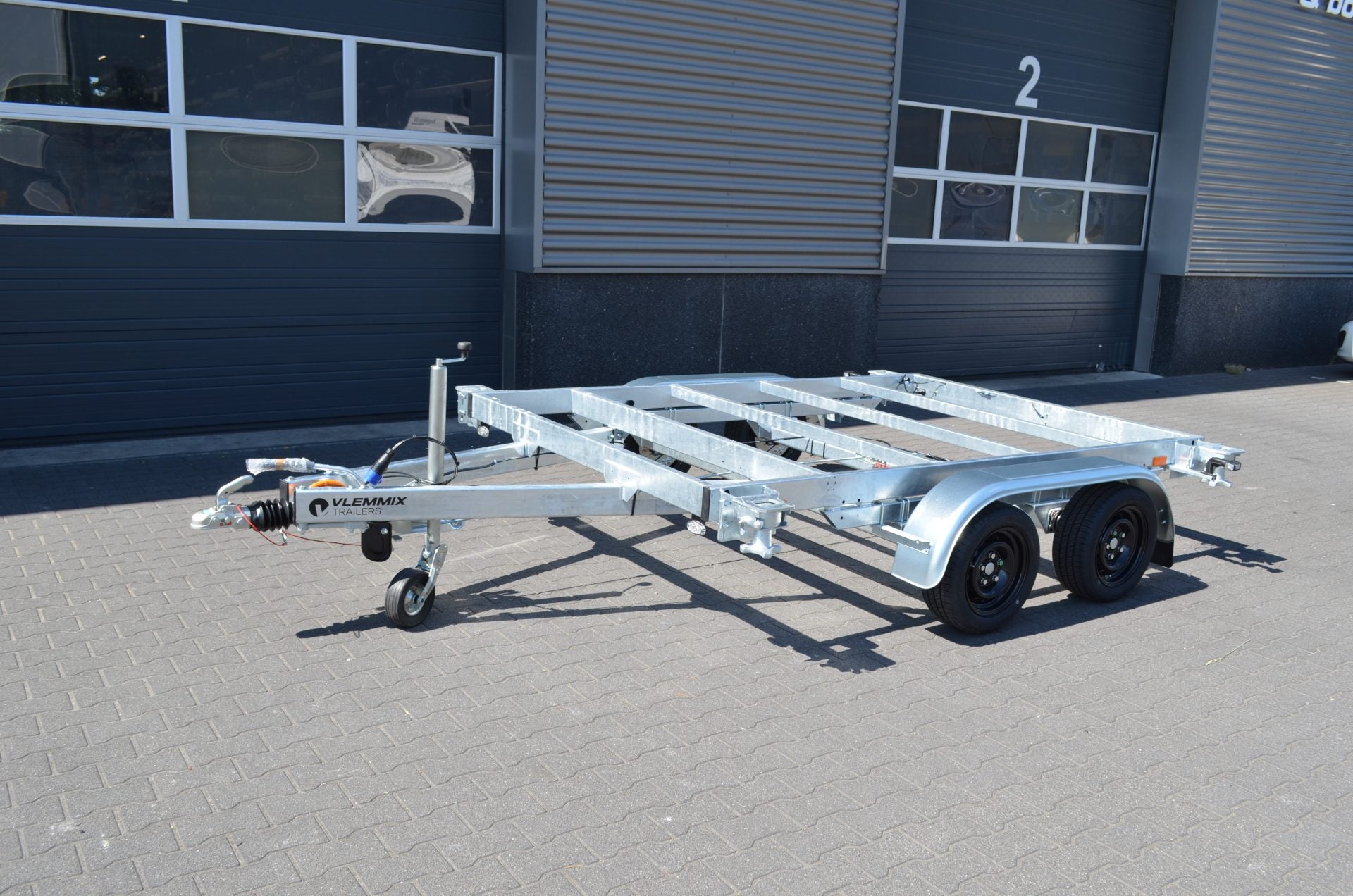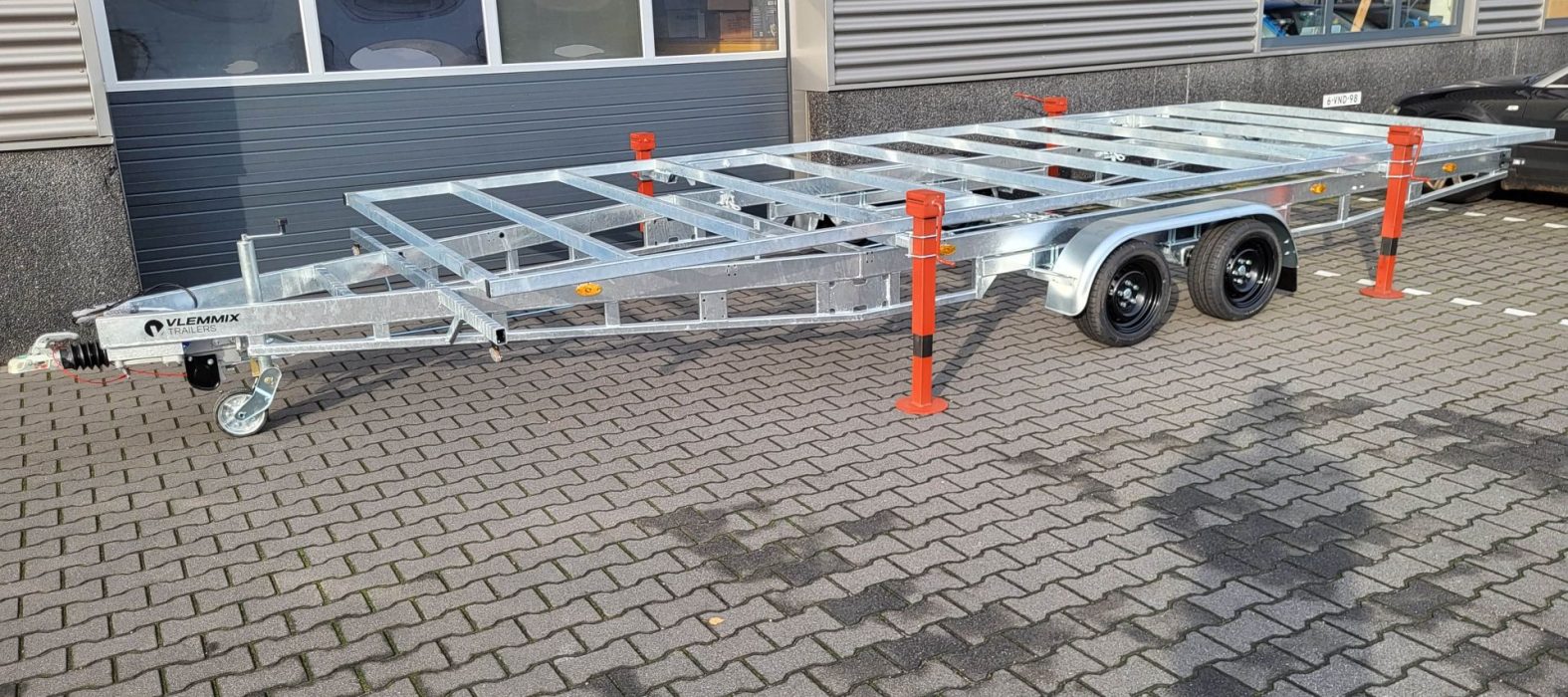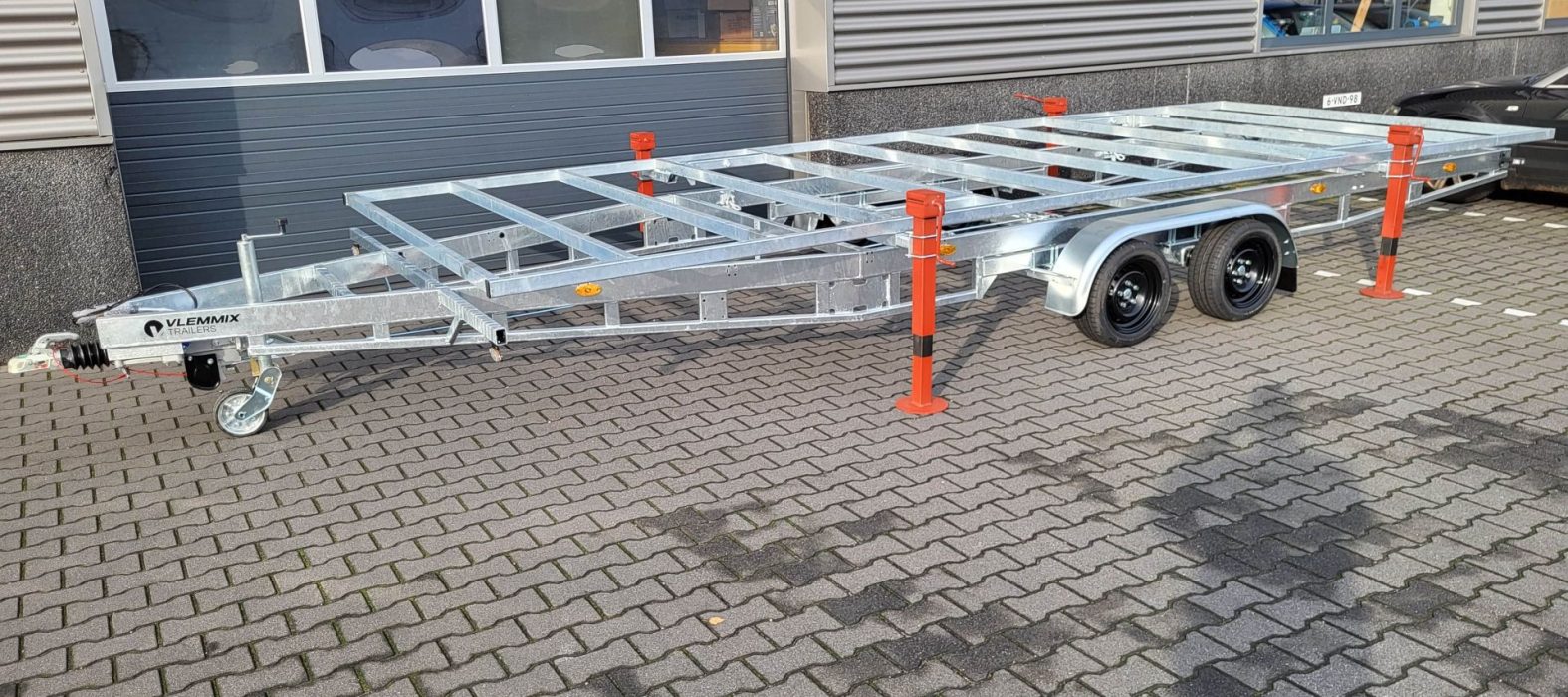

Incorrectly loading a trailer has three predictable consequences: swaying and snaking on the highway, damage to the tow vehicle's suspension and steering, and a fine of between €200 and €500 if the DGT (Spanish Traffic Authority) stops you with an improperly secured load or an overloaded combination. All three can be avoided by following four technical rules: 60% of the weight forward of the trailer axle, 10-15% of the total weight supported by the hitch ball, a low center of gravity over the axle, and securing the load with certified straps to the frame's anchor points. This guide will walk you through it step-by-step, with figures and references to current DGT regulations in Spain.
Before loading: three facts you need to know
Proper loading begins before you place anything on the platform. If you don't know these three facts, you cannot calculate how much and where to place the load.
Trailer's MMA (Maximum Authorized Mass) and your car's maximum towable mass
On the tow vehicle's technical data sheet, look at two fields:
-
Field F.2: Car's Maximum Authorized Mass.
-
Field O.1: Maximum towable mass WITH BRAKES. This is the legal limit of the trailer's MMA that your car can tow with a braked trailer.
-
Field O.2: Maximum towable mass WITHOUT BRAKES (usually 750 kg).
The trailer's payload is: Trailer's MMA − Tare (empty weight). If your trailer has an MMA of 3,500 kg and an empty weight of 680 kg, your payload is 2,820 kg. This is the figure you CANNOT exceed.
The combined weight (car weight + trailer MMA) determines the legal license required: ≤3,500 kg combined → B license, ≤4,250 kg → B96 license, up to 7,000 kg → B+E license. More details in the blog about which license you need to drive a trailer.
Maximum vertical load supported by your hitch ball
On the car's technical data sheet, field S indicates the maximum vertical load that the hitch ball can support. This is usually between 50 and 100 kg for passenger cars and 100-200 kg for SUVs and vans. It is a legal limit: if you exceed it, your hitch could break or transmit excessive stress to the rear suspension.
The actual vertical load of the loaded trailer must be between 10% and 15% of the total weight of the loaded trailer, never exceeding the S value of the hitch ball. If your loaded trailer weighs 2,500 kg, the correct vertical load is 250-375 kg, but if your car only allows 100 kg on the hitch ball, you are limited to 100 kg and must redistribute the load to the rear of the trailer to reduce it.
Whether the load is divisible or indivisible
The distinction is legal and dictates how you can place the load:
-
Divisible load: packages, pallets, sacks, tools. Must be within the plan projection of the trailer (not protruding from the sides or front).
-
Indivisible load: vehicle, machinery, large tank, a single piece that cannot be divided. For vehicles less than 5 m in length, it can protrude up to one-third of the vehicle's length from the rear. For vehicles over 5 m, up to 2 m from the front and 3 m from the rear, always marked.
Further details with specific figures can be found in our blog about how much a trailer load can protrude.
The 60/40 rule: 60% of the weight forward of the axle

This is the most important technical rule in the entire guide. 60% of the load's weight must be between the trailer's drawbar and the axle (or the first axle in a double/triple axle). The remaining 40% should be between the axle and the rear of the trailer.
Why this distribution and what happens if you reverse it
With the load concentrated forward of the axle, the weight is transferred to the hitch ball and then to the tow vehicle, whose suspension, brakes, and steering are designed to handle it. The trailer remains stable because its center of gravity is anchored to the car.
With the load concentrated behind the axle, the drawbar lifts (the lever effect pulls the hitch ball upwards), the car's front suspension loses grip, and above 80-90 km/h, the snaking effect appears: the trailer begins to oscillate laterally, and each sway is greater than the last. In 5-10 seconds, the combination jackknifes or overturns.
The snaking effect should NOT be corrected by accelerating or sudden braking. The correct maneuver is to release the accelerator, keep the steering wheel straight, and let the trailer stabilize itself. If you have an independent brake on the trailer control (manual), apply it briefly to brake the trailer without braking the car.
How to apply the 60/40 rule to single, double, or triple axle trailers
|
Configuration |
Axle Reference |
Distribution |
|
Single axle |
Single axle |
60% forward of the axle · 40% behind |
|
Double axle (tandem) |
Midpoint between the two axles |
60% forward of the midpoint · 40% behind |
|
Triple axle |
Central axle (the middle one) |
60% forward of the central axle · 40% behind |
On double and triple axle trailers, the tolerance margin is greater (additional axles stabilize the combination), but the rule still serves as a starting point.
Numerical example: 2,700 kg mini-excavator on a plant trailer
Imagine a plant trailer with a 4.8 x 1.8 m platform, 3,500 kg MMA, and 680 kg tare weight. Legal payload 2,820 kg. You are going to transport a 2,700 kg Kubota KX027 mini-excavator (cab + standard bucket + 100% fuel).
Weight distribution: 60% (1,620 kg) must be forward of the central axle (in a triple axle) or the midpoint of the two axles (in a double axle). Since a mini-excavator already has its own weight distribution (engine in front, boom and bucket in back), the machine's position on the platform is determined by its geometry: with the boom pointing to the rear of the trailer, the engine is forward of the axle, and the natural weight approximately follows the 60/40 rule.
Estimated vertical load result: 250-400 kg on the hitch ball, within the 10-15% range of the total loaded trailer weight (3,380 kg). If your car has S=100 kg, you need to move the machine slightly backward to reduce vertical load without compromising distribution.
Vertical load on the hitch ball: 10-15% of the total weight
Vertical load is the downward force exerted by the loaded trailer on the hitch ball. It is determined by where you place the weight on the platform. It is the easiest metric to measure and the easiest to get wrong.
How to measure actual vertical load
Three methods in order of precision:
- Portable hitch ball scale (between €25 and €60): placed between the trailer's drawbar and the hitch ball, it shows the direct weight. This is the only reliable measurement.
- Industrial bathroom scale: with the trailer unhitched and the jockey wheel down, rest the drawbar on a bathroom scale with sufficient capacity. This is approximate.
- Practical drawbar height rule: with the trailer hitched and loaded, the rear of the car should drop 5-15 mm compared to its height without a trailer. If it drops more, there is too much vertical load. If it doesn't drop at all or rises, there is too little weight forward of the axle.
What happens if you have too much or too little
Too much (>15% of trailer mass, or exceeding S of the hitch):
-
Car's rear suspension compressed. Dips the front.
-
Headlights point to the sky (night driving risk) and light steering (aquaplaning risk).
-
Longer braking distance because front wheels lose grip.
-
Possible hitch breakage by exceeding the declared S value.
Too little (<10% of trailer mass):
-
Snaking effect at high speed. The most dangerous.
-
Feeling that the trailer is pushing the car during braking ("jackknife").
-
Increased wear on trailer tires due to uneven weight distribution over the axles.
The exception: how the hitch ball's S field influences it
If your car declares S=100 kg on the technical data sheet and the 10-15% rule gives you 300 kg for a 2,000 kg loaded trailer, the legal limit is still 100 kg. You cannot exceed S, no matter how much physics is on your side. The practical consequence: with cars that have low S values, more weight must be distributed towards the center of the trailer, and you must accept working closer to 10% than 15%.
How to distribute laterally and in height
Lateral: left-right balance
The load must be centered on the trailer's longitudinal axis. If you concentrate weight on one side (typical in a move with heavy furniture only on the left), the trailer tilts laterally, the tires on one side are overloaded, and there is a tendency to drift out of the lane on curves.
Simple rule: for each heavy item you place on one side of the longitudinal axis, place another of similar weight on the other side. For unique items (vehicle, machine), visually center them with reference to the lateral tie-down rings.
Height: heavy items low, light items high
Low center of gravity = stable trailer. High center of gravity = trailer that overturns at lower lateral speeds on curves. Load the heaviest objects directly onto the platform and place lighter items (boxes, clothes, packaging) on top.
Example of a correct move: appliances at the bottom, heavy book and tool boxes in a second layer, clothes boxes and fragile items on top. Secure the whole with a palletized net or several crossed straps.
Centering the load over the axle (center of gravity)
The ideal point is: the load's center of gravity slightly forward of the axle (or the central axle in double/triple configurations) and as close as possible to the platform floor. The closer to the axle line, the more stable the trailer on curves. The lower, the less risk of lateral overturning.
Legal securing according to the DGT
Which straps, chains, or nets are valid
Regulations (General Traffic Regulations and UNE technical standards) require that any securing element must have:
-
Documented certified resistance (label with maximum weight). Minimum recommended 2,500 kg per strap for heavy loads.
-
No obvious wear (cuts, fraying, rust on chains).
-
Ratchet or tensioning mechanism that maintains pressure throughout the journey.
Ropes, elastic straps, and bungee cords are NOT suitable as the sole securing method. Only as a supplement to certified straps. DGT inspection verifies this visually.
Anchors on the frame: every 50 cm as a reference
Trailer tie-down rings must be:
-
Distributed along the frame (reference: every 50 cm in professional trailers).
-
Certified with a minimum resistance of 2,500 kg per ring.
-
Anchored to structural parts of the frame, not to the floor sheet metal.
Tying the load to the top edge of the platform, to the ramp, or to the movable side panel is NOT effective: these are weak points, and the strap will give way during sudden braking.
Protruding load: regulatory flag and fine
If your load protrudes from the rear of the trailer beyond the platform, you must signal it with a V-20 panel: a reflective red and white panel with diagonal stripes, placed at the rearmost end of the load, at a height between 0.5 and 1.5 m from the ground. At night, it must have additional red light.
The fine for not signaling a protruding load is €200, which can increase to €500 if the violation is considered serious due to risk to other vehicles.
Frequent errors that cause accidents or fines
- Exceeding the trailer's MMA or the car's maximum towable mass (O.1). Fine for overloading: €200-€500. Risk: axle breakage, sunken suspension, catastrophic braking.
- Loading all the weight at the back (not applying 60/40). Snaking effect guaranteed above 80 km/h. No specific fine, but probable accident.
- Non-certified straps or straps tied to weak parts of the frame. Fine for improper securing: €200. Load may fall during braking.
- Not checking the vertical load before setting off. Risk: headlights pointing skyward (fine for improperly adjusted lights: €80-€200), long braking distance, steering without grip.
- Not using V-20 when the load protrudes. Fine: €200.
- Exceeding the S value of the hitch ball. Risk: hitch breakage during use (no specific fine but civil liability of the driver in case of an accident).
- Tying the load to the top profile of the platform or to the ramp. Gives way during braking. No fine unless subsequent accident occurs.
- Loading everything on one side of the platform. Risk: lane departure, irregular wear of trailer tires.
Pre-trip checklist
Print this list or save it on your phone. It takes 5 minutes to check and prevents 90% of problems.
- Trailer's MMA NOT exceeded (total weight with load < MMA).
- 60% of the weight between the drawbar and the axle (or the midpoint in a double axle).
- Vertical load between 10-15% of the total trailer weight, without exceeding your hitch's S value.
- Weight balanced laterally (left = right).
- Heavy items low, light items high. Center of gravity over the axle.
- Minimum of 4 certified straps (2,500 kg each) crossed, anchored to the frame's rings.
- Divisible load within the platform (not protruding laterally).
- If it protrudes from the rear, V-20 panel placed and visible.
- Trailer lights working (turn signals, braking, position).
- Breakaway cable of the inertia brake attached to the hitch ball.
- Jockey wheel raised and locked.
- Car headlights correctly aimed (quick test: park in front of a wall at 10 m, it should illuminate the wall line, not point to the sky).
How to load specific loads (anchors + internal linking)
Each type of load has its own fastening and distribution technique. For product details, go to the corresponding category.
Mini excavator or compact machinery
Position the machine with the arm pointing backward. The engine (heaviest part) is in front of the axle, naturally complying with the 60/40 rule. Lower the shovel until it rests on the platform. Secure with 4 crossed straps to the main chassis (not to the arm, not to the shovel). Block the tracks or wheels with front and rear chocks. Specific catalog: trailers for mini excavators and machinery carriers.
Quad, ATV or UTV
Drive the vehicle up the ramps at a slow speed. Position with the engine forward. Engage the handbrake. Secure with 4 straps at the chassis tie-down points (NOT to the handlebars, NOT to the suspension). Catalog: trailers for quads, ATVs, and UTVs.
Scissor lift platform
Load the platform with the entire base resting on the flatbed. Engage the lift's brake. Secure with straps at the 4 lifting points on the chassis (not in the basket). Catalog: trailers for lift platforms.
Palletized pallets
Load pallets with a manual pallet jack up the ramp (suitable for loads up to 200-300 kg). Position the heaviest ones over the axle and the lighter ones forward (balancing the 60/40 rule with natural distribution). Secure each pallet with 2 crossed straps or use a global pallet net. Catalog: pallet trailers.
10 or 20 foot container
The container is anchored at the 4 ISO twist locks in the lower corners of the platform. No additional straps (the twist locks secure the container to the chassis with a quarter turn). Catalog: container trailers.
Frequently Asked Questions
Q1. How should the load be placed on a trailer?
60% of the weight in front of the axle and 40% behind. The vertical load on the hitch ball should be between 10% and 15% of the total loaded trailer weight, without exceeding the S value declared in the towing vehicle's technical sheet. Heavy objects should be placed low and centered over the axle, lighter ones higher up. Secure with certified straps to the frame's anchor points.
Q2. How to properly load a moving trailer?
Appliances and heavy furniture directly on the flatbed and in front of the axle (60% in front). Boxes of books and heavy tools in the second layer. Boxes of clothes and fragile items on top, perfectly secured. Balance laterally: for every heavy piece you place on one side, put a similar one on the other. Secure with 4 crossed straps to the frame's anchor points. If you are carrying wrapped pallets, supplement with pallet netting.
Q3. How much weight should be on the hitch ball?
Between 10% and 15% of the total loaded trailer weight. For a 2,000 kg loaded trailer, the correct vertical load is 200-300 kg. However, you can never exceed the S value declared in your car's technical sheet (it is usually between 50 and 150 kg in passenger cars, 100-200 kg in SUVs and vans). If your S value is more restrictive, that is the limit.
Q4. What happens if I load all the weight in the back?
The "snaking effect" appears from 80-90 km/h: the trailer oscillates laterally with progressively increasing sway. In 5-10 seconds, the rig can jackknife or overturn. The trailer's drawbar lifts due to leverage, and the car's steering loses grip. This is the most frequent cause of highway accidents involving trailers.
Q5. How is vertical load measured without a special scale?
Three methods. (1) Portable hitch ball scale, 25-60 € at a trailer store. This is the reliable measurement. (2) Industrial bathroom scale with the trailer's drawbar resting on it. Approximate. (3) Practical rule: with the trailer loaded and hitched, the rear of the car should drop 5-15 mm compared to its height without the trailer. If it drops more, there is too much vertical load. If it doesn't drop at all, there isn't enough weight in front of the axle.
Q6. What straps are legally valid for securing cargo?
Ratchet straps with certified strength (label with maximum weight, minimum 2,500 kg recommended for heavy loads). No obvious wear, with functional ratchet. Ropes, elastic straps, and bungee cords are NOT suitable as the sole means of securing, only as a supplement. The DGT visually verifies the presence of certified straps during inspection.
Q7. What is the fine for improperly secured or overloaded cargo?
Improperly secured or fallen cargo: 200 €. Overloading the trailer beyond its MMA: 200-500 € depending on the percentage of excess (more than 20% is a serious infringement). Protruding cargo without a V-20 panel: 200 €. Car lights poorly aimed due to excessive vertical load: 80-200 €. Accumulating several infringements in the same inspection can amount to 800-1,000 €.
Q8. How do I signal a load that protrudes from the rear?
With a reflective red and white V-20 panel with diagonal stripes, measuring 50 x 50 cm, placed at the rear end of the load at a height between 0.5 and 1.5 m from the ground. At night, it must be supplemented with an additional red light. Without a visible V-20 panel: a 200 € fine.
Q9. What license do I need to tow a loaded trailer?
It depends on the combined MMA of the car + trailer. Up to 3,500 kg combined, a B license is sufficient. Between 3,500 and 4,250 kg, B96 is valid. Above 4,250 kg and up to 7,000 kg requires B+E. For professional cargo trailers (machinery carriers, container carriers) with an MMA of 3,500 kg, B+E is common.
Q10. What should I do if the snaking effect starts to occur?
Release the accelerator immediately and keep the steering wheel straight. DO NOT accelerate to try and straighten the rig. DO NOT brake abruptly with the car's brake. If your trailer has independent manual brake control, apply it briefly to brake only the trailer without braking the car. Once stabilized, stop in a safe place and recheck the load distribution. Recurrent snaking indicates that the load is improperly distributed.
Properly loading a trailer means repeating four rules on every trip: 60/40, 10-15% vertical load, low center of gravity over the axle, secure with certified straps. Five minutes of checking before leaving prevents fines, accidents, and damage to the towing vehicle.
If you are going to buy a trailer and want one that can withstand intensive professional use with a light chassis (to gain useful load under the same MMA) and integrated ramps, check out the full catalog in Cargo Trailers. For questions about which configuration suits your car and your usual load, write to Arnaud with your car's technical sheet and the weight of what you are going to transport.