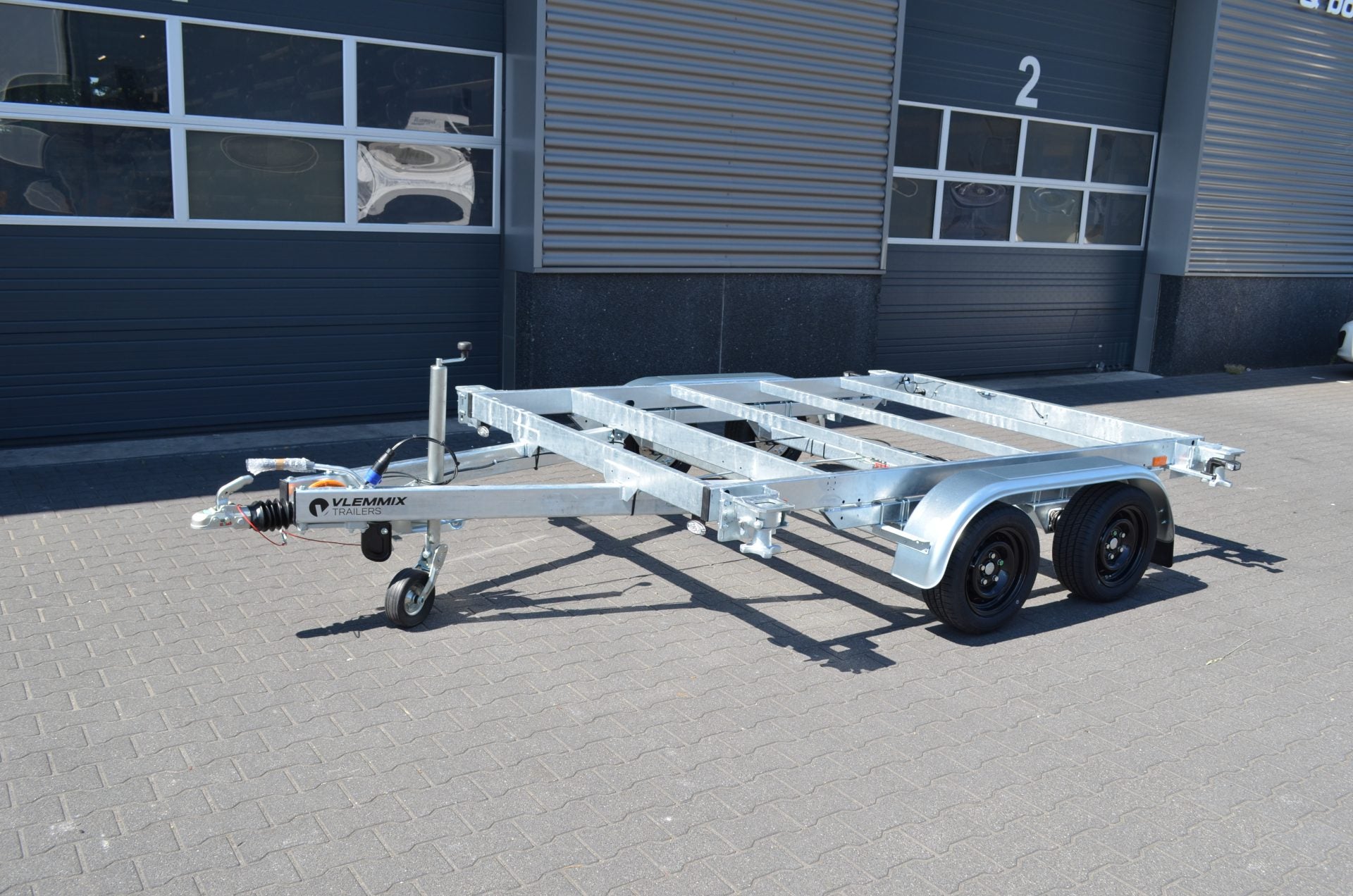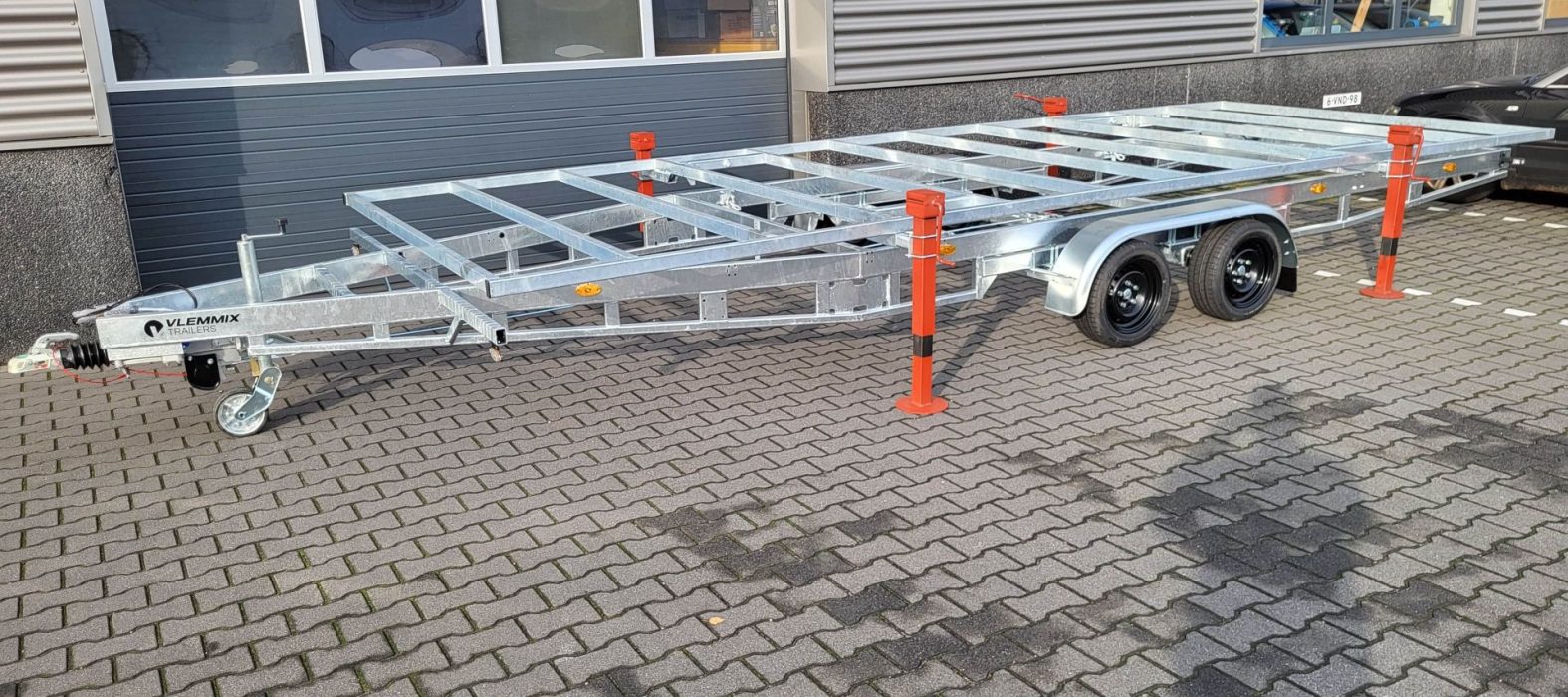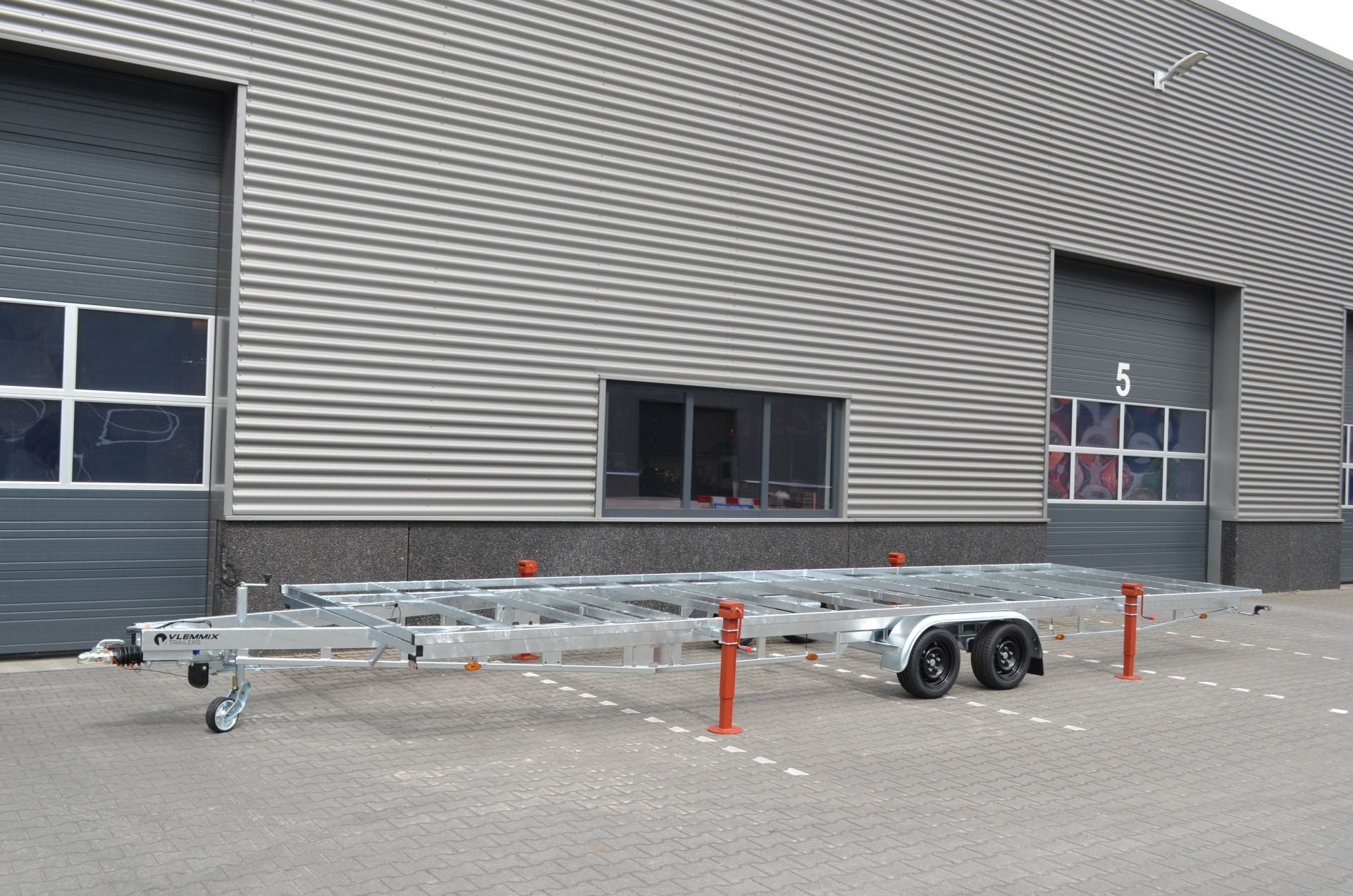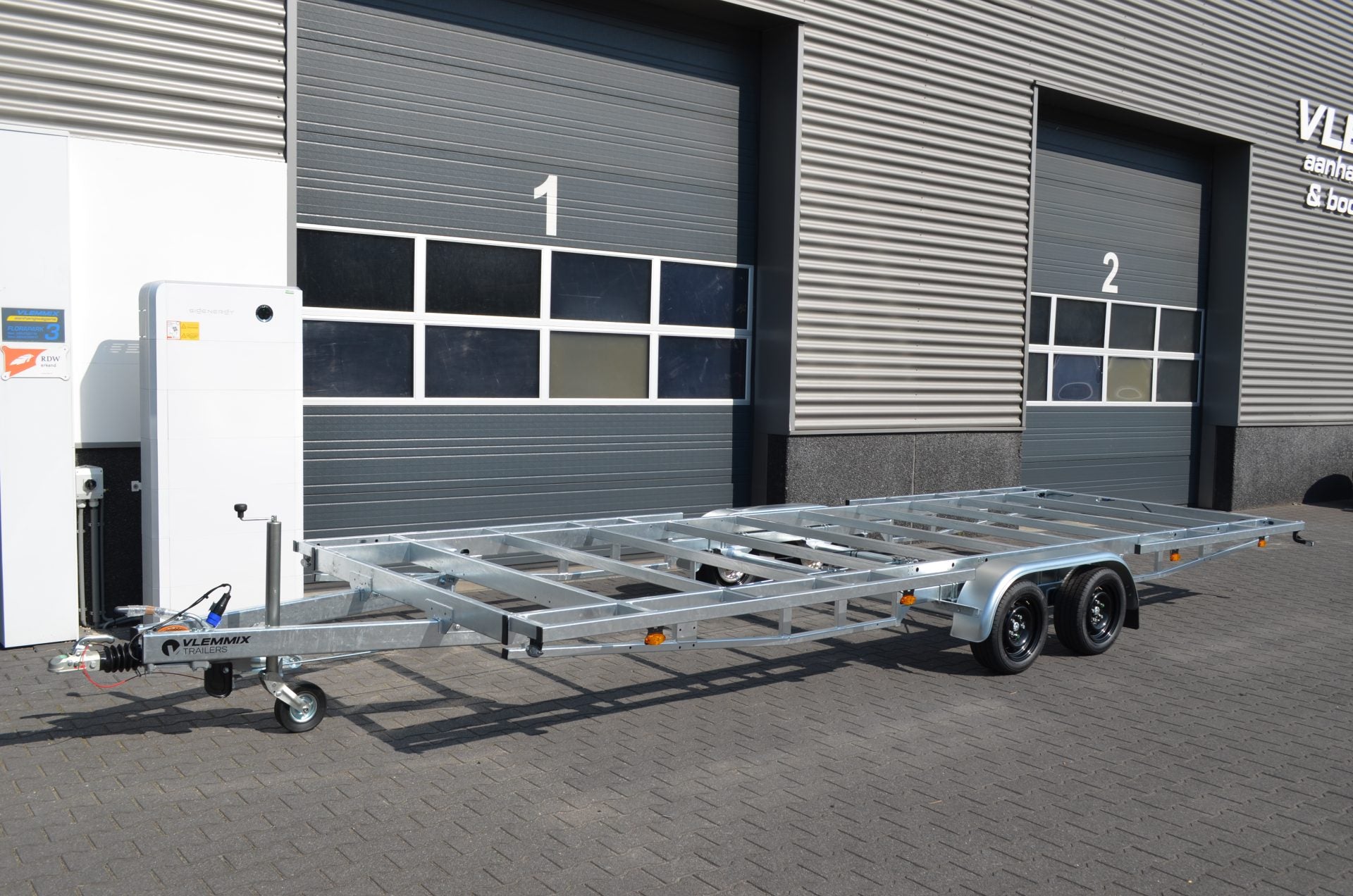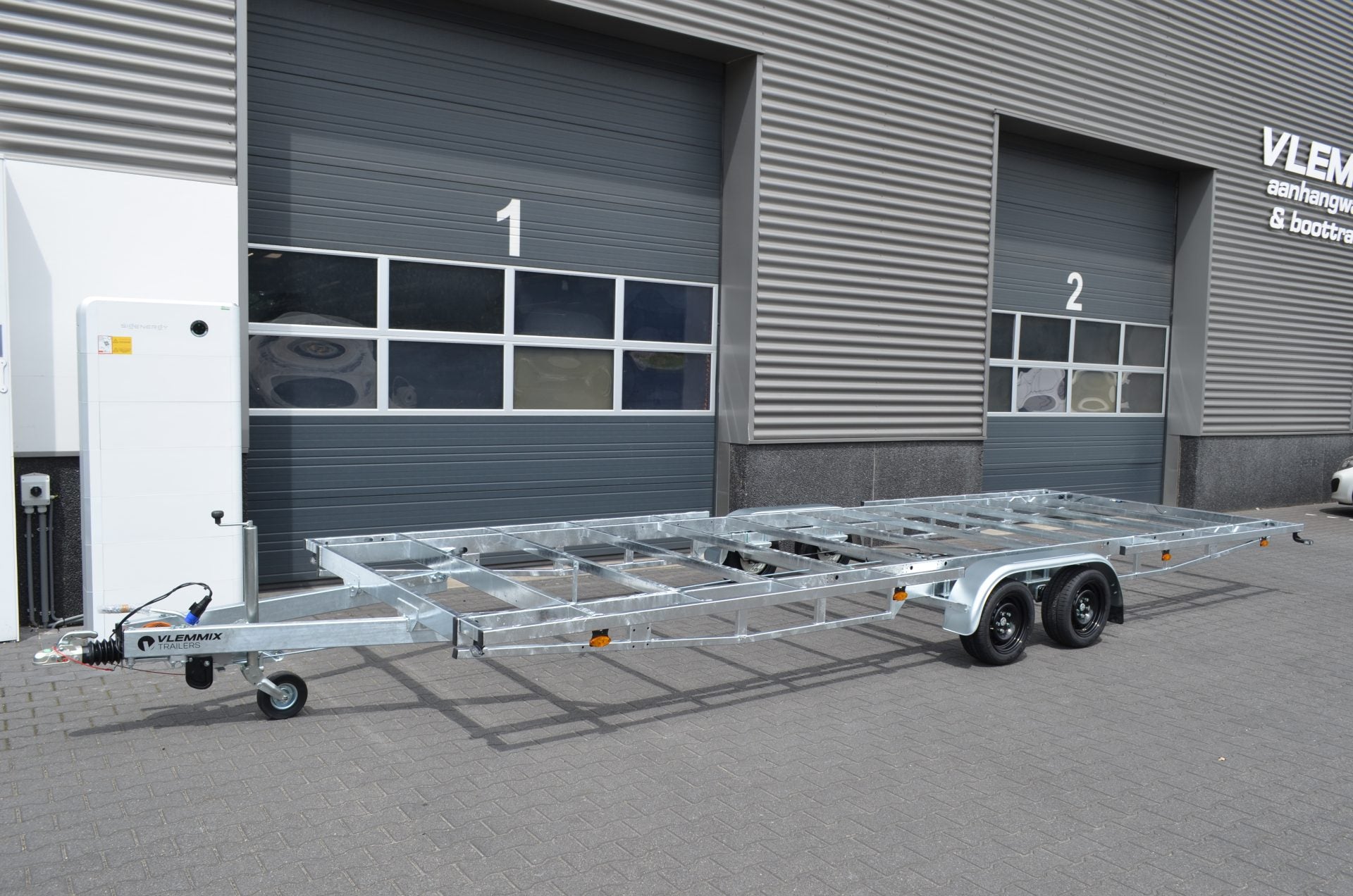
An Optimist hull weighs 35 kg; an ILCA around 59; a Hobie Cat 16 about 145. None of them needs a crane or a road trailer for day-to-day use: they need a launching trolley made to fit, the piece of kit that puts in the most hours at the club and the one most often chosen badly. This guide runs through the right trolley by class, what to look for in materials and supports, and when the set-up also calls for a type-approved trailer to travel to regattas.
TL;DR
- A launching trolley moves the boat from the dinghy park to the slipway inside the club: no type approval, no lights, not allowed on the road.
- Every class calls for its own geometry: Optimist (flat hull, bed support), ILCA/Laser (support on the cockpit or the gunwales), Hobie Cat and catamarans (supports under each hull).
- Materials that survive the slipway: aluminium or hot-dip galvanised steel, solid wheels or wide pneumatic tyres for sand.
- Trolley weight: 15-40 kg depending on class; one sailor must be able to pull it alone (or a child with the Optimist).
- For travelling to regattas by road, the trolley is no use: the boat goes on a type-approved trailer, single or a club multi-hull rig.
What a launching trolley does (and what it does not)
A dinghy launching trolley is a light frame with two wheels and supports shaped to the hull, designed for a 50-300 metre trip: from the dinghy park to the slipway and back, dozens of times a season. It goes into the water at every launch, puts up with sand and salt, and one person pulls it unaided.
What it does not do: travel on public roads. With no type approval, lights or brakes, a trolley cannot go on the road, not even to cross to the car park opposite. Getting to a regatta is another piece of kit's job, the type-approved trailer, and that two-part split is the standard set-up for any sailor or club.
The right trolley by class
| Class | Hull weight | Type of support | Critical detail |
|---|---|---|---|
| Optimist | 35 kg | Bed or flat pads | The child must manage it alone |
| ILCA / Laser | 59 kg | Cockpit cradle or gunwale supports | Do not support the flat hull in the centre |
| 420 / 470 / Snipe | 80-120 kg | Pads under the hull | Track width for stability |
| Hobie Cat / catamaran | 130-180 kg | Rollers or chocks under each hull | Track width exactly matched to the beam |
| Windsurf / wing / kayak | 10-30 kg | Multiple vertical supports | Carrying several at once |
Two principles run through the whole table. Supports bear where the hull is strong: a racing dinghy is minimal construction and a badly placed support dents a racing hull in one season. And the trolley's track (the distance between the wheels) gives stability: catamarans need trolleys built to their hulls' beam, not adaptations.
In junior classes the master criterion is a different one: independence. The right Optimist trolley is the one an 8-year-old sailor handles unaided, with the weight balanced over the axle and the handle at their height. Coaches know it: half the logistics of a sailing school is children being able to launch on their own.
Materials: the slipway destroys anything cheap
A launching trolley works in the worst possible environment for metal: immersion in salt water several times a week, sand acting as sandpaper and sun for the rest of the day. Painted steel lasts a season or two before rusting at the welds. The two serious options are anodised aluminium or hot-dip galvanised steel, both good for decades.
The wheels decide usability. Solid polyurethane: no punctures, perfect on a concrete slipway. Wide low-pressure pneumatic tyres: essential on beach sand, where a narrow wheel buries itself with 60 kg on top. The hubs, in engineering plastic or greasable stainless: a plain steel hub seizes within one season of dunkings.
The same galvanising argument we make for trailers applies here several times over, because a trolley goes into the water more often than any trailer: looking after metal in a salt environment is covered in how to extend the life of your trailer in salt water.
From the club to the regatta: when the trolley is not enough
A racing sailor's season includes 4-10 trips to other venues, and there the set-up changes scale: the boat travels by road on a type-approved trailer with lights, a technical record and the car's registration. The usual configurations: a single trailer with the hull on a bed (and the launching trolley on top, inverted), or a club multi-hull trailer stacking 4-8 boats on two levels.
At dinghy lengths and weights, the trailer is light and unbraked (under 750 kg gross vehicle weight): it can be towed by any car with a tow hitch and a category B licence in Spain. The tying-down and weight distribution technique is the same as for any small boat, and the blog guides apply directly: choosing the outfit in the guide to choosing the perfect trailer for your boat and safe sailboat transport in how to tow a sailboat safely.
In the current range, the starting point for dinghies and river craft is the raft trailers category, with flat beds adaptable to light hulls, and for larger sailboats, the sailboat trailers with a keel support. If your club would value a multi-hull configuration or class-specific supports, Arnaud can look at bespoke configurations to order: ask with no obligation.
Club buying versus individual buying
An individual sailor buys once and looks for the exact trolley for their class. A club buys fleets, and there the criteria change: standardisation (same trolleys, same spare parts), robustness against handling by dozens of people and storage in the smallest possible space, with trolleys that stack or hang on the store's wall.
The club's sums also include the shared travel trailer: a well-configured multi-hull rig replaces 4-6 cars with individual trailers on every trip, and reduces regatta logistics to a single driver with a B+E licence. For mixed fleets (Optimist plus ILCA plus 420), an adjustable-bar configuration avoids buying one trailer per class.
The complete fleet decision (trolleys, travel trailer and winter storage) benefits from the same analysis as any boating purchase: real weights, correct supports and galvanising on everything that touches water. The general boat trailers range shares those criteria as standard: 3 mm steel, hot-dip galvanised and a 2-year warranty, bought direct. And for the club's jet skis, which share the slipway and the same logic as dinghies, the jet ski trailers complete the fleet to the same standard.
A tidy boat store: storing trolleys and boats
The boat store is the other half of club logistics. Well-chosen launching trolleys stack or hang vertically, and light boats spend the winter on three-level racks with the hulls supported at their strong points, never hanging from the gunwales. An Optimist can be stored vertically on its bow; an ILCA prefers to lie horizontally on pads in the cockpit.
Catamarans raise the width problem: hulls dismantled in the classes that allow it, or an outdoor area with a cover and the hulls on chocks. In every case, the winter rule is the same as for any boat ashore: weight spread over reinforcements, minimum pressure and a five-minute monthly check to catch distortion in time.
Maintenance: five minutes that double the life
The after-sailing routine fits in one sentence: a fresh-water hose over the whole trolley, paying attention to hubs and axles. The monthly routine adds greasing the hubs if they are greasable, checking the pads and tightening the fasteners, because the vibration of towing loosens everything that can loosen.
In winter, the trolley is stored hanging or under cover, without the boat on it if the supports are foam, which deform under months of static load. And keep pneumatic tyres at their proper pressure: a half-flat tyre left all winter comes out oval in spring. The rest of the pre-season preparation, boat included, is in the checklist for the first outing of the year.
Frequently asked questions
What is a dinghy launching trolley?
A light two-wheeled frame with supports shaped to the hull, used to move the boat between the dinghy park and the slipway inside the club. It goes into the water at every launch and one person pulls it. It is not type approved for road use: for travelling, you use a type-approved trailer.
What trolley does an Optimist need?
One with a flat bed or wide pads, weighing 15-20 kg, with the track and handle designed so the young sailor can manage it alone. Aluminium or hot-dip galvanised, and wheels that will not bury themselves on the club slipway: solid on concrete, wide on sand.
And an ILCA or Laser?
A trolley with a cockpit cradle or supports at the gunwales, never a flat support in the centre: the ILCA's bottom is thin and distorts. Total trolley weight around 15-25 kg. It is the class where the most hulls are damaged by the wrong trolley, precisely because of its minimal construction.
What trolley does a Hobie Cat or a light catamaran take?
A catamaran-specific one: two supports or sets of rollers under the hulls, with the track exactly matched to the class beam. Home-made adapters on monohull trolleys concentrate the weight where the hull has no reinforcement and end in cracks beside the beams.
Can I take the launching trolley on the road to the beach?
No. The trolley has no type approval, lights or brakes, and cannot go on public roads, not even for short trips. For any road journey the boat travels on a light type-approved trailer (under 750 kg gross vehicle weight), which any car can tow on a category B licence in Spain.
What trailer do I need for regattas?
Individually: a light trailer with a bed shaped to the hull, with the launching trolley travelling on top, inverted. As a club: a multi-hull trailer stacking 4-8 boats on two levels, driven on a B+E licence depending on the total weight. In both cases, hot-dip galvanised if it is going to use slipways.
What material should the trolley be?
Anodised aluminium or hot-dip galvanised steel: they are the only ones that survive years of constant immersion in salt water. Solid polyurethane wheels for a hard slipway or wide pneumatic tyres for sand, and hubs in engineering plastic or greasable stainless steel.
How much does a launching trolley cost?
Light-class ones (Optimist, ILCA) run around €150-€400 in serious materials; catamaran ones €300-€700 depending on beam and supports. A cheap painted steel trolley costs half and lasts a season or two: in club use, the galvanised one pays for itself in the second year.
Can a club standardise trolleys across several classes?
Partly: adjustable-bed trolleys cover several junior monohull classes with a few tweaks, and that simplifies spares. Optimists, ILCAs and catamarans are best kept on class-specific trolleys because of hull geometry. The real fleet saving comes from unifying the brand, wheels and hubs.
What should I check when buying a second-hand trolley?
Hubs (smooth rotation, no play), the state of the galvanising (rust at the welds rules it out), pads with no distortion and geometry that looks straight by eye. A used aluminium or galvanised trolley in good condition is a safe buy; a painted one with rust is a restoration project, not a saving.
How do you get the boat off the trolley on the slipway?
With the trolley submerged until the hull floats or nearly does: a dinghy goes in and out of the water floating, without being dragged over the supports. On gentle slipways, one person holds the bow while another pulls the trolley away; an experienced sailor does it alone by pivoting on the stern.
Does a launching trolley need insurance or paperwork?
No: as it does not use public roads, it has no registration plate, insurance or technical record. Inside the club, the site's rules apply. The paperwork appears with the type-approved travel trailer, which is a vehicle in every sense, with its plate and its obligations.
How many trolleys does a sailing school need?
One per active boat plus 10-15% in reserve for breakages and course peaks. A school's bottleneck is usually not the fleet but the number of working trolleys in July: a cheap reserve stops a seized hub leaving a boat ashore all week.
Does the same trolley work for the beach and the club slipway?
Only if it has wide low-pressure tyres, which work on both surfaces. Narrow solid wheels, perfect on concrete, bury themselves in sand under the weight of the hull. Clubs with both surfaces usually standardise on wide tyres for the whole fleet and forget the problem.