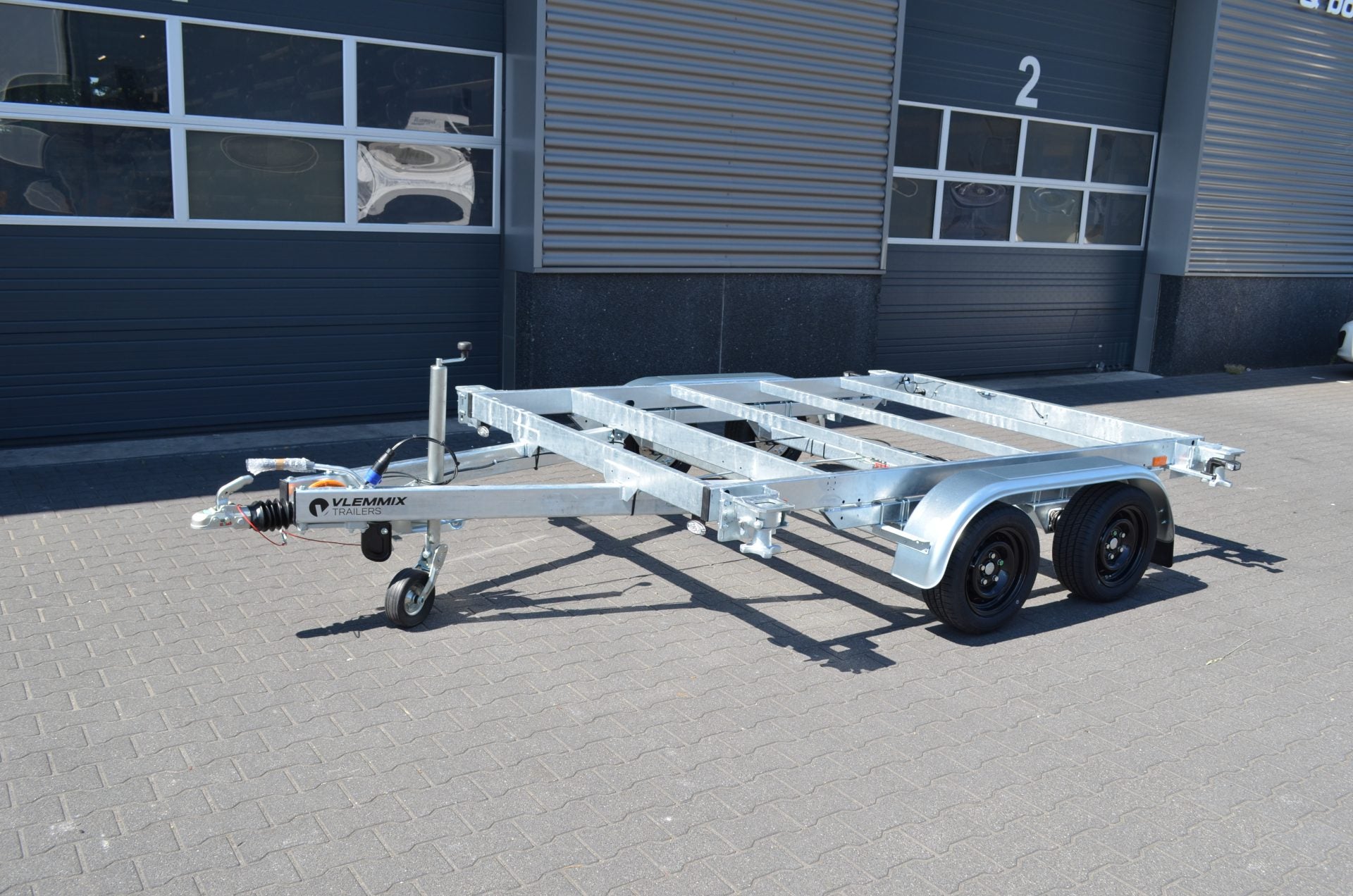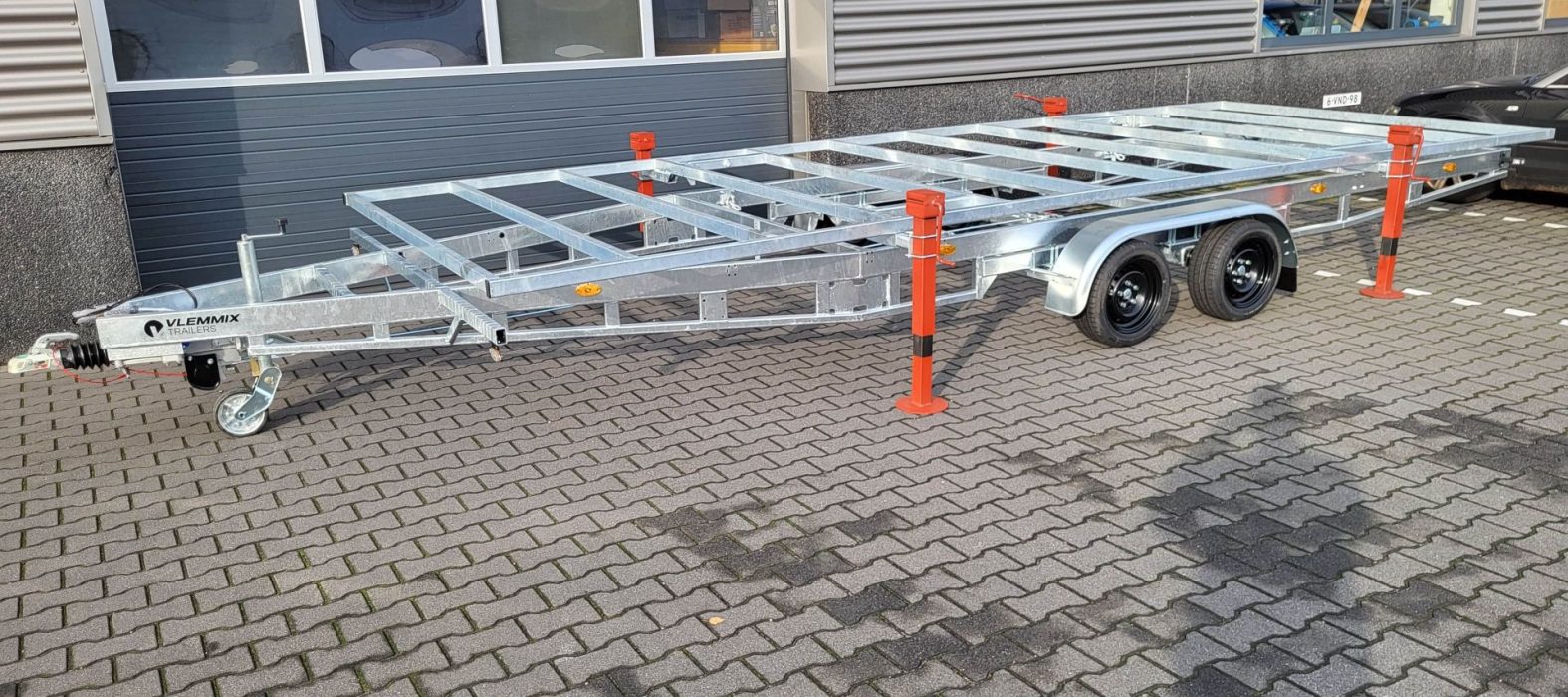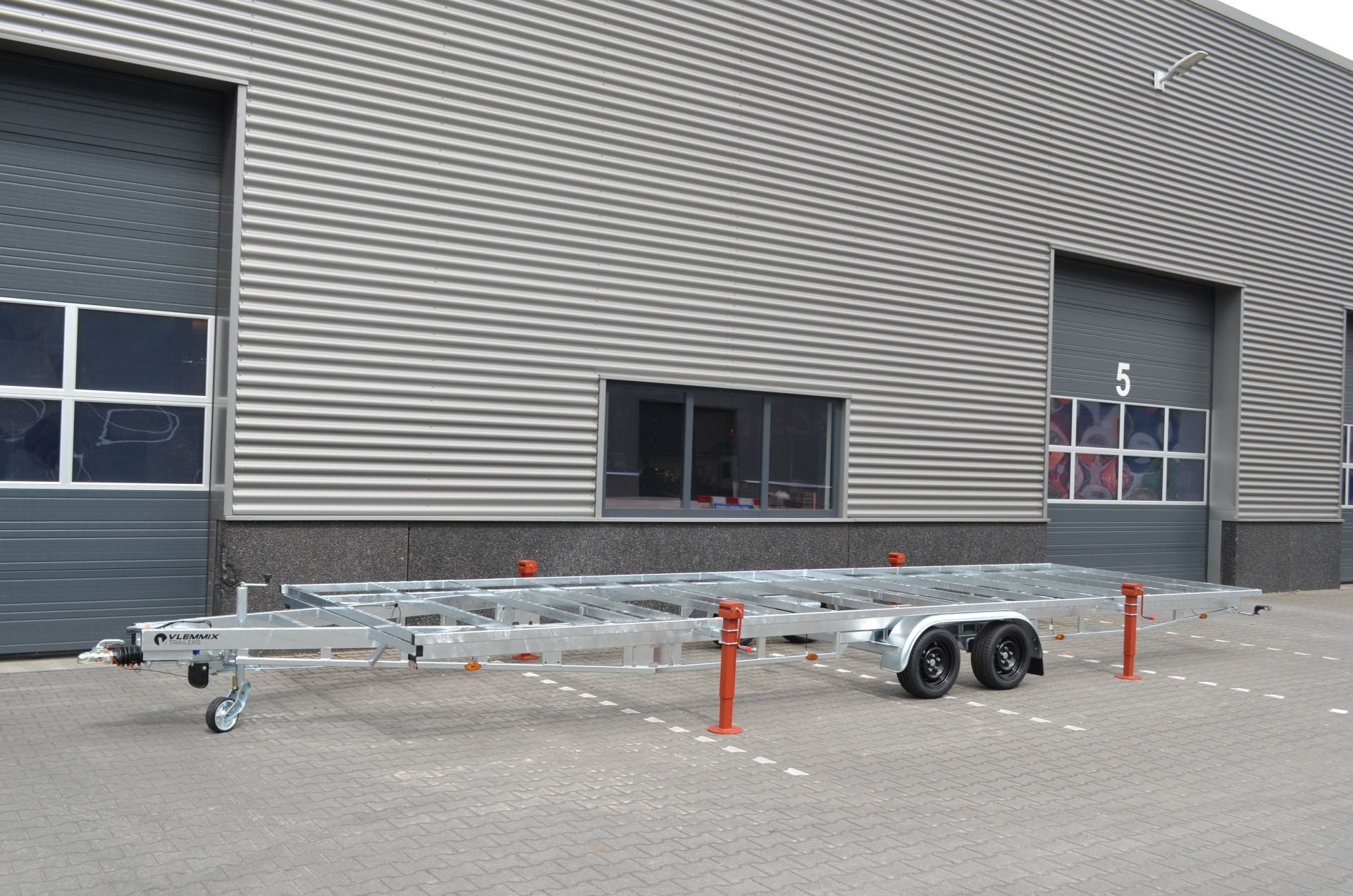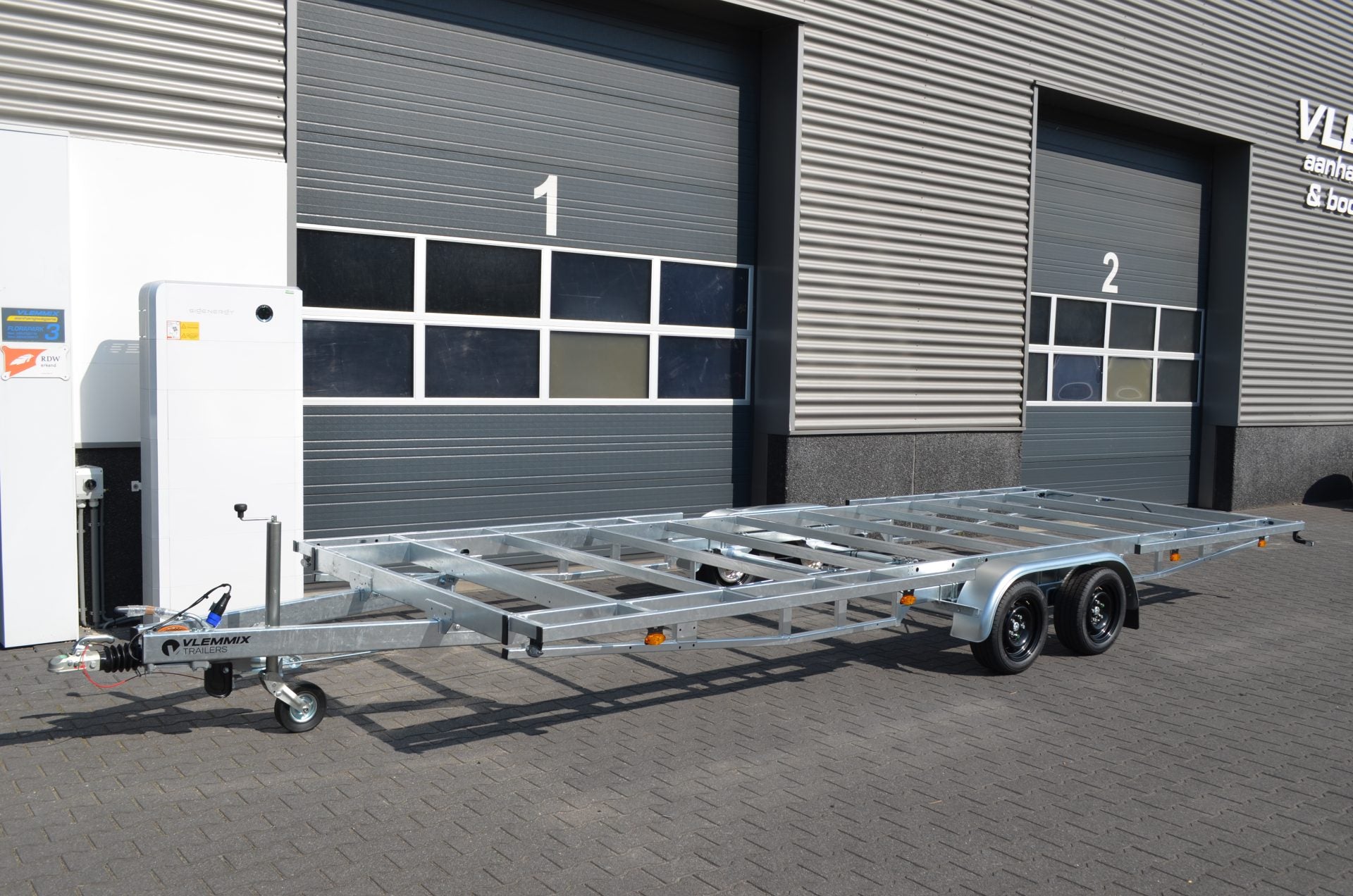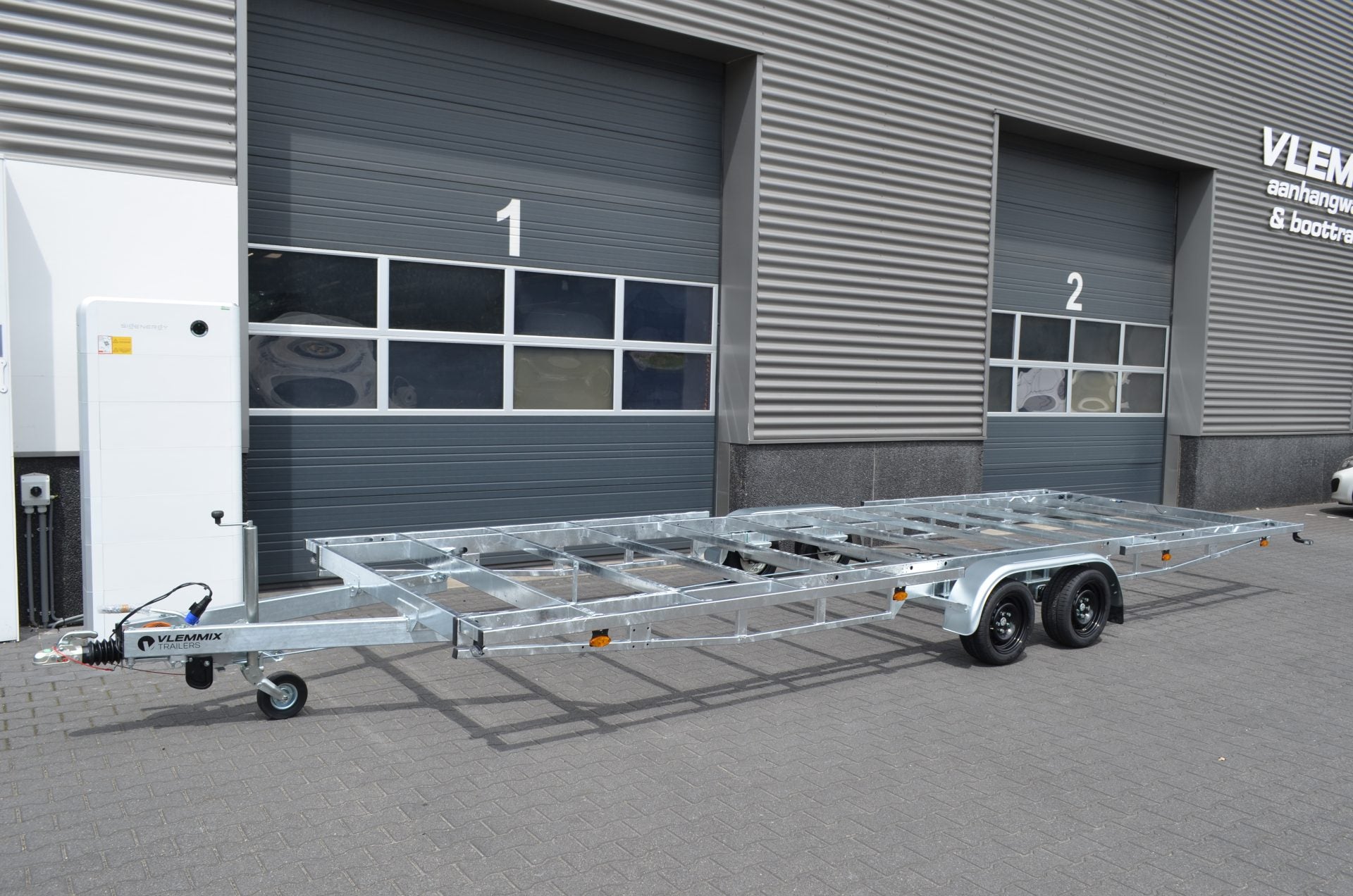
A 20-foot container is 6.06 meters long and weighs between 2,080 and 2,300 kg empty. There is only one way to move it behind a car: a custom-designed trailer with twist locks and a 3,500 kg PTAC. There are few models on the Spanish market that meet these requirements, and choosing incorrectly can be costly. This guide reviews the important specifications, one by one.
TL;DR
- Mandatory dimensions: 6.06 x 2.44 meter chassis, the exact footprint of a 20-foot container.
- Anchoring: four twist locks aligned with the ISO corner castings. Without them, stowage is not legal.
- GVW: 3,500 kg PTAC. With a trailer tare of 750-900 kg, there is just enough payload for the empty container.
- Configuration: tandem axle with inertia brake, mandatory at this weight.
- Chassis: hot-dip galvanized and 2 mm steel. The price starts at around 5,200 euros new with European homologation.
Direct answer: what must it comply with
Four technical requirements separate a real container trailer from a simple large flatbed, and it is advisable to check them one by one before comparing prices between models and sellers on the Spanish market. We review them in order of importance. Chassis with the exact footprint of the container (6.06 x 2.44 m). Twist locks on all four corners, aligned with the ISO corner castings. 3,500 kg PTAC with braked tandem axle. And European homologation with complete documentation.
Everything else offered in the general catalog (tipping, ramps, folding sides) is superfluous for this specific task. The container is a self-supporting load that is anchored by its corners: the perfect trailer for it is a rigid and light skeleton, without elements that reduce payload.
Dimensions and weights: the arithmetic of the 20-foot container
| Data | 20-foot container | Suitable trailer |
|---|---|---|
| Length | 6.06 m | Chassis of 6.06-6.10 m |
| Width | 2.44 m | 2.44 m between anchor points |
| Height | 2.59 m (2.89 high cube) | Low loading height, better stability |
| Tare | 2,080-2,300 kg | 750-900 kg |
| Empty combination | (sum) | 2,900-3,200 kg actual |
| Required PTAC | (minimum) | 3,500 kg |
The key calculation is in the last column: an empty container plus a trailer weighs around 3,000 kg, so the 3,500 kg PTAC leaves a margin of only 300-600 kg. This is sufficient and legal for an empty container; insufficient for carrying it loaded with goods. Anyone who needs to move a loaded container regularly needs a truck, and it is advisable to accept this before buying the wrong equipment.
That narrow margin makes the trailer's weight the decisive purchase factor. Every kilo of trailer tare is deducted from your margin. Well-designed 2 mm steel chassis weigh less than oversized chassis made of inferior steel, and that is the difference between just making it or having a margin. The complete calculation for the combination can be found in GVW and payload: how to calculate it without exceeding limits and without fines.
Twist locks: the anchor that changes everything
A twist lock is a forged steel rotating latch that enters the container's ISO corner casting and locks the assembly with a simple quarter turn of its lever. Four points, one per corner, and the container and trailer behave as a single rigid unit. It is the same system used by ships and trains, on a road scale.
The homemade alternative (straps over a flatbed) fails due to physics: the container has smooth walls, with no real lashing points, and 2,000 kg sliding in a brake will break any strap. Poor stowage is punishable by up to 500 euros and immobilization, and in case of third-party damage, the driver is responsible.
When buying, check three things about the twist locks: that they are made of forged steel and not cast, that the mechanism closes tightly (no play with the container seated), and that the bases are welded to the chassis with reinforcement, not bolted to a simple cross member.
Tandem axle, inertia brake and stability
With a 3,500 kg PTAC, a tandem axle is not optional: it distributes the weight, keeps the assembly stable if a tire fails, and reduces the load per wheel. Add to this the mandatory inertia brake for weights above 750 kg and the reinforced jockey wheel for maneuvering the assembly when stopped.
The container adds its own challenge: height. Its 2.59 meters raise the center of gravity of the assembly, and with crosswinds, the box acts as a sail. A low-platform, wide-track chassis compensates for much of the effect; even so, driving rules apply: 90 km/h legal limit and extra caution with gusts and overtaking trucks.
Galvanized chassis: the difference between 5 and 20 years
A container trailer works outdoors: plots, construction sites, ports. A painted chassis begins to corrode at the welds and inside the profiles within 2-3 years. Hot-dip galvanizing protects the steel inside and out for decades, without repainting or treatments.
Thickness matters just as much. The market standard is 1.5 mm steel; 2 mm chassis offer 33% more resistant cross-section at critical points, where the twist locks transmit the container's forces. A complete comparison of treatments is available at galvanized vs painted trailer.
New or second-hand: what to look for in each case
The used container trailer market is small and usually offers heavily used fleet units or truck semi-trailers that are not suitable for cars. If you are considering a used unit, carefully check the twist locks, documentation, and inertia brake for any play or cracks. The complete checklist is available at new or second-hand trailer.
The price of new sets the standard: a homologated 20-foot container trailer with a galvanized chassis starts at around 5,200 euros with a 2-year warranty. A used one without papers or with a corroded chassis is not worth 1,000 euros less, because legalizing and repairing it will eat up the difference.
Before signing any purchase, go through the 12 questions on the checklist before buying a trailer: they filter out most expensive mistakes in two minutes.
What car pulls this combination (and with what license)
The actual combination (trailer plus empty container) weighs around 3,000-3,200 kg. You need a vehicle with a braked towing capacity of 3,500 kg: a pickup truck, SUV, or large diesel SUV. The list of models with their actual towing masses is published on the blog.
Regarding licenses, a Class B license is insufficient in almost all cases: the combined GVW of an SUV (2,700-3,200 kg) plus the trailer (3,500 kg) exceeds the 3,500 kg limit of a Class B license. The usual here is the B+E license, which covers up to 7,000 kg combined; the B96 (up to 4,250 kg) is only sufficient with light tractors.
The four most costly buying mistakes
The first is buying an "adaptable" platform. The ad says it can accommodate a container with some bolted-on anchors. The trailer's homologation does not cover this modification, stowage is in limbo, and the insurance company may reject a claim due to improperly secured cargo. A container trailer must be purchased as such, with factory-installed twist locks.
The second is confusing categories: truck container semi-trailers are abundant in the used market at tempting prices. They cannot be hitched to a car (fifth wheel, not ball hitch), and buying them is wasted money for this use. Filter by "central axle trailer for passenger car" and discard everything else.
The third is ignoring the trailer's tare weight. Two models with the same 3,500 kg PTAC can offer a 200 kg difference in payload depending on the chassis design. With the tight margin of the 20-foot container, those 200 kg are the difference between legal transport and transport at the limit.
The fourth is buying without seeing the homologation documentation. Without a European password or certificate of conformity, there is no red license plate, and without a license plate, a trailer over 750 kg cannot circulate. Ask for the papers before paying, not at delivery.
How to load the container onto the trailer
The container trailer does not have a crane: lifting is handled separately and is only needed for loading and unloading. The two usual methods are a rented telehandler (200-350 euros per day) and container lifting jacks (600-1,500 euros per set), which lift the box by its corner castings while the trailer reverses underneath.
The maneuver requires method more than strength. Align and brake the trailer, lift the container 10-15 cm above the twist locks, approach slowly, and guide the descent until all four corner castings are seated. Closing is a quarter turn per corner and a lever-by-lever tension check. With practice, the entire operation takes less than 30 minutes.
Two warnings from experience. The ground matters: the jacks require a hard and level surface, and the telehandler appreciates maneuvering space on the sides. And the closing order matters: close diagonally (front left, rear right, and crosswise), just as wheel bolts are tightened, so that the box sits flat without tension on the chassis.
Where to buy it and what it includes
The 20-foot container trailers feature a hot-dip galvanized 2 mm steel chassis, four twist locks aligned to ISO footprint, braked tandem axle, and configurable PTAC up to 3,500 kg. They are delivered with European homologation and complete documentation, ready to be registered with a red license plate.
If your container is 10 feet long, the shorter version is available in 10-foot container trailers, with the advantage of being able to move it even with a partial load. The complete range, with both sizes and variants, is in container carriers, within the family of cargo trailers.
The purchase is direct, without intermediaries, with 15-50% savings compared to equivalent multi-brand distributors. Arnaud manages your order from start to finish: consultation, configuration, registration, and after-sales. Consult without obligation.
Frequently asked questions
How much does a 20-foot container trailer cost?
A new, homologated 20-foot container trailer with a hot-dip galvanized chassis starts at around 5,200 euros. Truck semi-trailers are another category (and another budget), and the used car market is scarce and often requires repairs that cancel out the savings.
Can I carry the loaded 20-foot container on the trailer?
Not with significant load. The combined weight of the trailer (750-900 kg) and an empty container (2,080-2,300 kg) is around 3,000-3,200 kg, and the legal PTAC is 3,500 kg. This leaves a margin of 300-600 kg, intended for the packaging itself and little else. A loaded container travels by truck.
What are twist locks and why are they mandatory?
They are rotating steel closures that anchor the container to the chassis by its four ISO corner castings, the same system used by ships and trains. Without them, legal stowage is not possible: straps do not secure a container, and the penalty for inadequate stowage can be up to 500 euros.
What license do I need for a 20-foot container trailer?
Almost always B+E. The combined GVW of the assembly (SUV of 2,700-3,200 kg plus trailer of 3,500 kg) exceeds both the Class B license limit (3,500 kg) and the B96 limit (4,250 kg). The B+E covers up to 7,000 kg combined and is obtained with a maneuvering exam.
Can the 20-foot trailer also be used for a 10-foot container?
It depends on the model. Some chassis have intermediate twist locks that accept both sizes; others only the 6.06 m footprint. If you are going to alternate sizes, ask for the multi-position configuration when placing your order. If you only move a 10-foot container, the short trailer is lighter and cheaper.
What maintenance does a container trailer require?
The same as any braked cargo trailer: tires, hubs, lights, and inertia brake adjustment once a year. Additionally, check the twist locks before each trip (full rotation and no play). The galvanized chassis does not require painting or rust preventatives.
How long does delivery take and what does it include?
The trailer is delivered ready for registration: European homologation, technical sheet, and certificate of conformity included. Registration with a red license plate is done at the DGT (Spanish traffic authority) or through an agent. Consult Arnaud for updated delivery times, as they vary according to configuration and stock.
Can a container trailer be used for other cargo?
Yes, with nuances. The skeleton chassis is optimized for containers, but it can accommodate rigid loads anchored to the ISO points (modular cabins, tanks with frames). For pallets, machinery, or loose cargo, a flatbed or machinery carrier with a full floor and conventional lashing points is more suitable.
Can I store the container on the trailer?
Yes, and it is a common use: the combination functions as a mobile warehouse that can be repositioned without a crane at any time. For long stays, it is advisable to relieve weight from the tires with jacks or supports under the chassis, maintain correct pressure, and move the assembly a few meters every few months so that the tires do not deform due to prolonged static support.