

Boat Storage Trailers up to 8.4 m | Remolque.es
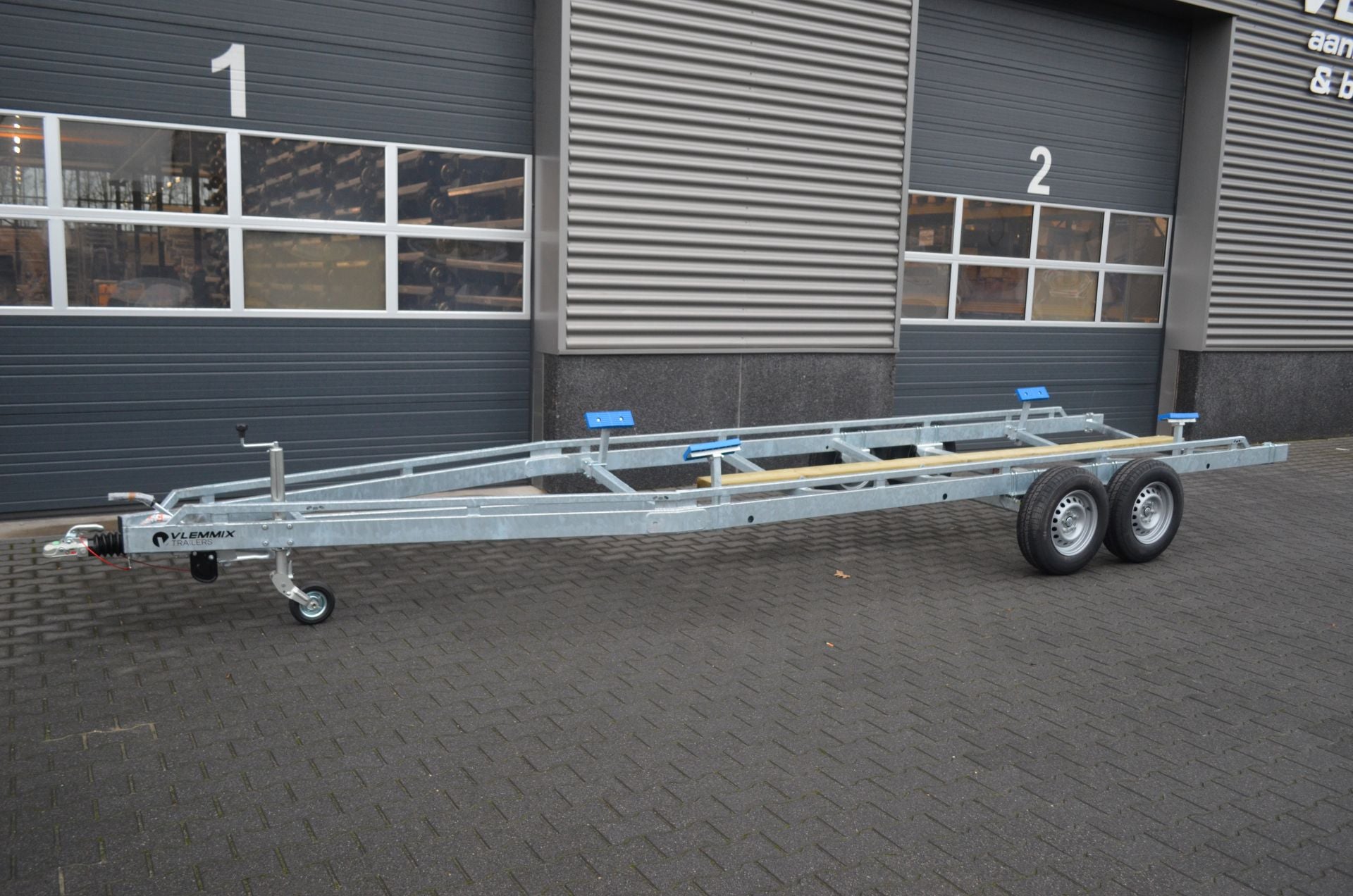
Type-approved trailers built specifically to keep your boat dry for months. These are not reinforced transport trailers: the chassis itself is engineered for long stationary use.
Adjustable keel supports, curved cross members that lower the centre of gravity and a chassis galvanised inside and out to survive years of exposure without internal corrosion.
Eleven configurations from 6.31 to 10 metres with 1, 2 or 3 axles rated at 1,800 kg. Europe's No. 1 brand in the Netherlands. 2-year warranty. Delivery throughout Spain.
If you are looking for the complete solution to move and store your boat, Remolque.es has everything you need. Browse our range of standard boat trailers, the versatile Flex Roll multi-roller trailers, our practical boat cradles and the full boat storage range. Find the right trailer for the size and type of your boat.
Built to keep your boat dry for months
A standard transport trailer can hold a parked boat for months. It was never designed to. Repeated pressure points on the same part of the hull, internal corrosion inside the hollow chassis and the lack of adjustable supports eventually damage either the boat or the trailer.
These trailers solve the four usual problems of long-term storage:
- Load spread along the keel with an impregnated timber board
- Internal galvanising that stops corrosion where you cannot see it
- Side and keel supports adjustable to the exact shape of the hull
- Low centre of gravity thanks to curved cross members
If your boat is going to sit on the trailer for months, this matters more than the brake type or the top towing speed.
5 technical differences against a transport trailer
1. Adjustable keel supports
They adapt to the exact shape of the hull and spread the weight of the boat across the whole contact area instead of a few points.
That prevents deformation in GRP hulls during long storage. Your boat comes off the trailer without marks after months standing still.
2. Impregnated keel board
Treated timber that protects the keel during prolonged contact with the trailer.
It absorbs light vibration and prevents marks on the hull. Replaceable when worn, with no work on the chassis.
3. Chassis galvanised inside and out
Hot-dip galvanising covers the whole structure, including the inside of the tubes.
On a poorly galvanised hollow chassis, corrosion starts from within and shows up years later. Not here.
4. Curved cross members
The boat sits as low as possible on the trailer.
Better static stability, less height to manoeuvre under the boat and easy access to the underwater hull for maintenance.
5. Heavy-duty folding jockey wheel
Makes it easier to manoeuvre the loaded trailer while stationary.
It folds away so it never gets in the way when hitching up, and it carries the noseweight without bending.
Which model you need for your boat
Small powerboats and RIBs (up to 5 m)
Light boats up to 1,000 kg. The models in this range (from 6.31 m) are larger than this class needs.
They make sense if you want spare capacity for winter storage, or if you plan to move up to a bigger boat within a few years.
Mid-size powerboats and RIBs (5-7 m)
Boats of 800-2,000 kg dry. This is where most of the range sits: 1 axle 7 m, 2 axles 6.31 m, 2 axles 7 m.
The 2-axle 7 m configuration is the best balance for long storage with occasional road use.
Small sailing boats and cabin cruisers (7-8.5 m)
Boats of 1,500-2,500 kg. The 2-axle 7.8 m and 2-axle 8.4 m models are the most requested.
The 3-axle 8.4 m option adds static stability for outdoor storage exposed to wind or uneven ground.
Large boats (8.5-10 m)
Boats of 2,500-4,000 kg. The 2-axle 9.2 m, 2-axle 10 m, 3-axle 9.2 m and 3-axle 10 m models cover this range.
The 3-axle is the recommended option for heavy boats left standing for whole seasons: better load distribution across the hull.
Typical use cases
Long dry winter storage. Taking the boat out of the water through the cold months prevents osmosis, fouling and antifouling wear.
Saving on berthing fees. The annual cost of a marina berth often exceeds the price of the trailer. Storing on your own land pays the trailer back in 1-2 years.
Regular hull maintenance. Polishing gelcoat, applying antifouling, repairing the underwater hull. The boat stays accessible ashore with no boatyard fees.
Second home with your own boat. You bring the boat to the coast once a year and it lives on the trailer between outings.
Marine professional with a rotating fleet. Several static trailers in a shed let you swap boats without taking up space in someone else's boatyard.
EU type approval and driving licence
Every model meets the EC Directive and is supplied with the paperwork for registration in Spain. Even though the main use is static, you keep the option of towing the boat on the road whenever you need to.
Category B licence. Car and trailer combination up to 3,500 kg gross weight. Covers the single-axle models with light boats.
Category B+E licence. Required above 3,500 kg. Covers the 2 and 3-axle models with mid-size and large boats.
Before you buy, confirm the exact gross weight of the combination and the paperwork your local licensing authority requires with Arnaud.
Frequently asked questions
How are they different from a normal transport trailer?
Storage trailers are engineered from the design stage so the boat can sit on them for months without damage.
They have adjustable keel supports, an impregnated board, internal chassis galvanising and curved cross members. A standard transport trailer copes with towing, but it was never designed for prolonged load spread or long-term internal corrosion.
Can I also use it to tow the boat on the road?
Yes. They carry EC type approval and Spanish registration. They work as a transport trailer whenever you need one.
That is not their main purpose, but they allow occasional moves (changing marina, taking the boat to the workshop, moving between homes).
How long can the boat stay on the trailer?
There is no technical limit. These trailers are designed for storage lasting months or years.
For stays over 6 months we recommend chocking the wheels, easing tyre pressure and checking the support settings once a year.
Do I need to chock the wheels if the boat stands for months?
Yes. Chocks prevent flat spots forming on the tyres from sustained pressure.
It is also worth reducing tyre pressure by 50% during long stays to preserve the rubber.
How do I know which model I need?
Send us the length, dry weight, beam and hull type. We confirm the correct model before you order.
Keep your licence in mind too: with a category B licence the car and trailer combination cannot exceed 3,500 kg gross weight.
What warranty do they carry?
2-year warranty against manufacturing defects. It covers the galvanised chassis, axles, braking system, supports and rollers.
After-sales technical support with Arnaud for the whole working life of the trailer.
What is the delivery time?
5-15 working days from order confirmation.
For winter storage season we confirm an exact date before you order.


